

How to Organize Your Chests in Minecraft: Best Storage Room Layouts
Introduction
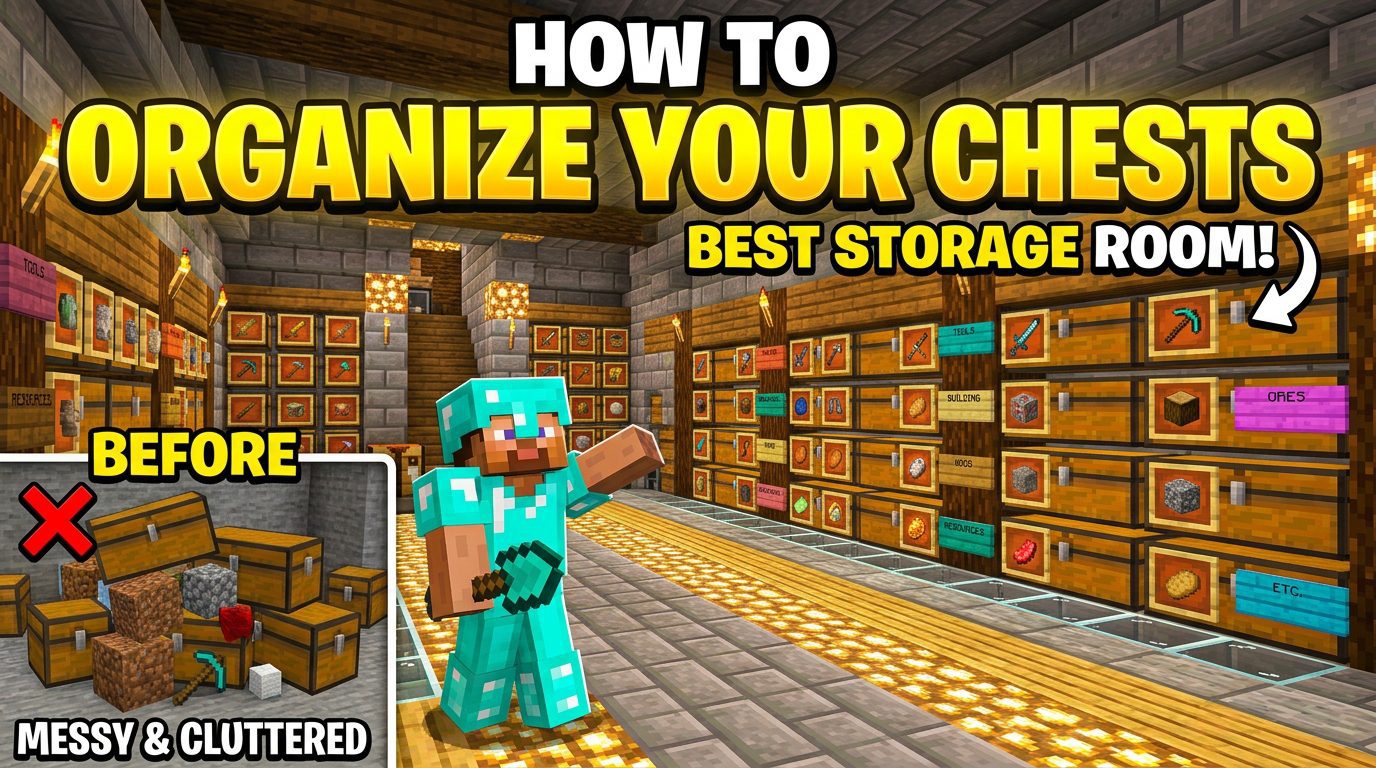
In Minecraft, a chaotic chest system is a recipe for frustration. Whether you’re a survival veteran or a redstone beginner, an organized storage room saves time, reduces clutter, and makes you a more efficient player. This guide compiles the best practices from Reddit’s r/Minecraft, Planet Minecraft tutorials, and popular YouTube creators like Mumbo Jumbo, Grian, and ImpulseSV. We’ll cover item sorting philosophies, room layouts (from simple to advanced), and how to integrate redstone auto-sorters while keeping your build aesthetic.
1. The Golden Rules of Chest Organization
Before placing a single chest, understand these universal principles collected from the community:
- Group by Category, Not Alphabetically: Keep similar items together (all ores, all wood, all mob drops). Alphabetical sorting is tedious and often breaks when you add new items.
- Use a “Hotbar” or “Daily Use” Chest: Dedicate a small chest near your exit for commonly grabbed items like torches, food, and weapons.
- Plan for Expansion: Leave empty spaces or double chests for future updates. Minecraft adds new blocks every release.
- Color Code or Label: Use item frames, signs, or banner markers to identify chests quickly.
- Auto-Sorters Are Not Required: Many players prefer manual sorting for small bases. Only build a full-item sorter if you have a massive farm output.
2. Choosing the Right Chest Type
| Chest Type | Use Case | Pros | Cons |
|---|---|---|---|
| Single Chest (27 slots) | Small bases, temporary storage | Cheap, compact | Limited space |
| Double Chest (54 slots) | Main storage, bulk items | Large capacity, easy to access both sides | Blocks walkway if placed incorrectly |
| Barrel (27 slots) | Quick access, under floors/ceilings | Full block (can be used as floor), stackable | Cannot be placed next to other barrels without double-barrel mechanic |
| Shulker Box (27 slots) | Portable storage, sorting within inventory | Carries contents in item form, dyeable for color coding | Requires End City raiding, expensive early-game |
| Ender Chest (27 slots, per-player) | Emergency access, long-distance transport | Contents are personal and accessible anywhere | Only 27 slots per player, no auto-sorting |
3. Room Layout Basics: Size and Access
The shape and size of your storage room dictate how many chests you can fit without making navigation painful. Common layouts from YouTube tutorials:
- Hallway Style: Two rows of double chests along both walls, with a 2-block wide aisle in the middle. This is the most space-efficient for large collections (e.g., 40+ double chests).
- Radial / Hub Style: Chests arranged around a central pillar or island. Good for smaller bases where you want quick access from all directions.
- Vertical Tower: Stack chests upward using ladders or water elevators. Requires careful lighting to avoid mobs, but saves floor space.
4. Category Mapping (The “Tree” of Items)
Organize your chests by logical categories. Here’s a widely accepted hierarchy from Reddit’s r/Minecraft:
- Building Blocks – Wood (planks, logs, slabs, stairs, fences), Stone (cobble, stone bricks, andesite/diorite/granite variants), Terracotta (all 16 colors), Concrete (all colors).
- Ores & Metals – Coal, Iron, Gold, Redstone, Lapis, Diamond, Emerald, Netherite scrap, ingots, blocks.
- Food & Farming – Crops (wheat, carrots, potatoes, beetroot), meat (cooked/raw), fish, cakes, suspicious stew, and all farm produce.
- Mob Drops – Bones, string, gunpowder, rotten flesh, slimeballs, spider eyes, ender pearls, blaze rods, etc.
- Tools & Armor – Enchanted books, tools, weapons, armor, horseshoes (if modded).
- Redstone & Mechanism – Repeaters, comparators, pistons, observers, rails, minecarts, hoppers, torches.
- Decorative & Misc – Flowers, dyes, paintings, banners, heads, spawn eggs (creative).
- Loot & Treasure – Enchanted books, golden apples, saddles, armor trims, trial chamber keys.
Customize the tree based on your play style. For example, builders need a “stairs & slabs” subcategory; redstone engineers need a separate “redstone dust & repeaters” chest.
5. The Classic “Bulk Storage Room” (Low-Tech)
Most popular on Planet Minecraft and early-game survival. Requirements: 30-40 double chests, wood, torches, signs. Steps:
- Dig a 9×9 room (or larger) with a 2-high ceiling. Floor can be stone brick or any neutral block.
- Place double chests along the walls, leaving a 1-block gap between each chest pair for signs/item frames. Use a pattern: left wall for building blocks, right wall for ores/foods, back wall for mob drops.
- For the central area, place 1-2 double chests facing each other forming an “island” for your hotbar items.
- Label each chest with an item frame holding a representative item (e.g., a piece of cobblestone, an iron ingot). Below the frame, place a sign with the category name.
- Light the room with torches on the ceiling or floor to prevent mob spawns.
Pros: Cheap, expandable, no redstone required. Cons: Manually sorting large farm outputs can be tedious.
6. The “Wall of Shulker Boxes” (Portable Sorting)
Endgame players on YouTube (e.g., Grian’s Hermitcraft season 7) often skip chests entirely and use shulker boxes stored in barrels or chests. Layout:
- Build a large wall with 3-block deep indentations. Each indentation holds a double chest or multiple barrels.
- Inside the chest, store exactly one type of shulker box per chest (e.g., “blue shulker = ores”, “red = redstone”). Use the chest inventory as a “catalog” – each slot holds a shulker box filled with a specific item subcategory.
- Add a “dump chest” at the entrance: toss all items into it, then quickly move shulker boxes to your inventory and sort manually.
Why it’s popular: You can carry 27 shulker boxes in your inventory (plus one in your offhand) effectively moving 27×27=729 stacks of items. Perfect for moving bases or restocking.
7. Redstone Auto-Sorter Systems (Intermediate/Advanced)
Mumbo Jumbo and ImpulseSV have popularized multi-item sorters that automatically store anything you feed into them. The classic design uses:
- Filter hoppers: Each hopper has a “key” item (e.g., 1 iron ingot) in one slot, and 41 more of that same item in the other 4 slots (using 1 comparator output signal). When iron is dropped in, it fills a chest.
- Overflow protection: If a chest fills, items pass to a “trash” chest or to a bulk buffer.
- Compact row design: Stack sorters in rows of 6-8 double chests, each row 2 blocks high. Use water streams or hopper lines to bring items from a central input chest.
Layout for an auto-sorter room:
- Build a long corridor (1-block wide, 2-high) with chests on both sides (double chests facing outward). Behind each chest, place the redstone comparator and torch tower.
- Run a hopper line on the ceiling or floor that feeds into the top of each sorter column.
- Set up a “loading station”: a chest where you dump items, connected to a dropper that shoots items into water streams.
- Add a “junk chest” at the end for unclassified items (all items not covered by a filter).
Common pitfalls from Reddit: Avoid chest names that are too long (causes comparator signal issues). Use a 4-wide building space for a single row of 8 sorters. Test with a single stack before building the whole array.
8. Aesthetic Themes and Decor Strategies
Your storage room doesn’t have to be a gray box. Planet Minecraft builders suggest these themes:
- Library Style: Use oak fences and birch planks to create bookshelf-like chests. Add lecterns with maps as “catalogues.”
- Warehouse / Industrial: Iron blocks, pistons, hoppers exposed. Use glass floors to show redstone wiring. Grian’s “industrial district” look.
- Underground Vault: Deepslate, chiseled stone bricks, dim lighting. Use allays (1.19) to carry items to chests.
- Lab / Research Facility: White concrete, polished diorite, glowstone floor. Item frames with “sample” items like a spider eye in a glass bottle (map art).
9. Megabase Storage Rooms (Very Large Scale)
If you’re building a base with hundreds of chests, you need modularity. Popular YouTube designs:
- The “Pillars of Chests”: A 3×3 spiral staircase with chests covering the outer wall of each floor. Each floor is a category.
- Item Sorting Warehouse: A 100×100 room with rows of auto-sorters. Input is via a minecart system from various farms. Use chunk loaders to keep it active.
- Shulker Loader Array: Auto-crafters (1.21) that fill shulker boxes with specific items, then dump them into a centralized vault.
For such builds, efficiency is key: use hopper speed calculations (20 items/second per hopper row), and avoid server lag by turning off sorters when not in use (lever-based power).
10. Tips from the Community (Reddit & Forums)
- “Never store your valuables (diamonds, netherite) in the same chest as your redstone components – you’ll accidentally use them.”
- “Place a crafting table and a furnace inside the storage room. You’ll craft half your projects there.”
- “Use water streams to move items from your base entrance to the storage room – saves walking time.”
- “For servers, use a shared ender chest and a locked room with iron doors – prevents theft.”
- “Color-code shulker boxes: e.g., black for stone, brown for wood, gray for redstone.”
Tags:
YOU MAY ALSO LIKE...


