Bedrock vs. Java Mechanics: Everything That Will Unexpectedly Kill You When You Switch
Minecraft’s two primary editions, Java and Bedrock, offer vastly similar core gameplay experiences, yet beneath the surface lie numerous mechanical distinctions that can lead to surprising and often fatal encounters for players accustomed to one version suddenly finding themselves in the other. These differences aren’t just minor quirks; they represent fundamental shifts in how the world interacts with the player, how mobs behave, and how survival strategies must adapt. Ignoring these nuances can result in unexpected deaths, turning what should be familiar situations into lethal traps. This guide delves into the critical mechanical disparities that can catch a seasoned player off guard, transforming a simple switch between editions into a perilous learning curve.
Drowned Spawning and Combat
- Platform Differences: The aquatic undead, Drowned, present a significantly different threat depending on your edition. In Bedrock Edition, Drowned are a more formidable foe right from the start, often spawning in groups of 2-4. Furthermore, their chance of spawning with a trident is a considerable 15%. In stark contrast, Java Edition Drowned typically spawn individually, making them easier to manage, and their trident spawn rate is much lower at 6.25%. This disparity in numbers and weaponry immediately changes the dynamic of underwater encounters.
- Precise Steps to Unexpected Death: A Java player accustomed to facing Drowned one-on-one, perhaps only occasionally encountering a trident-wielder, will be in for a rude awakening in Bedrock. Swimming into a group of 2-4 Drowned, where one or two might be armed with tridents, can quickly overwhelm them. These Bedrock tridents can inflict six hearts of damage, a substantial increase compared to Java’s four hearts, meaning fewer hits are needed to take a player down.
- Version Notes and Combat Discrepancies: The Impaling enchantment on tridents also functions differently. In Bedrock Edition, Impaling deals extra damage to any mob in water or rain, making Drowned even more lethal against players submerged in their element. In Java Edition, however, Impaling does not deal extra damage to Drowned because they are classified as undead, not aquatic, meaning the enchantment’s bonus damage does not apply to them. This makes Bedrock Drowned with Impaling tridents exceptionally dangerous. Moreover, Bedrock Drowned with tridents possess an additional melee attack they can use if the target is within 3 blocks, alongside their trident-throwing ability. Java Drowned, on the other hand, solely rely on throwing their tridents. A Java player switching to Bedrock will find themselves unexpectedly vulnerable to a close-range, high-damage melee attack from a trident-wielding Drowned, a mechanic they never had to contend with before, potentially leading to a swift and unforeseen demise during what they might perceive as a standard underwater skirmish.
Underwater Breathing with Doors
- Platform Differences: One of the most long-standing and well-known tricks for underwater exploration in Java Edition involves the clever placement of doors. In Java, placing a door underwater instantly creates an air pocket in the block space it occupies, allowing players to breathe indefinitely. This is a vital technique for extended underwater mining, building, or raiding Ocean Monuments without the need for potions or conduits. In Bedrock Edition, this fundamental mechanic is absent; doors placed underwater do not provide any air pockets whatsoever.
- Precise Steps to Unexpected Death: A player transitioning from Java to Bedrock, ingrained with the habit of using doors for underwater breathing, will likely suffer a swift and unexpected death by drowning. Imagine a Java player embarking on an Ocean Monument raid in Bedrock, confidently placing doors as they clear out water or mine through walls, only to find themselves suffocating with no air pocket appearing. This can happen during critical moments, such as when cornered by Guardians, deep inside the monument, or while attempting to escape, turning a familiar survival tactic into a fatal miscalculation. The expectation of a safe breathing spot that never materializes is a classic example of how edition differences can lead to an abrupt end.
Ocean Monument Mining Fatigue
- Platform Differences: The dreaded Mining Fatigue effect, inflicted by Elder Guardians within Ocean Monuments, also behaves differently across editions, particularly concerning its removal. In Java Edition, after a player consumes a bucket of milk to clear the Mining Fatigue effect, there is a one-minute interval before Elder Guardians can re-inflict the debuff. This provides a crucial window for players to mine or place blocks effectively. In Bedrock Edition, however, there is no such grace period; Mining Fatigue can be re-inflicted immediately after consuming milk.
- Precise Steps to Unexpected Death: For a Java player venturing into an Ocean Monument in Bedrock, this difference can be deadly. They might enter the monument, get inflicted with Mining Fatigue, consume milk, and expect a brief period of normal mining speed to break through a wall or place a critical block. Instead, they will find themselves instantly re-inflicted with the debuff, rendering them virtually immobile and unable to effectively retaliate or escape. This constant, unyielding fatigue leaves them highly vulnerable to the relentless attacks of Guardians, who can easily chip away at their health while the player struggles to perform even basic actions, ultimately leading to an unexpected and frustrating death deep within the monument. The inability to clear the debuff, even temporarily, disrupts established monument-clearing strategies and can quickly turn a planned assault into a desperate struggle for survival.
Combat Mechanics (General)
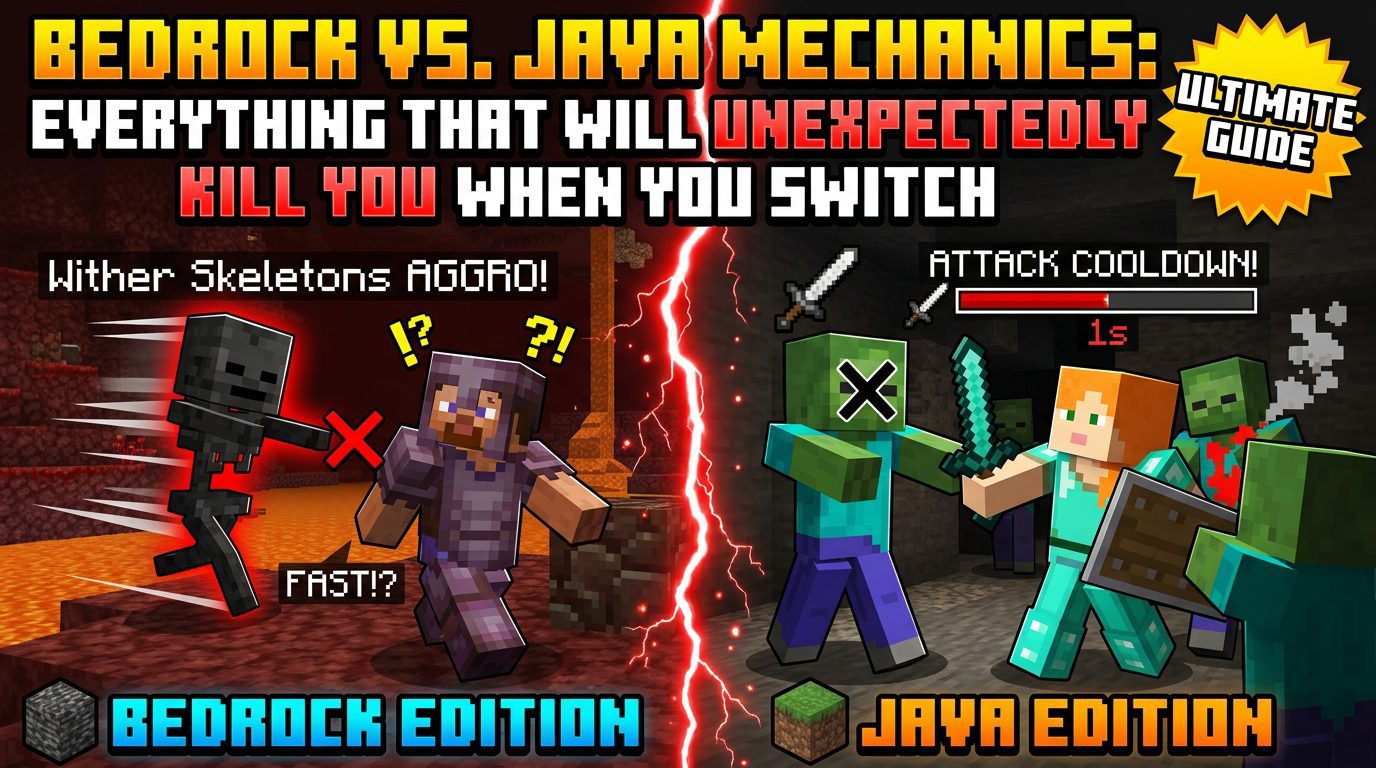
- Platform Differences: Combat in Minecraft received a significant overhaul in Java Edition’s 1.9 update, introducing mechanics that are entirely absent in Bedrock. Java combat revolves around attack cooldowns for melee weapons, requiring players to time their swings for maximum damage output. This update also brought sweeping attacks with swords, allowing players to hit multiple enemies in a cone. Axes in Java Edition gained the unique ability to disable a shield with a 25% chance upon hitting a blocking player or mob. Bedrock Edition, conversely, lacks these cooldown features, allowing players to “spam click” for continuous full damage output without timing. Axes in Bedrock do not inherently disable shields, though a 5-second cooldown was added to shields when hit by an axe in Bedrock 1.18.30, a different mechanic altogether. Beyond player combat, mob AI also differs; Java Edition mobs generally exhibit more sophisticated AI, and entities collide with each other, meaning players can be pushed by mobs. In Bedrock, players pass through entities, pushing them instead.
-
Precise Steps to Unexpected Death:
- Java Player Switching to Bedrock: A Java player accustomed to precise timing, sweeping attacks, and shield-disabling axes will find Bedrock combat chaotic and overwhelming. Their carefully timed swings will offer no advantage over simply spam-clicking, and their muscle memory for sweeping attacks will be useless. Mobs in Bedrock, while not having the same sophisticated AI, can still overwhelm through sheer numbers and continuous damage, especially since the player isn’t used to the faster pace of combat without cooldowns. Furthermore, the lack of entity collision means they might not anticipate being able to simply walk through a group of enemies, leading to confusion in crowd control.
- Bedrock Player Switching to Java: Conversely, a Bedrock player used to spam-clicking their way through hordes will struggle immensely in Java Edition. Their continuous clicks will only register partial damage due to the attack cooldowns, severely reducing their damage per second and making even common encounters far more dangerous. They will miss the ability to continuously hit targets and will need to learn to time their attacks for peak efficiency. The concept of sweeping attacks will be new, and they might not leverage it effectively. The most unexpected and potentially fatal difference for a Bedrock player in Java is entity collision. Accustomed to pushing through mobs, a Bedrock player might unknowingly walk onto a one-block bridge or ledge with mobs present, only to be unexpectedly pushed off by colliding entities, resulting in a fatal fall. This subtle difference in physical interaction with the game world can lead to very sudden and surprising deaths.
Health Regeneration
- Platform Differences: Health regeneration, a fundamental survival mechanic, operates at noticeably different speeds between the two editions. In Java Edition, health regeneration is relatively swift, allowing players to recover from damage quickly, especially with a full hunger bar. In Bedrock Edition, however, health regeneration is significantly slower, demanding much more careful resource management and strategic planning.
- Precise Steps to Unexpected Death: A Java player transitioning to Bedrock will undoubtedly find themselves in precarious situations due to this disparity. Accustomed to Java’s faster regeneration, they might take risks in combat, expecting to quickly heal up after disengaging or consuming a small amount of food. In Bedrock, this strategy is a recipe for disaster. Healing nine hearts, for example, takes a full minute and twenty seconds in Bedrock, a stark contrast to Java’s much more rapid recovery. This means that sustained damage, even from seemingly minor sources, can become critical. A Java player in Bedrock might run out of food faster than anticipated, find themselves unable to recover enough health between waves of mobs, or simply bleed out from lingering damage that Java players would easily shrug off. The slower regeneration necessitates carrying significantly more food, prioritizing safety, and avoiding damage much more diligently, otherwise, an unexpected death from attrition is almost guaranteed.
Mob Spawning and Behavior
- Platform Differences: Mob spawning mechanics and individual mob behaviors vary considerably, creating distinct challenges. In Bedrock Edition, mob spawn rates can often be more intense, leading to higher densities of hostile creatures in unlit areas. This necessitates more thorough and extensive lighting efforts to secure an area. Skeletons in Bedrock are particularly notorious for their “spam arrow” behavior, firing arrows at a much faster rate, making them a significantly greater threat, especially in water or the difficult terrain of the Soulsand Valley. Zombies in Bedrock Edition possess an unexpectedly large reach compared to their Java counterparts, often hitting players from distances that would be safe in Java. Vexes, the annoying spirits summoned by Evokers, also differ; in Bedrock, they do not despawn when a raid ends, persisting as a threat. Phantoms, the nocturnal flying mobs, can drown in Bedrock Edition, taking water damage, whereas in Java Edition, they are unaffected by water.
-
Precise Steps to Unexpected Death:
- Overwhelmed by Numbers: Players switching to Bedrock may be utterly overwhelmed by the higher mob densities. What might be a manageable handful of zombies in a Java cave could be a relentless horde in Bedrock, leading to quick encirclement and death. The expectation of clearing an area with minimal lighting, based on Java experience, can result in being swarmed.
- Lethal Skeletons: A Java player used to dealing with Skeletons at a measured pace will find Bedrock Skeletons incredibly lethal. Their rapid-fire arrows can deplete health bars in seconds, making water combat (where movement is restricted) or navigating the open, exposed terrain of the Soulsand Valley far more dangerous than anticipated. Getting caught by multiple spam-firing Skeletons can lead to an instant, unexpected death.
- Surprise Zombie Attacks: The extended reach of Bedrock Zombies means players might be hit from a distance they thought was safe, leading to unexpected damage and potentially death, especially if they are low on health or caught off guard.
- Persistent Vexes: For Java players, a raid ending usually means the Vex threat is over. In Bedrock, finding a Vex still chasing you after the raid bar has disappeared can lead to complacency and an unexpected death from a mob you thought had despawned.
- Phantom Water Traps: While Phantoms drowning in Bedrock might seem like an advantage, a Java player might be surprised to see a Phantom taking water damage, as they are used to them being invulnerable to it. Conversely, a Bedrock player in Java might try to lure a Phantom into water to kill it, only to find it unharmed and continuing its attack. While not directly a death trap for the switcher, it highlights a behavioral difference that can alter combat strategies and expectations.
Wither Boss
- Platform Differences: The Wither, one of Minecraft’s most challenging boss encounters, is significantly more formidable in Bedrock Edition. In Bedrock, the Wither boasts double the health of its Java Edition counterpart and is generally more powerful, with increased damage output and potentially more aggressive AI.
- Precise Steps to Unexpected Death: A Java player, confident in their Wither-fighting strategies honed over many battles, will face a brutal and unexpected challenge when attempting to defeat the Wither in Bedrock. Their usual tactics – specific arena designs, gear requirements, and damage output calculations – will fall short against the Bedrock Wither’s massively inflated health pool and enhanced power. What might have been a manageable fight in Java becomes a protracted, resource-intensive, and often fatal struggle in Bedrock. The player might run out of healing items, critical ammunition, or simply be overwhelmed by the Wither’s sustained assault, leading to an unexpected and humiliating death against a boss they thought they knew intimately. The increased difficulty demands a complete re-evaluation of preparation and combat strategy, otherwise, death is almost certain.
Entity Cramming
- Platform Differences: Entity cramming is a mechanic exclusive to Java Edition. This system dictates that if too many entities (typically 24 or more by default) occupy a single block space, they will begin to take damage until the number of entities drops below the threshold. This mechanic is often used in mob farms to automatically kill mobs, but it can also occur naturally. This mechanic is entirely absent in Bedrock Edition.
- Precise Steps to Unexpected Death: For a Bedrock player switching to Java, entity cramming represents a completely alien and potentially lethal threat. Accustomed to freely piling up farm animals, passive mobs, or even being surrounded by hostile mobs without consequence in Bedrock, a Java player might create a dense animal farm or find themselves trapped by a large group of hostile entities in a small area. Expecting no damage from mere overcrowding, they could suddenly and unexpectedly start taking continuous damage, leading to death. This is particularly insidious because it’s not an attack from a single mob, but rather an environmental hazard caused by the game’s physics, catching players completely off guard in situations they previously considered safe or even advantageous.
Fall Damage Calculation
- Platform Differences: While the basic formula for fall damage (one point of damage, equivalent to half a heart, for each block fallen after the third) is stated across both editions, players have consistently observed subtle inconsistencies. These inconsistencies suggest that there might be differences in how fall damage is precisely calculated or applied, especially when factoring in player velocity, interaction with blocks, or edge cases.
- Precise Steps to Unexpected Death: These subtle variations can lead to highly unexpected deaths for players switching editions. A fall that a Java player might confidently survive, perhaps with only a few hearts of damage remaining, could prove unexpectedly lethal for a Bedrock player, or vice-versa. This might occur due to slight discrepancies in how a fall from a specific height is interpreted, or how minor interactions with terrain or momentum modify the final damage calculation. A player might misjudge a jump, thinking they’ll barely survive, only to find the fall damage calculation in the other edition is slightly less forgiving, resulting in a sudden and unforeseen demise. Since the core formula is similar, these deaths feel particularly unfair and random, as the player believes they have correctly assessed the risk based on their experience.
Desync and Random Deaths (Bedrock Specific)
- Platform Differences: Bedrock Edition is unfortunately known for a range of “death glitches” and “random fall damage” incidents that are far less prevalent, if not entirely absent, in Java Edition. A significant contributor to these issues is server lag, which can lead to desynchronization (desync) between the player’s client and the server’s actual state. This desync can result in situations where the player’s screen doesn’t accurately reflect what’s happening on the server. Furthermore, in some extreme cases, Bedrock worlds with excessively large file sizes have been reported to randomly remove entire chunks, leaving gaping holes in the terrain.
-
Precise Steps to Unexpected Death: These Bedrock-specific issues are among the most frustrating and inexplicable ways to die, as they often occur in seemingly safe situations.
- Unseen Mob Attacks: Due to desync, a Bedrock player might appear to be safely out of range of a mob on their screen, but on the server, they are still within striking distance. The player takes damage and dies without ever seeing the attack animation or understanding why they died, as the mob appeared to be too far away.
- Falling into the Void from Desync: Desync can also cause a player to visually appear on solid ground, but the server registers them as falling. This can lead to sudden, inexplicable fall damage or even falling into the void from a flat, safe surface, as the client catches up to the server’s state.
- Chunk Removal Glitches: In worlds with large file sizes, the random removal of chunks is a particularly brutal and unexpected cause of death. A player could be walking across a familiar landscape or building within their base, only for the ground beneath them to vanish without warning, plunging them into the void below. This is a pure bug that offers no player agency or counterplay, resulting in instantaneous and completely unforeseen deaths that can be devastating, especially in Hardcore-like scenarios. These types of deaths are especially jarring for Java players who expect a higher degree of consistency and predictability from the game world.
Elytra in Water
- Platform Differences: The behavior of elytra, the magnificent gliding wings, also differs significantly when interacting with water. In Java Edition, activated elytra remain functional and allow players to glide seamlessly even when entering water. This enables smooth transitions from air to water, or even gliding just above or below the surface. In Bedrock Edition, however, elytra deactivate immediately upon entering water, ceasing all gliding functionality.
- Precise Steps to Unexpected Death: A Java player, accustomed to the freedom of gliding into and through water with their elytra, will face a grave and unexpected danger when attempting this maneuver in Bedrock. Imagine a Java player soaring high above a body of water, perhaps aiming for an underwater entrance to a base or simply enjoying a long glide, and deciding to make a graceful water landing. Upon entering the water in Bedrock, their elytra will instantly deactivate. If they are gliding at a significant height and velocity, this sudden deactivation can lead to immediate and lethal fall damage as they plummet into the water. Even if the fall isn’t high enough to be instantly fatal, the loss of gliding control can cause them to hit solid blocks beneath the water or become disoriented, potentially leading to drowning if they are deep underwater and unable to resurface quickly. This unexpected loss of flight capability can turn a routine travel method into a sudden, fatal plunge.