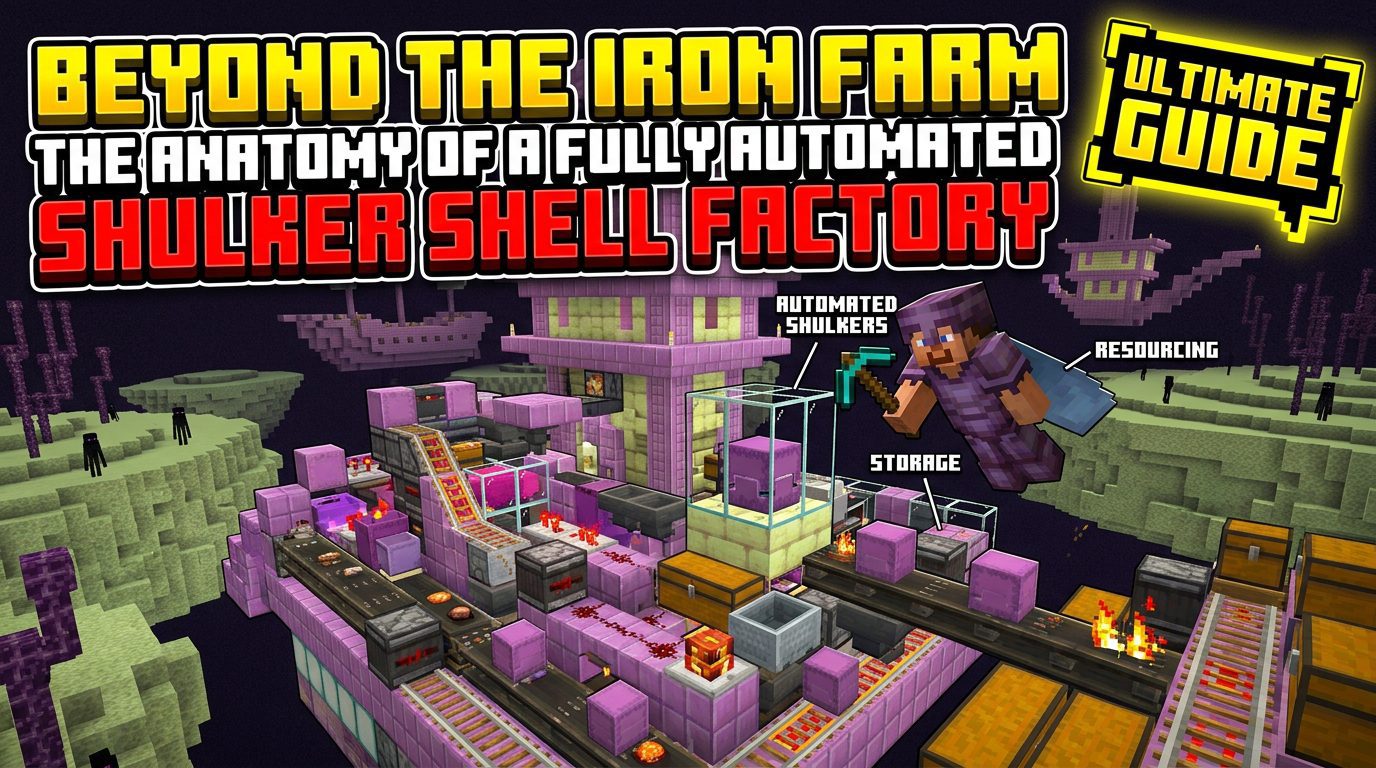
Beyond the Iron Farm: The Anatomy of a Fully Automated Shulker Shell Factory
The pursuit of automation in Minecraft often begins with basic resource farms, like the ubiquitous iron farm. However, for those aspiring to truly master logistics and storage, the ultimate goal lies beyond mere ingots: the fully automated shulker shell factory. This sophisticated contraption is designed to continuously generate shulker shells, the invaluable component for crafting shulker boxes, which revolutionize inventory management in the game. Understanding the intricate anatomy of such a factory is key to unlocking limitless portable storage.
The Genesis of Shulker Shells: Acquisition and Core Mechanics
Shulker shells are among the most coveted resources in Minecraft, primarily due to their role in crafting shulker boxes. These boxes, capable of storing an entire inventory’s worth of items and retaining their contents when broken, are indispensable for exploration, mining, and large-scale building projects. The recipe for a shulker box is elegantly simple: two shulker shells combined with one chest. It is crucial to note that while a mod exists to craft shulker shells from two Iron Ingots, one Diamond, one Chest, and one Purple Dye, this method is not part of vanilla Minecraft gameplay and will not be considered in the context of a vanilla automated factory.
The journey to obtaining shulker shells begins exclusively in the End dimension. Shulkers, the source of these shells, are hostile mobs found only within End Cities. These sprawling structures are themselves located in the outer End islands, accessible only after defeating the Ender Dragon. Upon the Dragon’s defeat, End Gateway portals appear, allowing players to travel to these distant islands. Each shulker has a 50% chance to drop a shulker shell upon death. This drop rate can be significantly improved by using a weapon enchanted with Looting, making the initial hunting phase more efficient for acquiring starter shells or for manual collection.
Essential Ingredients: Components of the Factory
A fully automated shulker shell factory is a marvel of redstone engineering and mob mechanics, requiring a diverse array of components to function seamlessly. Each ingredient plays a critical role in the factory’s structure, duplication process, killing mechanism, and collection system.
- Shulkers: At least one live shulker is the absolute minimum requirement to kickstart the duplication process. This initial shulker serves as the breeding stock, generating new shulkers through its projectile attacks.
- Building Blocks: A variety of building blocks are essential for constructing the factory’s physical structure. Glass is often used for visibility into the duplication chamber, while solid blocks form walls, floors, and ceilings, ensuring containment and guiding mob movement. Slabs are particularly useful for creating specific light levels or preventing mob spawning where undesired, and for manipulating hitboxes. These blocks are acquired through standard mining and crafting processes.
- Redstone Dust: The circulatory system of any automated farm, redstone dust transmits signals across distances, connecting various components and orchestrating complex operations. It is fundamental for timing mechanisms, activating pistons, and controlling other redstone devices.
- Repeaters: Redstone repeaters serve several functions: they extend redstone signals over longer distances, prevent signals from going backward, and introduce delays into circuits, crucial for precise timing in automation.
- Comparators: Redstone comparators are versatile components used for reading the fullness of containers, detecting specific block states, and performing arithmetic operations on redstone signals, enabling smart sorting and detection systems.
- Observers: Observers detect block updates directly in front of them and emit a short redstone pulse. They are invaluable for creating compact, efficient circuits, particularly in detecting shulker lid states or other dynamic changes within the farm.
- Hoppers: Hoppers are the backbone of any item collection system. They automatically pick up items dropped into their inventory space and transfer them into connected containers, such as chests, or into other hoppers.
- Chests: Used in conjunction with hoppers, chests provide storage for the collected shulker shells, allowing the factory to operate autonomously for extended periods before manual collection is needed. Large chest arrays are common in high-capacity farms.
- Lava: Lava serves as an efficient and often preferred killing mechanism for duplicated shulkers. It quickly eliminates mobs while preserving their dropped items, which then fall into the collection system beneath.
- Water: Water is utilized in various ways, primarily for creating item transportation streams to guide dropped shells towards hoppers or for mob transportation streams to move duplicated shulkers to killing chambers.
- Ice: Packed ice or blue ice can be used to create extremely fast item or mob transportation channels, as entities slide much faster across ice blocks when pushed by water streams.
- Soul Sand: Soul sand creates upward bubble columns when water is placed above it, a powerful tool for vertically transporting items or mobs within the factory’s design.
- Buttons and Levers: Simple input devices, buttons provide a momentary redstone pulse, while levers provide a continuous on/off signal. They are used for manual controls, activating specific farm sections, or troubleshooting.
- Minecarts and Rails: Minecarts, running on various types of rails (powered, detector, activator), are used for transporting items (hopper minecarts), players (for AFK aggro targets), or even the initial shulker from the End City to the farm location. Powered rails accelerate minecarts, detector rails send redstone signals when a minecart passes over them, and activator rails can interact with entities in minecarts.
- Snow Golems: Often employed as an aggro target, snow golems are crafted by placing two snow blocks vertically and topping them with a carved pumpkin. Their snowballs inflict no damage but provoke shulkers into shooting, triggering the duplication process. They are easily replaceable and don’t require player intervention.
All these building blocks and redstone components are generally acquired through standard mining, crafting, and farming processes within the Minecraft world, making the factory a true culmination of various in-game achievements.
The Blueprint: General Principles of an Automated Shulker Shell Factory
Constructing a fully automated shulker shell factory involves a series of precise steps, each designed to leverage shulker mechanics for continuous shell generation. The overall design focuses on efficiency, containment, and automated collection.
1. Initial Shulker Acquisition
The foundational step for any shulker farm is to acquire at least one live shulker from an End City. This is often the most challenging part of the entire process. Shulkers are delicate to transport due to their teleportation abilities and susceptibility to damage. Common methods for transporting them to the desired farm location, which could be in the Overworld, Nether, or even a custom End island, include:
- Minecarts and Rails: This is a common and reliable method. A shulker can be carefully pushed into a minecart. Once in the minecart, it cannot teleport and can be transported across vast distances using a network of rails, potentially through Nether portals for faster travel.
- Specific Portal Setups: Advanced techniques involve manipulating Nether portals or End portals to teleport shulkers directly, though these often require precise timing and setup to prevent the shulker from teleporting away or dying.
Once the shulker is at the chosen site, it must be carefully extracted from the minecart (if used) and guided into its designated duplication chamber without escaping or taking damage.
2. Duplication Chamber Construction
The duplication chamber is the heart of the factory, where the magic of shulker reproduction occurs. This enclosed area is meticulously designed around the shulker duplication mechanic. The primary shulker (or multiple shulkers, depending on the design) is strategically positioned within this chamber. The key to duplication lies in shulker bullets: when an open shulker is hit by a shulker bullet, it attempts to teleport. If this teleportation attempt is successful, a new shulker can spawn in its original location. The chamber must allow for shulkers to shoot at each other or at an aggro target, ensuring that bullets frequently hit open shulkers to trigger duplication.
- Enclosed Area: The chamber must be completely enclosed to prevent shulkers from teleporting outside the farm boundaries. This typically involves solid blocks for walls, floor, and ceiling.
- Shulker Positioning: The initial shulker(s) are placed in a way that maximizes their ability to shoot and be shot, often in a central location or specific patterns that encourage bullet propagation.
- Bullet Propagation: The design needs to ensure that shulker bullets can travel and hit other shulkers, or the primary shulker itself, to initiate the duplication sequence.
3. Aggro Mechanism
For shulkers to shoot projectiles and thus trigger duplication, they need a target to provoke them. An effective aggro mechanism ensures continuous bullet generation.
- Snow Golem: This is the most common and practical method. A snow golem, crafted from two snow blocks and a carved pumpkin, continuously throws snowballs. While snowballs inflict no damage on shulkers, they register as an attack, provoking the shulkers into shooting their own projectiles. Snow golems are easily replaceable if they accidentally die and do not require player presence.
- AFK Player: An alternative is for a player to stand within range of the shulkers. The shulkers will target the player, causing them to shoot. However, this requires the player to be actively AFK (Away From Keyboard) at the farm, which can be less convenient than an automated mob.
The aggro target must be positioned safely, often behind glass or in a protected enclosure, to prevent direct attacks from the shulkers themselves, especially if the player is the target.
4. Shulker Removal/Killing System
As shulkers duplicate, their numbers grow. An efficient farm needs mechanisms to prevent overcrowding, which can reduce duplication chances, and to kill the excess shulkers to collect their shells.
- Preventing Overcrowding: In Java Edition, the duplication chance decreases significantly if more than five shulkers are within an eight-block radius. Therefore, duplicated shulkers must be moved away from the breeding shulker(s) promptly.
- Killing Methods:
- Entity Cramming: This method leverages a game mechanic where 24 or more entities in a single block space will start taking suffocation damage until only 23 remain. This is a common, reliable, and item-friendly killing method for many mob farms, including shulker farms.
- Lava: Lava provides a quick and efficient way to eliminate shulkers. Properly designed lava blades or pools ensure that shulkers die rapidly, and their dropped items fall safely into a collection system below before despawning.
- Transportation to Killing Chamber:
- Water Streams: Water currents are frequently used to push duplicated shulkers from the duplication chamber to a designated killing area. These streams can be enhanced with ice blocks for faster transport.
- Minecarts: For more complex or spread-out designs, minecarts can be used to pick up and transport shulkers to the killing mechanism.
5. Item Collection System
Once shulkers are killed, their dropped shells must be automatically collected. This is achieved through a network of hoppers and chests.
- Hoppers: Hoppers are strategically placed beneath the killing area. As shulkers die and drop shells, the hoppers immediately pick them up.
- Chests: The hoppers feed into chests, often arranged in large storage arrays, to store the collected shulker shells. This allows the farm to run for extended periods without requiring player intervention for item collection.
6. Containment
Shulkers have a natural ability to teleport. A critical aspect of farm design is constructing a robust perimeter to prevent any shulker from teleporting outside the farm boundaries. This ensures that all duplicated shulkers remain within the system for processing and that no shulkers escape into the surrounding environment, potentially causing issues or reducing farm efficiency. Walls of solid blocks, often several layers thick, are typically used for this purpose.
The Heart of the Operation: Shulker Duplication Mechanics Across Platforms
While the general principles remain consistent, the precise mechanics of shulker duplication and shell drops vary significantly between Minecraft’s Java and Bedrock Editions. Understanding these platform differences is crucial for designing an optimized and functional automated shulker shell factory.
Java Edition
- Shulker Duplication Mechanic: In Java Edition, shulkers duplicate under specific conditions. When a shulker is hit by a shulker bullet while its lid is open, it attempts to teleport. If this teleportation attempt is successful, a new shulker can spawn in its initial location. This mechanic forms the cornerstone of all Java Edition shulker farms. The duplication chance is not constant; it actively decreases if there are more than five shulkers within an eight-block radius of the shulker attempting to duplicate. This necessitates efficient removal systems to maintain high duplication rates.
- Shulker Shell Drop Rates: Java Edition shulkers have a fixed drop behavior: a shulker can drop a maximum of one shulker shell upon death. Furthermore, this drop is not guaranteed, even when using a weapon enchanted with Looting III. While Looting increases the base 50% chance of a drop, it does not increase the quantity of shells dropped per shulker beyond one. This means Java farms prioritize high kill rates over individual shulker yields.
- Redstone and Mob Spawning: Java Edition generally allows for more complex and compact redstone designs. Its redstone mechanics are often more consistent and predictable, enabling intricate timing and logic gates crucial for advanced automation. Regarding mob spawning, Java’s mechanics, including a larger despawn sphere and bottom-up spawning logic (mobs attempt to spawn from the lowest valid block upwards), enable larger-scale farms with potentially higher rates. These characteristics allow for the construction of highly efficient and massive shulker farms, provided the player can manage the complexity.
Bedrock Edition
- Shulker Duplication Mechanic: For a significant period, the shulker duplication mechanic was exclusive to Java Edition. However, in version 1.19 onwards, this mechanic was implemented in Bedrock Edition. This brought the possibility of automated shulker shell factories to Bedrock players. Prior to 1.19 (e.g., in versions 1.17-1.18), Bedrock players could not build these types of farms. The implementation in Bedrock, while similar in principle, often leads to farm designs that are simpler due to other inherent differences in Bedrock’s game engine and mob AI.
- Shulker Shell Drop Rates: Bedrock Edition offers a distinct advantage in terms of shell yield per shulker. With Looting III, a shulker in Bedrock Edition can drop between zero and four shulker shells upon death. This means that while Bedrock farms might have different duplication rates or mob spawning limitations, the individual yield per killed shulker can be significantly higher, potentially compensating for other design complexities.
- Redstone and Mob Spawning: Bedrock Edition’s redstone can sometimes be less consistent or behave differently compared to Java, leading to different design considerations for automation. Furthermore, Bedrock’s mob spawning limits are generally more restrictive. This can make building extremely large-scale farms with exceptionally high rates more challenging than in Java Edition, often requiring different strategies to maximize efficiency within these limitations. Bedrock farms might focus on optimizing the duplication rate within smaller footprints or leveraging the higher shell drop rates per kill.
Evolution of Automation: Version Notes
The landscape of automated shulker shell factories has evolved with Minecraft’s updates, primarily concerning the core duplication mechanic:
- Minecraft 1.17 – 1.18: During this period, the shulker duplication mechanic was exclusively available in Java Edition. Bedrock players during these versions could not build automated shulker farms based on duplication.
- Minecraft 1.19 onwards: A significant update for Bedrock Edition players, as the shulker duplication mechanic was implemented, finally allowing for automated shulker shell factories on that platform. This opened up a new realm of automation possibilities for Bedrock players.
- Minecraft 1.20.4+: As with many complex redstone contraptions and mob farms, existing farm designs may require modifications to maintain their efficiency in newer versions. Game updates can subtly alter mob AI, block interactions, or redstone timing, necessitating adjustments to ensure optimal performance.
It’s worth noting that many automated shulker farm designs available today are developed and optimized for Minecraft 1.17 and newer versions, specifically leveraging the refined shulker duplication mechanics that became stable and widely understood during this era.
In conclusion, a fully automated shulker shell factory is a testament to advanced Minecraft engineering. It transforms a rare, End-game resource into an abundant commodity, empowering players with unparalleled storage capabilities. By understanding the intricate balance of shulker mechanics, redstone logic, and platform-specific nuances, any dedicated player can construct this ultimate logistical powerhouse, forever changing their approach to inventory management and large-scale building projects.
Tags:
YOU MAY ALSO LIKE...