How to calculate optimal enchantment combinations using an anvil
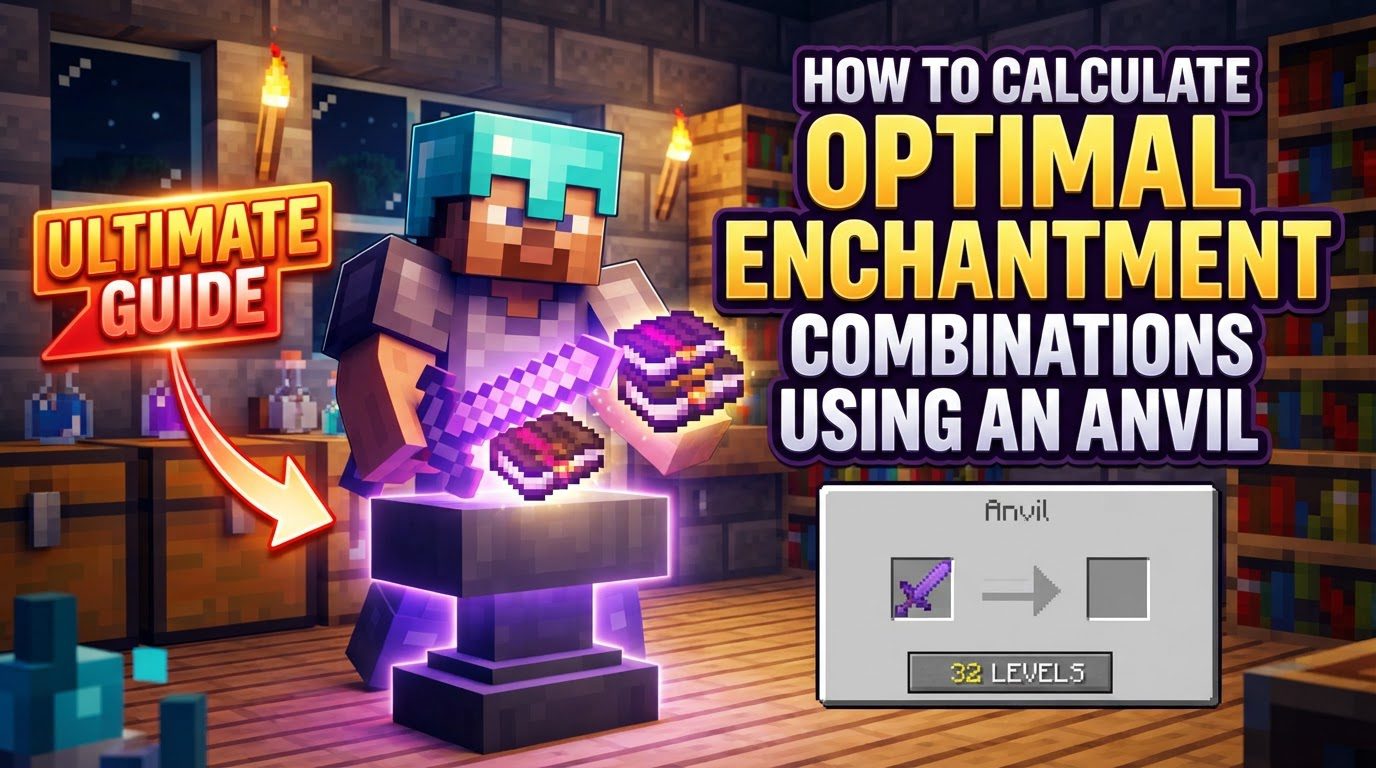
Mastering the anvil in Minecraft is crucial for creating powerful, long-lasting gear. It allows players to combine enchantments, repair items, and ultimately craft equipment that far surpasses what can be achieved through a simple enchanting table. However, without a strategic approach, anvil operations can quickly become “Too Expensive!” and render your best enchantments unobtainable. This guide will delve into the optimal methods for combining enchantments, focusing on cost efficiency and avoiding common pitfalls.
Understanding Anvil Mechanics
Before diving into specific strategies, it’s essential to grasp the fundamental mechanics governing anvil operations. These rules dictate the cost and feasibility of combining items and enchantments.
- Experience Cost: Every time an item or enchanted book is used in an anvil, an experience cost is incurred. This cost is not static; it scales based on several factors, including the number of enchantments being transferred, their individual levels, and their inherent rarity. Higher-level enchantments and those considered rarer will naturally demand a greater experience investment.
- Prior Work Penalty (Anvil Uses): This is perhaps the most critical mechanic to understand for optimal enchanting. Each time an item is used in an anvil, it accrues a “Prior Work Penalty,” also referred to as “Anvil Uses.” This penalty is a hidden counter that significantly increases the experience cost of all subsequent anvil operations involving that item. When two items are combined, the resulting item inherits the higher of the two items’ existing prior work penalties, and then an additional penalty of one is added to that inherited value. This escalating penalty is the primary reason items become “Too Expensive!”
- “Too Expensive!” Limit: A hard limit exists for anvil operations in Survival mode. If the calculated experience cost for any single anvil combination reaches 40 or more levels, the operation cannot be performed, and the anvil will display the message “Too Expensive!” This limit forces players to plan their enchantment combinations meticulously to stay below this threshold.
- Mutually Exclusive Enchantments: Not all enchantments can coexist on the same item. Certain enchantments are mutually exclusive, meaning if one is present, the other cannot be applied. For example, a sword cannot have both Sharpness and Smite, or Sharpness and Bane of Arthropods. Similarly, a bow cannot simultaneously possess Infinity and Mending. Attempting to combine mutually exclusive enchantments will result in only one of them being applied, typically the one already on the main item or the higher level one if both are on books, wasting the experience and the conflicting enchantment.
The Optimal Enchantment Combination Strategy
The key to efficient anvil enchanting lies in a systematic approach that minimizes the Prior Work Penalty and avoids the “Too Expensive!” limit. This often involves a “tree” structure for combining enchantments.
- Acquire Enchantments: The first step is to gather the necessary enchantments. This can be done through various in-game activities such as trading with librarian villagers, who are excellent sources for specific high-level enchanted books. Fishing can also yield enchanted books, as can discovering them in loot chests found in structures throughout the world. Finally, an enchanting table, surrounded by bookshelves, can provide enchanted books, though with less predictability.
- Combine Books into “Trees”: This is the cornerstone of optimal enchanting. Instead of directly applying individual enchanted books to your final gear item, you should first combine enchanted books with each other. Imagine a branching tree: you combine two books to create an intermediate enchanted book, then combine two more books to create another intermediate book, and so on. This process is repeated until you have a few highly enchanted books, each containing multiple desired enchantments, but critically, with a relatively low Prior Work Penalty.
- Balance “Anvil Uses”: When creating your enchantment “tree,” it’s crucial to balance the “Anvil Uses” of the items you are combining. The goal is to always combine items (in this case, enchanted books) that have a similar number of “Anvil Uses.” This prevents one branch of your tree from accumulating a disproportionately high Prior Work Penalty. For instance, if you have Book A (0 uses), Book B (0 uses), Book C (0 uses), and Book D (0 uses), combine (Book A + Book B) to get Result 1 (1 use). Then combine (Book C + Book D) to get Result 2 (1 use). Finally, combine (Result 1 + Result 2). This ensures the Prior Work Penalty on your intermediate results remains as low as possible, preventing premature “Too Expensive!” messages.
- Final Combination: Once you have successfully combined your individual enchanted books into a few powerful, multi-enchantment books (each carefully managed to have a low Prior Work Penalty), it’s time for the final step. Take these highly enchanted books and combine them onto your main gear item – be it a weapon, tool, or piece of armor. Because you’ve kept the Prior Work Penalty low on the intermediate books, the final combination onto your gear will be significantly cheaper than if you had added each enchantment one-by-one.
- Prioritize Expensive Enchantments: When planning your “tree” combinations, consider the cost of individual enchantments. More “expensive” enchantments, typically those with higher levels or those deemed rarer, should be applied earlier in the combination chain. This means incorporating them into books that have fewer existing “Anvil Uses.” By doing so, you minimize the escalating cost impact that these enchantments would have if added later to an item with an already high Prior Work Penalty.
Essential Tips for Success
Beyond the core strategy, several tips can further enhance your enchanting efficiency and ensure the longevity of your prized items.
- Mending is Key: The Mending enchantment is arguably one of the most valuable in the game. When an item with Mending is held in your hand (or off-hand) and you collect experience orbs, those orbs will repair the item’s durability instead of adding to your experience level. This effectively makes Mending items practically indestructible, as they can be continuously repaired through normal gameplay, drastically reducing your reliance on costly anvil repairs for durability.
- Villager Trading Halls: Establishing a dedicated villager trading hall is an incredibly efficient way to acquire specific, high-level enchanted books. Librarians, in particular, can be “locked in” to offer valuable enchantments like Mending, Unbreaking III, or Efficiency V. This method offers far more control and reliability than relying on random enchanting table outcomes or fishing.
- Optimal Order Tools: The calculations for the cheapest way to combine many enchantments can be complex due to the Prior Work Penalty. Fortunately, online enchantment ordering tools exist. These tools allow you to input your desired enchantments and will then calculate the most cost-effective sequence of anvil operations, minimizing XP cost and helping you avoid the “Too Expensive!” limit.
- Start with Quality: If you are using an enchanting table to get some initial enchantments or enchanted books, ensure your setup is optimal. The enchanting table should be surrounded by 15 bookshelves, placed one block away with an air block in between, to maximize the quality and level of enchantments offered.
- Consider Item Enchantability: Different materials have varying levels of “enchantability,” which influences the quality of enchantments received from an enchanting table. Gold items, surprisingly, have the highest enchantability. Netherite and Wood items also have good enchantability, while Diamond and Iron items are generally lower. While this doesn’t directly affect anvil combinations, it’s a factor when initially acquiring enchantments.
Common Mistakes to Avoid
Understanding and avoiding these common errors will save you countless experience levels and prevent frustrating roadblocks in your enchanting journey.
- Adding Enchantments One-by-One: This is the most common and detrimental mistake. Repeatedly adding single enchantments directly to your main item causes the Prior Work Penalty to accumulate extremely rapidly. Each new enchantment adds to the “Anvil Uses” counter, quickly driving up the cost of subsequent operations until the item becomes “Too Expensive!”
- Ignoring Prior Work Penalty: Not understanding or accounting for the “Anvil Uses” mechanic is the primary reason players encounter the “Too Expensive!” message. Every operation contributes to this hidden cost, and neglecting to manage it through a balanced combination strategy will inevitably lead to an un-enchantable item.
- Not Prioritizing Enchantments: Applying less useful or cheaper enchantments early in the combination process, especially to your main item, can inflate the overall experience costs unnecessarily. This can make it difficult or even impossible to add crucial, more expensive enchantments later due to the rising Prior Work Penalty and the “Too Expensive!” limit. Always plan which enchantments are most critical and manage their application carefully.
- Combining Incompatible Enchantments: Attempting to merge enchantments that are mutually exclusive (e.g., Sharpness and Smite on a sword, or Infinity and Mending on a bow) is a waste of experience. The anvil will not apply the conflicting enchantment, and you will lose the experience levels spent on that operation. Always check for compatibility before combining.
By diligently following these guidelines and understanding the underlying mechanics, you can efficiently create powerful, fully enchanted gear, ensuring your Minecraft adventures are as effective and enjoyable as possible.
Tags:
YOU MAY ALSO LIKE...