How to calculate Nether-to-Overworld portal coordinate ratios
Understanding Nether-Overworld Portal Coordinate Ratios
Navigating the vast world of Minecraft often involves traversing its challenging dimensions, with the Nether serving as a crucial hub for efficient travel. To effectively utilize the Nether for rapid transportation across the Overworld, a precise understanding of Nether-to-Overworld portal coordinate ratios is absolutely essential. Without this knowledge, players risk encountering misaligned portals, inconvenient spawn points, or even getting lost. This guide will delve into the core mechanics, provide a step-by-step process for accurate linking, offer important tips for success, and highlight common mistakes to avoid, ensuring your interdimensional travel is always seamless and predictable.
Core Mechanics of Portal Linking
The fundamental principle governing portal travel between the Overworld and the Nether revolves around a specific scaling ratio for horizontal coordinates.
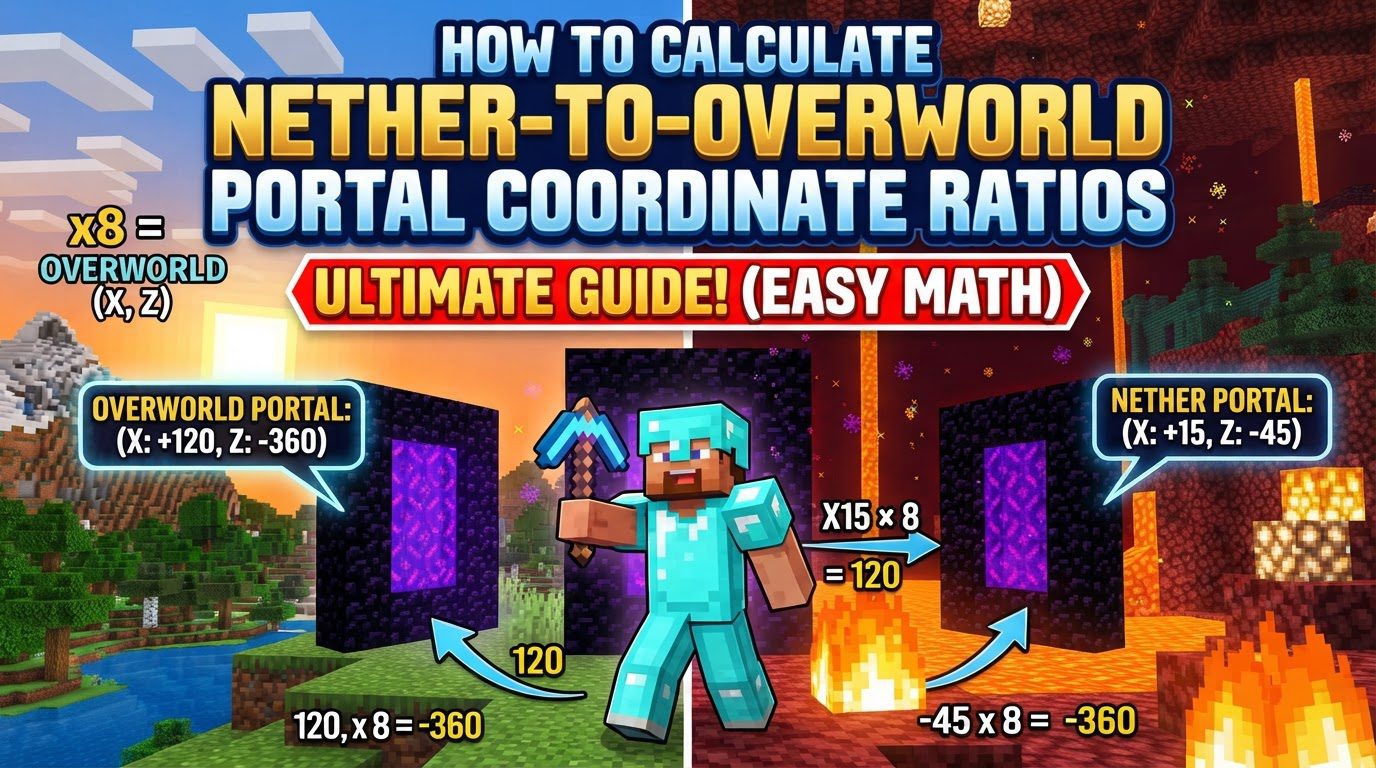
- Coordinate Scaling: For the X and Z coordinates, one block traveled in the Nether is equivalent to eight blocks in the Overworld. This 1:8 ratio is the cornerstone of efficient Nether travel, allowing players to cover significant distances in the Overworld by traveling a much shorter distance in the Nether. This means that if you travel 100 blocks in the Nether along the X-axis, you will emerge in the Overworld 800 blocks away along the X-axis from your entry point. This scaling is precisely why the Nether is so valuable for long-distance journeys.
- Y-coordinate (Height): Unlike the X and Z axes, the Y-coordinate, which represents height, does not follow this 1:8 ratio. The Y-coordinate remains the same in both dimensions. While it doesn’t scale, its value is still critically important when the game determines which portal to link to, as proximity in all three dimensions is considered. Therefore, building your portals at roughly equivalent Y-levels can significantly improve linking reliability.
- Portal Search Radius: When a player enters a portal, the game doesn’t just teleport them to the exact calculated coordinates. Instead, it initiates a search for an existing portal within a specific radius around the destination point. In the Overworld, the game searches within a 17×17 chunk area around the calculated destination (which translates to up to 8 chunks away from the center). A chunk is a 16×16 block area, so this search covers a substantial region. In the Nether, the search radius is smaller, spanning a 3×3 chunk area. Understanding these search radii is crucial because if an existing portal falls within this range, the game will prioritize linking to it, potentially leading to unexpected connections if not managed properly.
- Closest Portal and Generation: The game’s primary objective is to link the player to the closest existing portal within its search range. This “closest” determination is based on the Euclidean distance across all three coordinates (X, Y, Z), not just horizontal distance. If, after scanning the entire search area, no existing portal is found, the game will then automatically generate a new portal at the calculated destination coordinates. While convenient, allowing the game to generate portals often results in them appearing in inconvenient or dangerous locations, making precise manual placement highly preferable.
Step-by-Step Guide to Precise Portal Linking
To ensure your portals link exactly where you intend, follow these meticulous steps:
- Build Your Overworld Portal Frame: Begin by constructing the frame of your first Nether portal in your desired Overworld location. This could be near your base, a mining outpost, or any strategic point you wish to connect to the Nether. Crucially, do not light this portal yet. Leaving it unlit prevents the game from automatically generating a corresponding Nether portal before you’ve had a chance to calculate and build your own.
- Record Overworld Coordinates: Stand inside the unlit Overworld portal frame. Open your debug screen (F3 on Java Edition, or similar methods for other editions) to record your precise X, Y, and Z coordinates. It’s important to be as accurate as possible here, as these numbers form the basis of all subsequent calculations.
- Calculate Nether Coordinates: With your Overworld coordinates in hand, perform the necessary calculations. Divide your recorded Overworld X coordinate by 8, and do the same for your Overworld Z coordinate. The Y-coordinate remains unchanged. For example, if your Overworld coordinates are X=800, Y=64, Z=1600, your target Nether coordinates would be X=100, Y=64, Z=200. This division precisely translates your Overworld position into its Nether equivalent.
- Light and Enter Overworld Portal: Once you have your calculated Nether coordinates, light your Overworld portal using a flint and steel. Step through it. Since you haven’t built a corresponding portal in the Nether yet, the game will likely generate a new Nether portal at or near your calculated coordinates. This is generally acceptable at this stage, as you will be replacing it.
- Travel to Calculated Nether Coordinates and Build: Upon arriving in the Nether, immediately consult your calculated Nether X and Z coordinates. Travel to this precise location. It is highly recommended to build your new Nether portal frame exactly at these calculated X and Z coordinates, and as close to the calculated Y-level as safely possible. Construct the portal frame using obsidian, just as you did in the Overworld.
- Light Nether Portal and Confirm Link: Light your newly constructed Nether portal. Step through it to travel back to the Overworld. If you have followed the steps correctly, you should emerge precisely through your original Overworld portal, confirming that the two are now perfectly linked. This two-way travel verification is critical to ensure proper alignment.
- Destroy Unwanted Portals: If, upon your first entry into the Nether, the game generated a temporary Nether portal that is not at your desired, precisely calculated location, destroy it. This prevents any confusion or accidental linking to the incorrectly placed portal later on, ensuring that only your manually constructed portals are active.
Important Tips for Success
Beyond the basic steps, several tips can further enhance your portal linking experience:
- Utilize Online Nether Portal Calculators: While the division by 8 is straightforward, online Nether portal calculators can streamline the process, especially when dealing with larger numbers or needing to quickly convert multiple coordinate pairs. They eliminate the potential for manual calculation errors and provide instant results, saving you time and ensuring accuracy.
- Match Y-level Closely: Although the Y-coordinate doesn’t scale, matching the Y-level of your Overworld and Nether portals as closely as possible is a good practice. This is because the game uses Euclidean distance (which includes Y-axis proximity) when searching for the closest portal. A significant Y-axis discrepancy could cause your portal to link to a different, less ideal portal if one exists within range at a closer Y-level. Aim for safety and convenience, but remember that the Y-axis doesn’t scale.
- Always Manually Build Portals in Both Dimensions: Relying on the game to automatically generate portals is a common pitfall. Manually building portals in both the Overworld and the Nether gives you complete control over their exact placement. This precision is key to establishing reliable and predictable portal connections, preventing portals from appearing in dangerous lava lakes or precarious cliff edges.
- Round Down Decimals for F3 Coordinates: When recording coordinates from the F3 debug screen, especially if you’re standing on a block, you might see decimal values (e.g., X=800.5). Always round down to the nearest whole number for X and Z when performing calculations. For example, 800.5 should be treated as 800. This ensures consistency and prevents minor misalignments.
- Enclose Your Nether-Side Portal: The Nether is a hostile environment teeming with dangerous mobs and environmental hazards like lava. After building your Nether portal, immediately enclose it with a protective structure made of blast-resistant blocks like cobblestone or obsidian. This enclosure will guard against ghast fireballs, prevent mobs from wandering through your portal, and offer a safe zone upon entry.
Common Mistakes to Avoid
Even experienced players can make errors. Being aware of these common mistakes will help you achieve perfect portal linking:
- Forgetting to Divide Overworld X and Z by 8: This is arguably the most frequent and impactful error. Failing to divide your Overworld X and Z coordinates by 8 when planning your Nether portal’s location will result in your Nether portal being wildly off-target, leading to completely misaligned or non-functional links. Always remember the 1:8 ratio for horizontal coordinates.
- Assuming the Y-coordinate is Completely Irrelevant: While the Y-coordinate doesn’t scale, it is not entirely irrelevant. As previously mentioned, the game considers Euclidean distance across all three axes (X, Y, Z) when determining the closest portal. Ignoring the Y-coordinate completely can lead to unexpected links if another portal at a more favorable Y-level is within the search radius.
- Allowing the Game to Generate Corresponding Portals: Relying on the game’s automatic portal generation is a recipe for frustration. Auto-generated portals frequently appear in inconvenient, dangerous, or hard-to-access locations. Always take the time to calculate your coordinates and manually build your portals in both dimensions for optimal placement and control.
- Placing Overworld Portals Too Close to Each Other: If you build multiple Overworld portals too close together (less than 8 blocks apart in Overworld distance), their corresponding calculated Nether coordinates will be less than one block apart. This will cause them to link to the same Nether portal, or for one Nether portal to serve multiple Overworld portals, leading to unpredictable and confusing travel. Maintain sufficient distance between Overworld portals if you want them to link to distinct Nether portals.
- Not Destroying the Initial, Often Poorly Placed, Nether Portal: When you first enter the Nether from an unlinked Overworld portal, the game generates a new Nether portal. This portal is often not at your precise calculated coordinates and can be poorly placed. If you don’t destroy it after building your accurately placed Nether portal, the game might still try to link to the old, undesirable portal, causing linking issues. Always clear out any unwanted auto-generated portals.
- Entering the Overworld Portal Before Calculating and Building: This mistake directly leads to the “allowing the game to generate” problem. If you light and enter your Overworld portal before you’ve calculated the precise Nether coordinates and traveled to build your corresponding Nether portal, the game will automatically create a Nether portal for you. This forfeits your control over its placement and necessitates a cleanup operation. Always calculate, then build, then travel.
By meticulously following these guidelines and understanding the underlying mechanics, you will master the art of Nether portal linking, transforming the Nether into a powerful tool for efficient exploration and transportation in your Minecraft world. Precise portal placement not only saves time but also enhances the overall quality of your gameplay experience.
Tags:
YOU MAY ALSO LIKE...