Determining Optimal Food Choices for Saturation Efficiency — A Quick Guide
Understanding how to manage your hunger and saturation efficiently is crucial for survival and productivity in Minecraft. While the visible hunger bar might seem straightforward, a hidden mechanic called saturation plays an even more significant role in determining how long you can perform actions and regenerate health without needing to eat again.
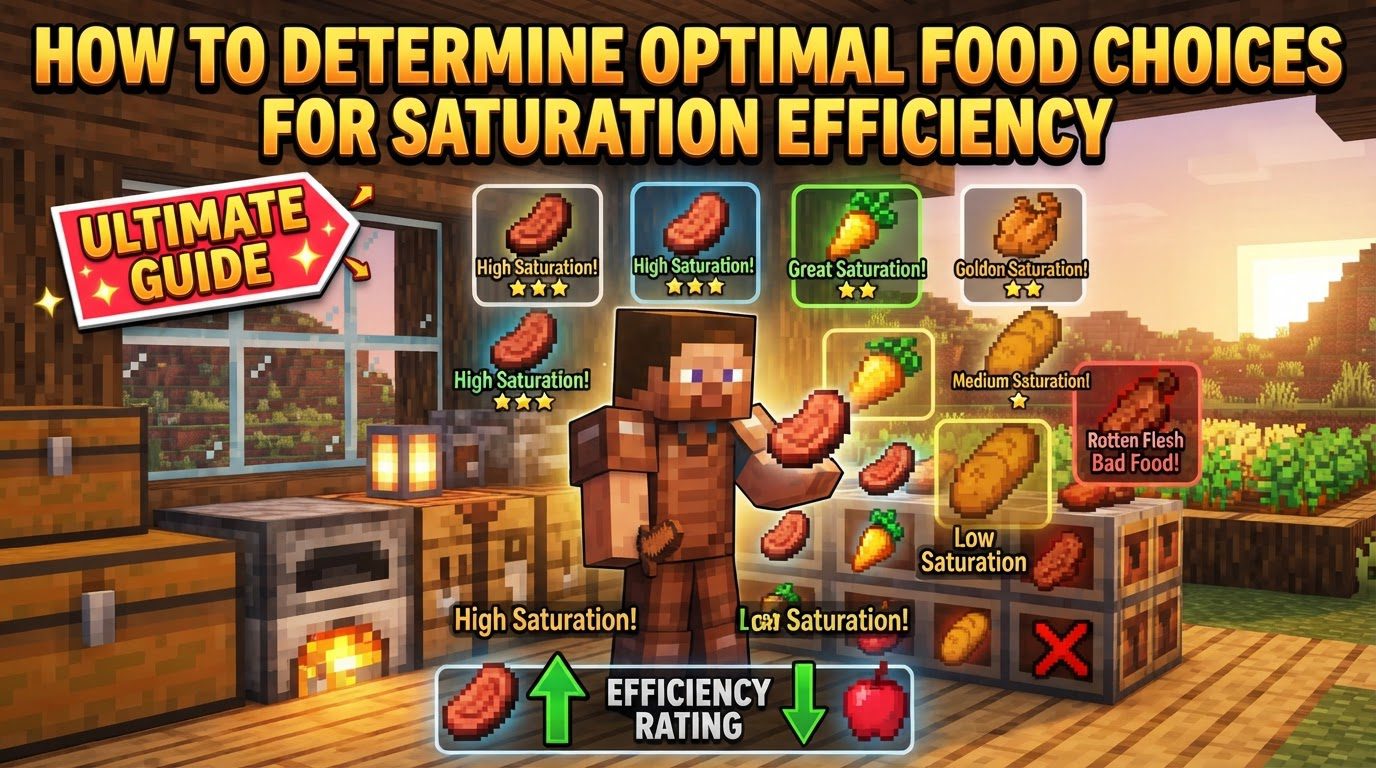
Key Mechanics of Hunger and Saturation
To make optimal food choices, it’s essential to first grasp the underlying mechanics that govern your character’s hunger and well-being.
- Hunger Bar (visible): This is the row of ten drumsticks at the bottom of your screen, representing 20 points of hunger. A full hunger bar is vital for health regeneration. If your hunger drops below 6 points (3 drumsticks), you lose the ability to sprint, severely impacting mobility. Should your hunger bar reach 0, your character will begin to take starvation damage, which can be fatal.
- Saturation (hidden): This is an invisible, secondary hunger bar that exists alongside your visible hunger bar. Saturation is depleted first when you perform actions that cause exhaustion. Only once your saturation has completely depleted does your visible hunger bar begin to drop. Foods that provide more saturation will keep your visible hunger bar full for longer periods.
- Exhaustion: Another hidden variable, exhaustion accumulates as you perform various actions in the game. Sprinting, jumping, attacking mobs, and mining all contribute to your exhaustion level. Once your exhaustion reaches a certain threshold, it causes a reduction in your saturation, and subsequently, your visible hunger. Managing exhaustion indirectly helps preserve your food resources.
- Health Regeneration: Your character’s health will automatically regenerate when your visible hunger bar is at 18 points (9 drumsticks) or more, provided you also have remaining saturation. This means that foods offering high saturation are incredibly valuable, as they keep your health regenerating for extended periods, reducing the need for potions or careful combat.
- Nourishment: This term refers to the ratio of saturation points restored to visible hunger points restored by a food item. Foods with a higher nourishment value are generally considered more efficient, as they provide more “hidden fullness” for each visible hunger point replenished, leading to less frequent eating.
Step-by-Step Process for Optimal Food Choices
Making informed decisions about your food supply can significantly impact your gameplay experience. Follow these steps to optimize your food choices for saturation efficiency.
- Understand the Situation: Before grabbing any food, assess your current needs. Are you embarking on a long mining expedition or a journey across the Overworld, where sustained saturation is paramount to avoid constant eating and maintain health regeneration? Or are you in a combat situation where quick hunger recovery is more important to immediately regain sprinting and health regeneration? Your situation will dictate whether you prioritize maximum saturation or a balance of hunger and saturation restoration.
- Check Saturation Value: Always refer to the specific statistics of food items. The saturation value is often the most critical factor for efficiency. Prioritize foods that offer higher saturation points. A higher saturation value means you will eat less frequently, saving inventory space and time, and keeping your health regenerating for longer.
- Consider Hunger Points: While saturation is key, do not completely overlook the hunger points restored. Even the highest saturation food won’t help if your visible hunger bar is too low to trigger health regeneration. Ensure the food you choose restores a reasonable amount of visible hunger to keep your health regenerating threshold (18 hunger points) consistently met. A good balance allows for both sustained fullness and active health recovery.
- Evaluate Crafting Difficulty/Availability: The “best” food is often the one you can consistently obtain. Consider your current game stage and resource availability. Early in the game, you might rely on easily farmable options like bread or baked potatoes. As you progress, you can transition to more resource-intensive but highly efficient foods like cooked steak or golden carrots, which require more advanced farms or mining for gold. The optimal choice is practical and sustainable for your current situation.
- Cook Raw Foods: A fundamental rule for food efficiency is to always cook raw meats and potatoes. Cooking significantly boosts both the hunger and saturation values of these items. For example, raw porkchop offers 3 hunger points and 1.8 saturation, whereas a cooked porkchop provides 8 hunger points and 12.8 saturation – a massive increase in efficiency for a small investment of fuel.
Important Tips for Food Management
Leveraging specific food items and strategies can further enhance your saturation efficiency.
- Golden Carrots are Top-Tier: With an impressive 14.4 saturation, Golden Carrots offer the highest saturation of any standard food item. This makes them exceptionally good for sustained fullness during long activities like mining or exploring. Although they restore fewer hunger points (6) compared to some meats, their unparalleled saturation means you’ll eat them less often.
- Cooked Meats are Highly Efficient: Cooked Porkchop and Cooked Steak are excellent choices, both providing 12.8 saturation and restoring 8 hunger points. Their high values for both metrics, combined with the relatively straightforward process of farming pigs or cows, make them a staple for mid to late-game food supplies.
- Rabbit Stew: This item provides very high saturation (12) and restores a substantial 10 hunger points. While highly effective, its main drawback is that it is not stackable in your inventory, which can be inconvenient for bulk storage or long trips. It also requires multiple ingredients, making it more complex to produce.
- Suspicious Stew (with Saturation effect): This unique food can offer the absolute highest saturation (21.2) and hunger (13) if crafted with specific flowers, such as a blue orchid or dandelion, which impart the saturation effect. However, like rabbit stew, it is not stackable, and its specific flower requirement makes consistent production for the saturation effect challenging.
- Automate Food Production: To ensure a consistent and reliable supply of high-saturation foods, set up automated farms. This could involve building cow farms, pig farms, or carrot farms. Automation minimizes the effort required to gather food, allowing you to focus on other aspects of the game.
- Early Game Choices: In the early stages of your world, when resources are scarce, Bread (6.0 saturation, 5 hunger points) and Baked Potatoes (6.0 saturation, 6 hunger points) are excellent options. Both are relatively easy to farm from wheat and potatoes respectively, providing a decent balance of hunger and saturation to get you started.
- Combat Food: While not primarily for saturation efficiency, Golden Apples are invaluable for combat. They provide temporary health regeneration and absorption effects, which can be life-saving in intense fights. Keep a few on hand for emergencies, but rely on other high-saturation foods for general sustenance.
Common Mistakes to Avoid
Being aware of common pitfalls can prevent wasted resources and unnecessary hunger management issues.
- Eating Low Saturation Foods: A frequent mistake is consuming foods that offer minimal saturation. Items like Pufferfish (0.2 saturation), Tropical Fish (0.2), Cake (0.4 per slice), Cookies (0.4), Sweet Berries (0.4), Raw Salmon (0.4), Dried Kelp (0.6), and Potatoes (0.6) provide very little hidden fullness. Relying on these will force you to eat much more frequently, consuming more inventory space and time.
- Consuming Food with Negative Effects: Avoid foods that can harm you. Raw chicken has a 30% chance of causing food poisoning, Rotten Flesh has an 80% chance of inflicting the hunger effect, and Spider Eyes and Pufferfish cause poison. These negative effects can counteract any minor hunger restoration and put you in a worse position.
- Overeating High Saturation Food When Nearly Full: While high-saturation foods are efficient, eating them when your hunger bar is almost full can lead to wasted benefits. Your saturation level cannot exceed your current visible hunger level. If you eat a food that restores 10 hunger and 14 saturation when you only have 2 hunger points missing, you effectively waste some of that valuable saturation. It’s often better to wait until your hunger bar has dropped more significantly before consuming a high-saturation item.
- Neglecting Saturation: Many players focus solely on the visible hunger bar, unaware of the critical role saturation plays. They might wonder why they’re constantly eating even with a seemingly full hunger bar. Saturation is the primary determinant of how long you remain full and how long your health regenerates. Ignoring this hidden mechanic leads to inefficient food consumption and more frequent eating.
Tags:
YOU MAY ALSO LIKE...