Calculating Enchantment Level Stacking Caps, Explained
Mastering enchantments is a cornerstone of survival and progression in Minecraft. Understanding how enchantment levels stack, particularly the caps involved, is crucial for creating powerful gear efficiently and avoiding costly mistakes. This guide will walk you through the core mechanics, the process of increasing enchantment levels, strategic tips, and common pitfalls to ensure your enchanting endeavors are successful.
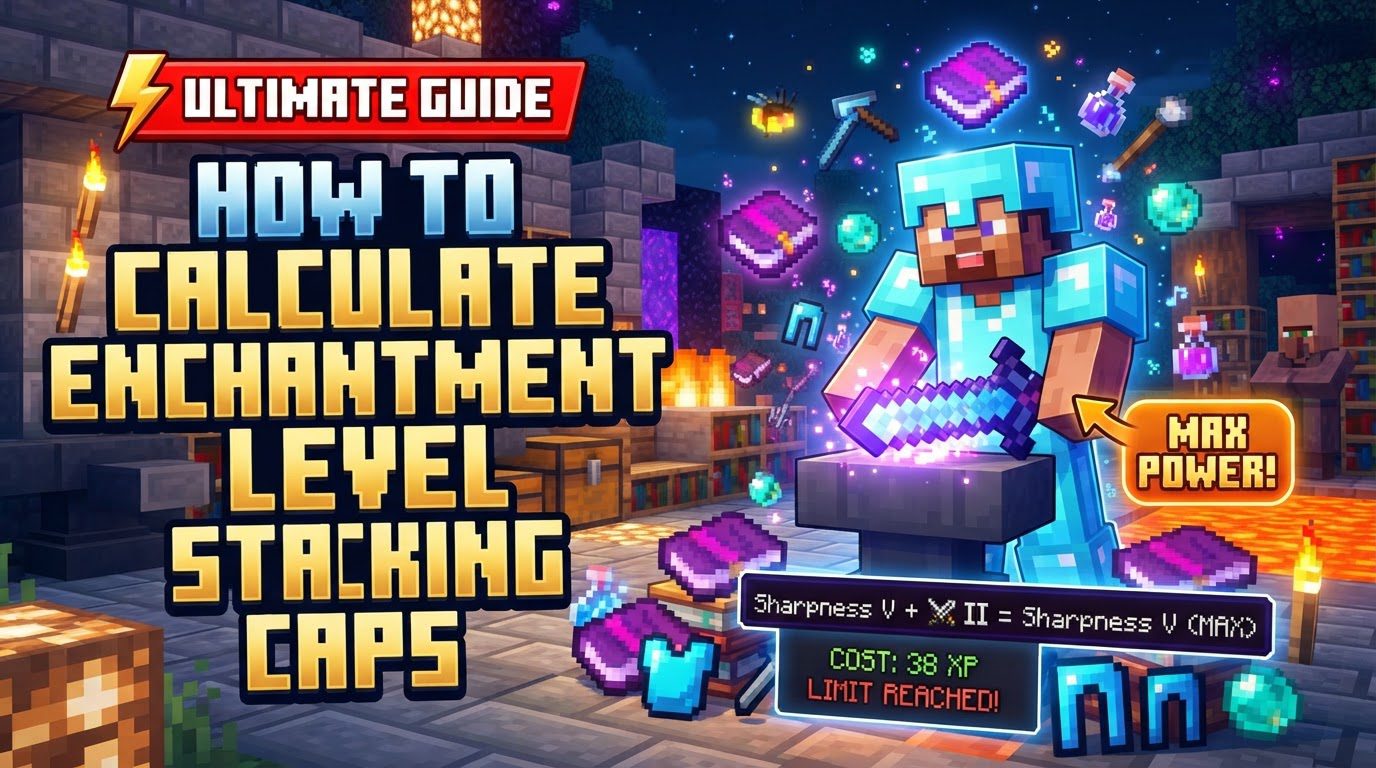
Understanding Key Mechanics of Enchantment Stacking
Enchantment stacking in Minecraft primarily revolves around the use of an anvil. This block allows players to combine items or enchanted books to merge their magical properties. However, there are specific rules governing how these combinations work and what limitations you will encounter.
-
Same Enchantment, Same Level Combination: The most fundamental rule for increasing an enchantment’s level is that you must combine two items or enchanted books that possess the exact same enchantment at the exact same level. For instance, combining two items with Efficiency II will result in a single item with Efficiency III. This process allows you to reach higher enchantment levels, up to their legitimate maximums within Survival mode.
-
Same Enchantment, Different Levels: A common misconception is that different levels of the same enchantment will somehow add together. This is not the case. If you combine two items or books with the same enchantment but at different levels (e.g., Efficiency II and Efficiency I), the resulting item will only retain the higher of the two enchantment levels. The lower level simply does not contribute to an increase.
-
Maximum Legitimate Levels: Every enchantment in Minecraft has a predefined maximum level that can be legitimately obtained through standard Survival gameplay. Examples include Efficiency V, Unbreaking III, and Fortune III. You cannot exceed these caps by simply combining more items; once you reach the maximum, further combinations at that level will not yield a higher tier.
-
Mutually Exclusive Enchantments: Not all enchantments can coexist on the same item. Certain enchantments are mutually exclusive, meaning they directly conflict and cannot be applied together. Prominent examples include Silk Touch and Fortune (you can only have one on a tool), Mending and Infinity (on a bow), and different types of Protection enchantments (e.g., Protection IV and Fire Protection IV cannot be on the same armor piece).
-
“Too Expensive!” Cap: In Survival mode, anvil operations are limited by an experience cost cap. If the experience cost for a combination or repair exceeds 40 levels, the anvil will display “Too Expensive!” and the operation cannot be performed. This cap is a significant factor in strategic enchanting and repair, as repeated operations on an item increase its “prior work penalty,” making future operations more expensive.
-
Creative vs. Survival Limits: It’s important to distinguish between legitimate Survival mode enchantment caps and what can be achieved in Creative mode or using commands. While commands like `/give` in Java Edition can apply enchantment levels up to 255 (or even higher 32-bit integer values), and Creative mode allows free application, these are not considered part of legitimate Survival gameplay and are irrelevant when discussing stacking caps in a standard playthrough.
Step-by-Step Process for Increasing Enchantment Levels
To systematically increase the level of an enchantment on your items, follow this process:
-
Acquire Materials: Begin by obtaining two identical items or two enchanted books, both of which have the same enchantment at the same level. For example, if you want Efficiency III, you would need two items (like two pickaxes) or two enchanted books, each possessing Efficiency II.
-
Use an Anvil: Place an anvil block in your world. Anvils are crafted from iron blocks and iron ingots and are essential for all enchantment combining operations.
-
Combine: Open the anvil’s interface. Place one of your enchanted items or books into the first input slot and the other into the second input slot. The anvil will calculate the experience cost for the combination.
-
Collect Result: Provided you have sufficient experience levels and the cost does not exceed the “Too Expensive!” cap, the output slot will display the combined item or book. This resulting item/book will have the enchantment at one level higher (e.g., combining two Efficiency II books will yield one Efficiency III book).
-
Repeat: To reach even higher legitimate levels, you must repeat this process. For example, to get Efficiency IV, you would need two Efficiency III items/books. This often means you’ll need four Efficiency II items/books to get two Efficiency III items/books, which then combine to make one Efficiency IV item/book. Continue this until you reach the enchantment’s maximum legitimate level.
Strategic Tips for Efficient Enchantment Stacking
Maximizing your enchanting efficiency and avoiding the “Too Expensive!” cap requires strategic planning. Here are some key tips:
-
Pre-combine on Books: It is almost always more cost-effective in terms of experience and managing the “prior work penalty” to combine enchantments on enchanted books first. Once you have a high-level enchanted book (e.g., Unbreaking III), you can then apply this single book to your desired item. This strategy reduces the number of times the primary item is processed on the anvil, thus keeping its prior work penalty lower and delaying the “Too Expensive!” cap.
-
Villager Trades: Librarian villagers are an invaluable resource for acquiring high-level enchanted books. Trading with villagers can often provide books with enchantments like Mending, Unbreaking III, or Efficiency V directly, saving you significant time and experience that would otherwise be spent combining lower-level enchantments. Establishing a reliable villager trading hall is highly recommended for advanced enchanting.
-
Mending: For any highly enchanted piece of gear you intend to use long-term, Mending is an absolutely essential enchantment. Mending allows the item to be repaired automatically by absorbing experience orbs while held or equipped. This completely bypasses expensive anvil repair costs, which are the primary cause of items hitting the “Too Expensive!” cap and becoming unusable for further modifications or repairs in Survival mode. Without Mending, even your best gear will eventually become too expensive to maintain.
-
Anvil Cost Management: Always pay close attention to the experience cost displayed in the anvil interface before committing to a combination. Plan your combining sequence carefully. Combining enchantments in a logical order (e.g., combining books into higher-level books, then applying them to the final item) can help distribute the prior work penalty and keep costs manageable, preventing your item from prematurely hitting the 40-level cap.
Common Mistakes to Avoid
Understanding these pitfalls can save you frustration and valuable resources:
-
Misunderstanding Level Combination: A very common error is believing that different levels of the same enchantment will add up. For example, combining an Efficiency II item with an Efficiency I item will not result in Efficiency III. Instead, the output will simply be Efficiency II, as only the higher level is retained. Only combining two enchantments of the same level will yield the next higher level.
-
Ignoring Mutually Exclusive Enchantments: Attempting to combine enchantments that are mutually exclusive (e.g., trying to put both Silk Touch and Fortune on the same pickaxe) will either prevent the combination entirely or result in only one of the enchantments being applied, often the one from the “sacrificial” item/book being ignored. Always check for conflicts before combining.
-
Hitting “Too Expensive!” Cap: Without proper planning, repeatedly combining or repairing items directly on an anvil can quickly accumulate a “prior work penalty.” This penalty increases the experience cost of subsequent anvil operations, leading to the item becoming “Too Expensive!” to modify or repair further in Survival mode. This mistake often renders highly enchanted gear useless for future upgrades unless Mending is present.
-
Over-enchanting: Trying to combine enchantments beyond their maximum legitimate level in Survival mode is futile. For instance, attempting to combine two Efficiency V items will not yield Efficiency VI because Efficiency V is the highest legitimate level. The anvil will simply output one Efficiency V item, often for a reduced or zero cost, but with no level increase.
By internalizing these mechanics, following the recommended steps, and heeding the strategic advice, you can efficiently create powerful enchanted gear, ensuring your survival and prosperity in the vast world of Minecraft.