Increasing Composter Fill Chance Per Item (Step by Step)
Mastering Composting: A Guide to Maximizing Bone Meal Production
In the vast world of Minecraft, efficiency is key to progression and sustainability. One often overlooked yet incredibly valuable mechanic is composting. Composters provide a renewable source of bone meal, an essential item for accelerating crop growth and crafting. Understanding how to increase the composter fill chance per item is paramount for any player looking to optimize their agricultural endeavors or simply make the most of their excess plant-based resources. This comprehensive guide will delve into the mechanics, strategies, and common pitfalls of composting, ensuring you can maximize your bone meal output.
Understanding Composter Mechanics
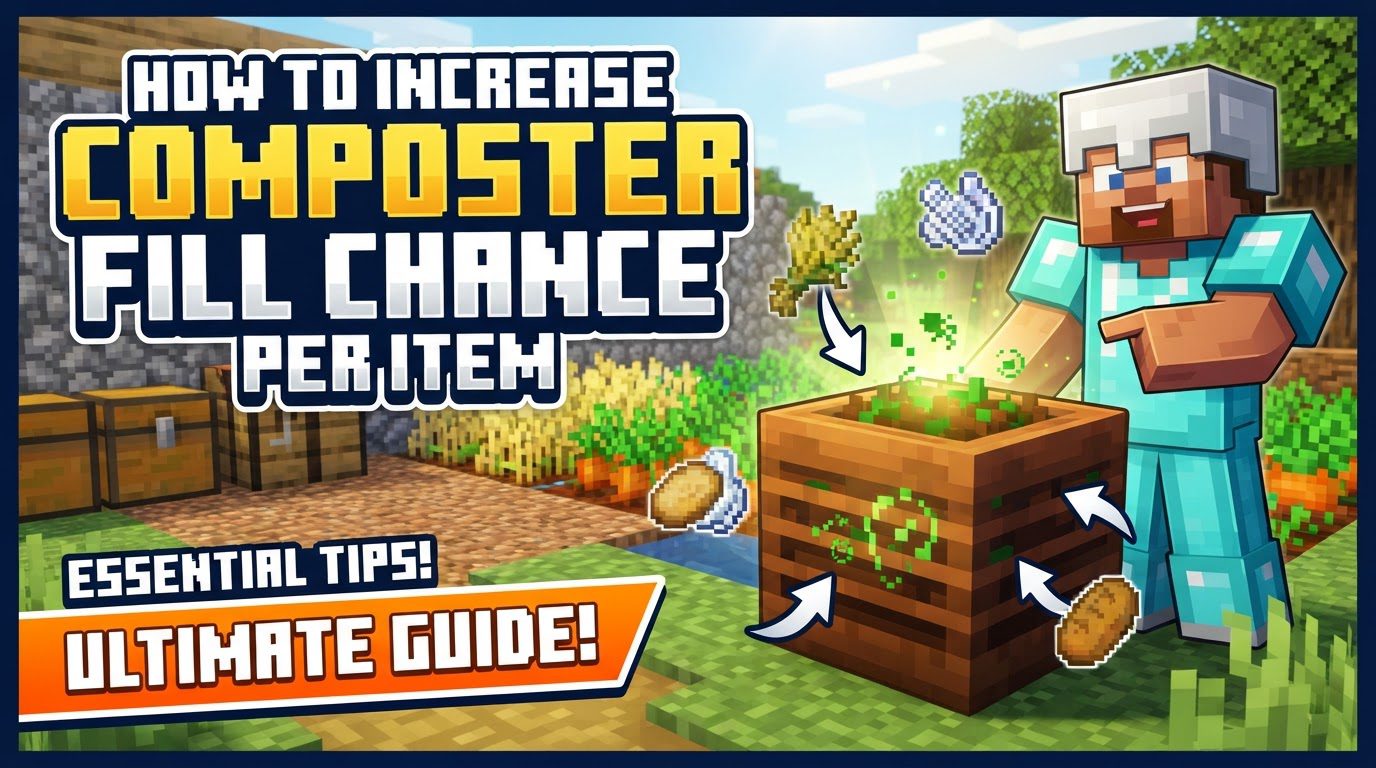
At its core, a composter is a utility block designed to convert various compostable plant-based items into bone meal. This process is not instantaneous or guaranteed for every item; instead, each compostable item possesses a specific percentage chance of successfully increasing the composter’s fill level. A successful increase is visually indicated by green particles emanating from the composter.
A composter operates on an 8-level fill system. It starts empty (level 0) and gradually fills up. Once the 7th level is achieved, adding just one more successful item will fully fill the composter, producing one bone meal, and subsequently resetting the composter to an empty state. Beyond its primary function, composters also serve as a job site block for farmer villagers, allowing them to take on a profession. Furthermore, the composter’s fullness can be detected by a Redstone comparator, emitting a signal strength from 0 (empty) to 8 (bone meal ready), which is incredibly useful for advanced automation systems.
The Composting Process: A Step-by-Step Guide
Engaging with composting is a straightforward process, but understanding each step ensures optimal use:
- Craft a Composter: The first step is to craft the composter itself. This requires 7 wooden slabs of any type, arranged in a U-shape on a crafting table.
- Place the Composter: Once crafted, strategically place your composter. Ideal locations include near your crop farms, tree farms, or any area where you regularly gather compostable items. Proximity to item collection points can significantly streamline the process.
- Add Items: To begin composting, simply right-click the composter with any compostable item in your hand. The item will be consumed, and if successful, green particles will appear, indicating a level increase.
- Monitor Fill Level: As items are added and the composter fills, its texture will visually change. Each distinct texture represents a different fill level, allowing you to easily gauge its progress towards producing bone meal.
- Collect Bone Meal: When the composter reaches its maximum fill level (level 8), which often appears as a white layer on top, it is ready to yield bone meal. Right-click the composter to collect the bone meal, and it will reset to an empty state, ready for more items.
Maximizing Efficiency: Important Tips for Higher Fill Chances
To truly master composting and achieve the highest bone meal output, focus on these critical strategies:
- Prioritize High-Efficiency Items: The single most impactful way to increase your composter fill chance per item is to use items with a higher composting percentage. This minimizes the number of items needed per bone meal and maximizes your resource efficiency.
- 100% Chance: These items guarantee a fill level increase every time. They are the most efficient but might be too valuable for large-scale composting if they have other uses.
- Cake
- Pumpkin Pie
- 85% Chance: Excellent choices for consistent and relatively high-yield composting. Many of these are easily mass-produced.
- Baked Potato
- Bread
- Cookie
- Hay Bale
- Mushroom Blocks (Brown and Red)
- Nether Wart Block
- Pitcher Plant
- Torchflower
- Warped Wart Block
- 65% Chance: Good mid-tier options, often readily available from farms.
- Apple
- Beetroot
- Carrot
- Cocoa Beans
- Ferns
- Flowers (all types)
- Lily Pad
- Melon (whole block)
- Mushrooms (Brown and Red)
- Potato
- Pumpkin (whole block)
- Sea Pickle
- Shroomlight
- Wheat
- Fungi (Crimson and Warped)
- Roots (Crimson and Warped)
- Spore Blossom
- 50% Chance: Acceptable for large quantities, but less efficient than higher-tier items.
- Cactus
- Dried Kelp Block
- Melon Slice
- Sugar Cane
- Tall Grass
- Vines
- Weeping Vines
- Twisting Vines
- Nether Sprouts
- 30% Chance: These are the least efficient. While they can be used for surplus, prioritize other items if possible. They are often best used when you have an overwhelming abundance of them.
- Beetroot Seeds
- Melon Seeds
- Pumpkin Seeds
- Torchflower Seeds
- Wheat Seeds
- Dried Kelp
- Glow Berries
- Grass
- Kelp
- Leaves (all types)
- Moss Carpet
- Pink Petals
- Saplings (all types)
- Seagrass
- Small Dripleaf
- Sweet Berries
- Automate: For any serious bone meal production, automation is crucial. Utilize hoppers placed above the composter to automatically feed items into it. Similarly, place hoppers below the composter to collect the bone meal as it’s produced. This creates a continuous, hands-free system.
- Integrate with Farms: Design your crop farms to automatically funnel excess plant matter directly into your composters. This creates a sustainable, closed-loop system where your farms generate resources that, in turn, produce bone meal to accelerate future farm growth. This synergy is highly efficient.
- Bedrock Edition Specific Tip: Players on Bedrock Edition have a unique advantage: the very first item placed into an empty composter always has a 100% chance to increase the level. This is a perfect opportunity to use a low-value item, such as a single seed, for the initial fill, saving your higher-value items for subsequent, percentage-based fills.
- Crafted vs. Raw: Pay attention to the form of your items. Often, smaller, crafted items like melon slices offer a better composting rate than their full block counterparts. However, there are exceptions; for instance, cookies (crafted from wheat) provide a significantly better composting rate than raw wheat, making them an excellent choice for converting excess wheat into bone meal.
Common Mistakes to Avoid
Even with the right strategies, certain mistakes can hinder your composting efforts. Be mindful of these common pitfalls:
- Using Low-Efficiency Items Exclusively: While tempting to compost everything, relying solely on items with low fill chances (like seeds or leaves) will drastically slow down your bone meal production, making the process feel unrewarding.
- Ignoring Automation: Manually filling composters and collecting bone meal is incredibly inefficient for large-scale operations. Embrace hoppers and Redstone to free up your time for other tasks.
- Forgetting to Collect Bone Meal: An often-overlooked mistake, if the composter fills up and the bone meal isn’t collected (either manually or by a hopper), it will cease to produce more. The composter will remain full until the bone meal is taken.
- Not Integrating with Farming Systems: Failing to connect your composting setup with your existing farms means you’re likely wasting valuable excess crops and seeds that could be converted into bone meal.
- Attempting to Compost Non-Compostable Items: Not all plant-based items can be composted. Items such as bamboo, poisonous potatoes, dead bushes, meat, and fish are not compostable and will simply be wasted if you try to add them. Always refer to the list of compostable items.
- Breaking a Filled Composter: If you accidentally break a composter that contains compostable material, it will drop as an empty composter, and all the material inside will be lost. Be cautious when moving or dismantling your composting stations.
- Improper Hopper Placement: Hoppers are particular about their interaction points. They only interact with the top of a composter for input and the bottom for output. Placing hoppers on the sides will not work.
- Overflow in Automated Systems: Without careful design, an automated system can continue to feed items into a composter even after it’s full but before the bone meal has been collected. This leads to wasted items that don’t contribute to the fill level. Using Redstone comparators to detect the composter’s fullness can prevent this by temporarily halting item input when it’s full.
By understanding the mechanics, prioritizing high-efficiency items, embracing automation, and avoiding common mistakes, you can transform your composting efforts into a highly productive source of bone meal, supporting your agricultural endeavors and overall survival in Minecraft.
Tags:
YOU MAY ALSO LIKE...