

Teaching a Parrot to Mimic Mob Sounds — A Quick Guide
Parrots in Minecraft offer a unique and valuable ability: the mimicry of mob sounds. This behavior is more than aesthetic; it’s a potent tool for navigating the dangerous landscapes and subterranean depths of your world. Understanding how parrots mimic and how to leverage this inherent trait can significantly enhance your survival and exploration, providing an auditory early warning system against unseen threats.
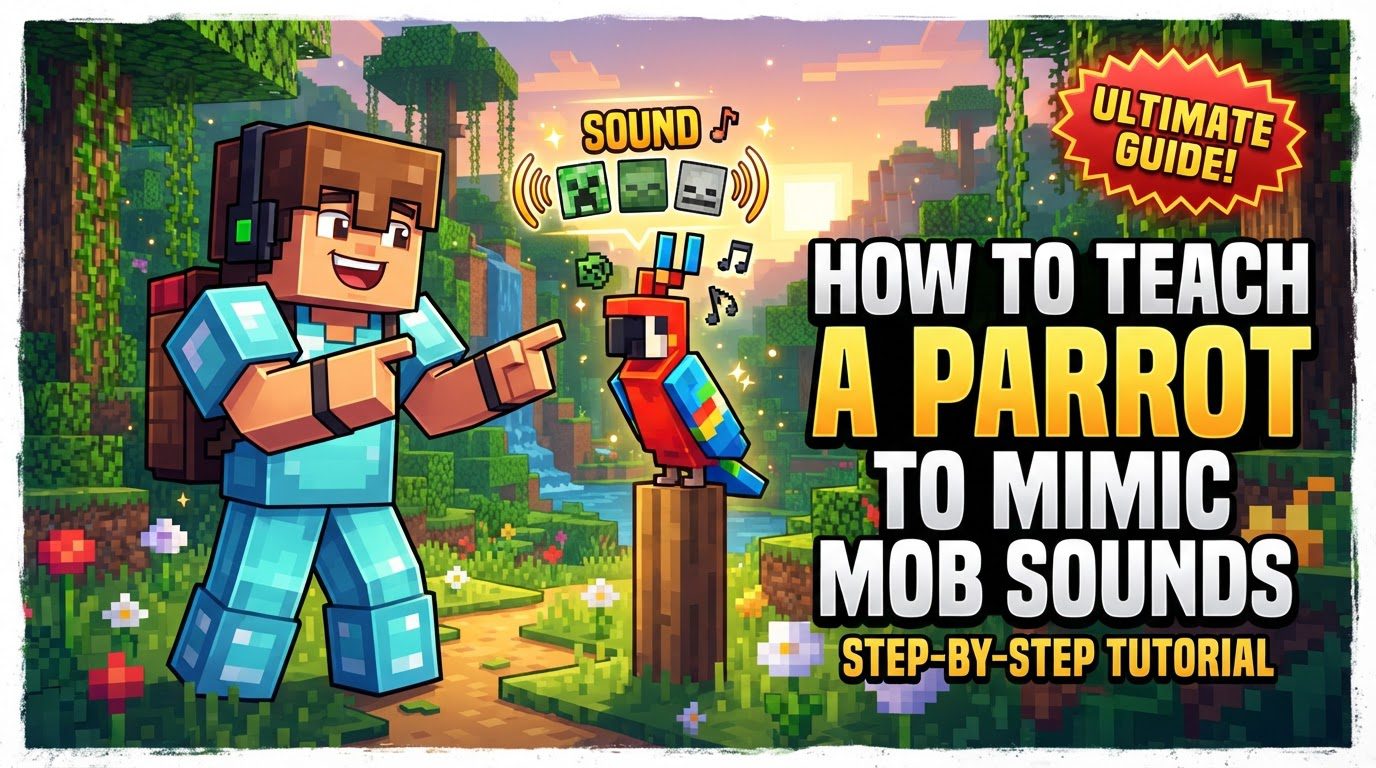
This guide will detail the precise mechanics of parrot mimicry, the straightforward process to enable it, and its practical applications, while also addressing common misconceptions.
Understanding Parrot Mimicry: The Core Mechanics
A parrot’s sound mimicry is an innate behavior, reacting predictably to its environment. They do not learn sounds; they simply imitate based on proximity to other creatures.
- Automatic Imitation: Parrots automatically imitate the idle sounds of nearby hostile and certain neutral mobs. This inherent behavior requires no player intervention beyond placing the parrot near these creatures. They will pick up ambient noises mobs generate, even if not actively engaged or making loud sounds.
- Detection Range: Parrots have a 20-block cubical detection range for sensing mobs to mimic. This means it extends 20 blocks in every cardinal direction (north, south, east, west, up, and down) from the parrot. This generous range often exceeds a player’s typical hearing radius, allowing them to detect mobs further away than you might hear them yourself.
- Sound Characteristics: The mimicked sound is identical to the original mob’s sound but played at a distinctly higher pitch. This alteration helps players differentiate between an actual mob and a parrot’s imitation, providing a clear signal that the sound is coming from your companion.
- Directional Indication: Parrots often look in the direction of the mob they are mimicking. This visual cue is incredibly helpful for pinpointing the exact location or general direction of an unseen threat, especially in dark caves or dense forests where visibility is limited.
- Occasional Randomness: While typically tied to nearby mobs, there is a fascinating anomaly in parrot behavior. Occasionally, a parrot may mimic sounds of mobs not actually present in the immediate area. This can sometimes lead to confusion, but it’s a known, albeit infrequent, part of their mimicry repertoire.
The “Teaching” Process: What You Need to Know
It’s crucial to understand that there is no specific “teaching” process for parrot mimicry. You cannot instruct a parrot to learn a sound; their mimicking is an inherent behavior based solely on proximity to mobs.
To have a parrot mimic mob sounds, follow these straightforward steps:
- Tame a Parrot: First, you must tame a wild parrot. Parrots are typically found in jungle biomes, flying around or perched on trees. Taming them is a simple matter of feeding them seeds. Acceptable seeds include wheat seeds, melon seeds, pumpkin seeds, or beetroot seeds. Once tamed, the parrot will follow you and can be commanded to sit or stand, much like a tamed wolf or cat. Taming establishes the bond necessary for them to become a useful companion.
- Bring the Tamed Parrot Near Mobs: With your tamed parrot by your side, the next step is simply to bring it into areas where mobs are likely to be present. This includes venturing into dark caves, exploring the depths of mineshafts, or navigating through dimly lit areas on the surface during nighttime. As soon as a hostile or relevant neutral mob enters the parrot’s 20-block cubical detection range, the parrot will automatically begin to mimic that mob’s idle sounds. There’s no further action required on your part; the parrot’s natural behavior takes over.
This simplicity makes parrots an effective passive warning system, leveraging their natural abilities without complex training or specific commands.
Leveraging Parrot Mimicry: Practical Applications
Understanding parrot mimicry reveals its practical utility in Minecraft. They are more than just decorative companions; they are invaluable tools for survival and exploration.
- Early Warning System: Perhaps the most significant advantage of having a mimicking parrot is its ability to act as an early warning system. Parrots will mimic the sounds of hostile mobs even if those mobs are hidden behind walls, deep underground, or simply out of your line of sight. This is particularly useful for identifying dangerous mobs like creepers. A parrot will mimic a creeper’s distinct hissing sound, even if the creeper isn’t actively making noise yet or is still some distance away. This advance notice can give you precious seconds to prepare for an encounter, reposition, or even avoid the threat entirely.
- Locating Unseen Mobs: The parrot’s extended detection range, spanning 20 blocks in all directions, significantly surpasses a player’s typical hearing range for many mob sounds. This makes them exceptionally useful for locating unseen mobs. When mining or exploring new cave systems, hearing a parrot mimic a zombie or skeleton sound from an unexpected direction can indicate the presence of a hidden cavern, a monster spawner, or simply a dark pocket where mobs are gathering. This can be a game-changer for finding new resources or anticipating threats before they surprise you.
- Shoulder Warnings: For maximum portability and constant vigilance, a parrot perched on your shoulder offers continuous protection. While exploring, mining, or building, a parrot on your shoulder will provide immediate warnings about nearby mobs. This hands-free alert system means you don’t have to constantly scan your surroundings or rely solely on your own limited hearing. The high-pitched mimicked sound directly from your companion serves as an undeniable signal that danger is approaching, allowing you to react swiftly.
Integrating a parrot into your adventuring party transforms it into a proactive defense mechanism, turning potential ambushes into manageable encounters.
Common Misconceptions and What Not to Do
Despite the straightforward nature of parrot mimicry, several misconceptions have circulated within the Minecraft community. Avoiding these misunderstandings is key to effectively utilizing your feathered friend.
- Do Not Expect to “Teach” Specific Sounds: A prevalent community suggestion, which is not an implemented game mechanic, was the idea that feeding parrots mob drops (like zombie flesh or bones) would teach them to mimic specific mob sounds. This is entirely false. Parrots do not learn sounds this way. Their mimicry is purely based on proximity and their inherent programming. Attempting to “teach” them will only waste valuable resources and lead to frustration.
- Don’t Be Confused by Random Mimicking: As mentioned earlier, parrots may sometimes imitate sounds even if no mob is directly present in the area, or if the mob is out of sight (e.g., underground). This occasional random mimicking is a known aspect of their behavior. While it can sometimes be confusing or create false alarms, it’s generally infrequent enough not to detract from their overall utility. It’s important to differentiate between these occasional random sounds and the consistent, directional warnings they provide when mobs are genuinely within range.
- Be Aware of Potential Annoyance: While incredibly useful, the constant high-pitched mimicked sounds can sometimes become annoying, especially in mob-dense areas like active mob farms, dark caves, or during prolonged nighttime explorations. The constant chatter, albeit informative, can be a source of distraction or irritation for some players. If the sounds become too much, you can always command your parrot to sit in a safe location until you are ready to move on, or simply dismount them from your shoulder temporarily.
By understanding these nuances, you can avoid common pitfalls and fully appreciate the unique contributions your parrot brings to your Minecraft experience.
In conclusion, Minecraft parrots are intuitive and effective early warning systems. Their ability to automatically mimic the high-pitched idle sounds of nearby hostile and select neutral mobs within a 20-block cubical range provides players with invaluable information.
No complex training is involved; simply taming a parrot with seeds and bringing it into mob-prone areas is all that’s required to activate its inherent mimicry. This behavior serves as a critical tool for detecting unseen threats, locating hidden cave systems, and providing constant vigilance when perched on your shoulder. By understanding the true mechanics – and avoiding common misconceptions like “teaching” sounds – you can harness the full potential of these fascinating creatures.
Embrace your parrot as a crucial scout and protector, and you’ll find your Minecraft adventures significantly safer and more informed.
Tags:
YOU MAY ALSO LIKE...


