Reducing Boat Friction Using Packed Ice — A Quick Guide
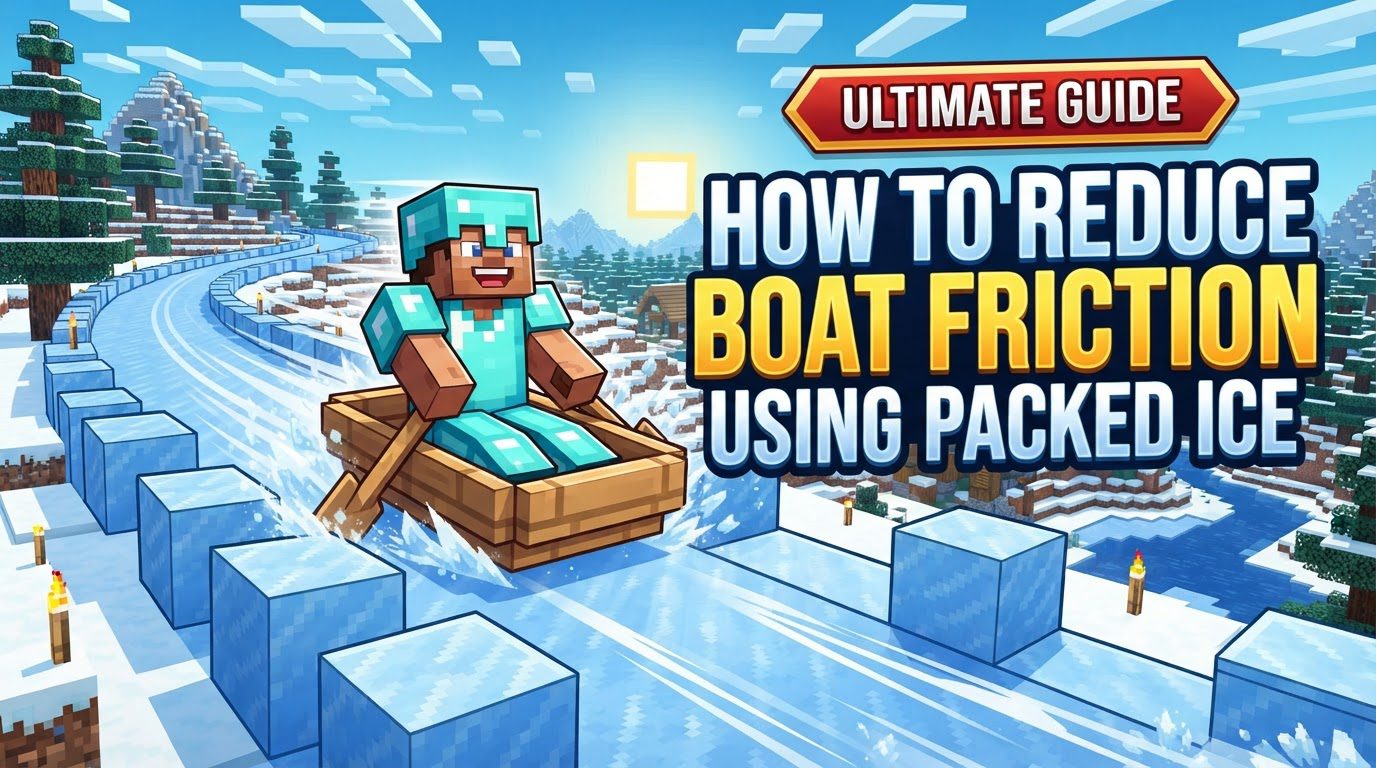
The fundamental principle behind this rapid transit method lies in the significantly reduced friction boats experience when traversing ice blocks. This unique interaction allows boats to achieve speeds far beyond what’s possible on water or land, revolutionizing how players navigate their worlds. Understanding the specific properties of different ice types and the mechanics of boat movement on these surfaces is crucial for designing and building effective high-speed transport systems.
Understanding the Mechanics of Ice Boat Travel
- Reduced Friction and High Speeds: The core of ice boat travel is the dramatic reduction in friction. When a boat is on any ice block, its friction coefficient plummets, allowing it to maintain momentum and achieve very high speeds. On standard ice, frosted ice, and packed ice, boats can reach an impressive speed of 144.0 km/h. This makes packed ice an excellent and relatively accessible material for creating extensive transport networks.
- Blue Ice for Maximum Velocity: While packed ice offers substantial speed, blue ice takes it a step further. Boats traveling on blue ice can reach an astonishing 252.0 km/h, making it the absolute fastest option available for boat-based transportation. However, this increased speed comes with a higher cost in terms of resource acquisition, requiring players to weigh the benefits against the effort needed to gather blue ice.
- Melting Properties and Nether Utility: A critical distinction between ice types is their melting behavior. Regular ice will melt when exposed to certain light levels, making it unsuitable for long-term, exposed tracks. In contrast, packed ice and blue ice are impervious to light-induced melting. This makes them ideal for tracks built in any environment, especially the Nether, where high light levels and extreme temperatures would quickly destroy regular ice. The Nether’s vast, often dangerous landscapes become much more traversable with non-melting ice boat tracks.
- Boat Hitbox Considerations: An important detail for track design is the boat’s hitbox. It is wider than a single block and, crucially, does not rotate with the boat’s visual angle. This means that at any given moment, multiple blocks beneath the boat’s hitbox contribute to its physics. Understanding this allows for clever track designs, such as resource-efficient tracks where ice blocks are spaced out, as the boat’s wide hitbox will still register contact with the ice.
Constructing Your Packed Ice Track
Building an efficient packed ice track requires careful planning and execution. Follow these steps to create a high-speed transport system:
- Flatten the Area: Before laying any ice, the first crucial step is to create a perfectly flat path. Boats cannot ascend blocks; any incline will stop the boat or severely impede its speed. Therefore, ensure your chosen route is completely level, digging down or building up as necessary to achieve a smooth, uninterrupted surface for your track.
- Choose Your Ice Type: Decide whether to use packed ice or blue ice. Packed ice strikes a good balance between speed and cost, making it a practical choice for most long-distance tracks. Blue ice, while faster, is significantly more expensive and harder to obtain, often reserved for critical express routes where maximum speed is paramount. Consider your available resources and desired travel speed when making this decision.
- Place Ice Blocks: Begin laying down your chosen ice blocks to form the track. For a basic track, a single row of ice blocks is sufficient. However, for more stability and to accommodate the boat’s wide hitbox, a two-block wide track is often preferred, though not strictly necessary if resource efficiency is a priority.
- Add Protective Walls: To prevent the boat from veering off course and stopping abruptly, construct walls alongside the track. These walls should be at least one block tall. Without them, the boat can easily drift off the ice, losing all momentum. Many players opt for glass panes as walls, especially in a 3×3 tunnel configuration, as they offer visibility and are generally easy to acquire in large quantities. The walls guide the boat and prevent costly collisions with the surrounding terrain.
Optimizing Your Ice Boat Experience
Beyond the basic construction, several techniques and considerations can help you get the most out of your ice boat tracks:
- Strategic Track Design: When designing your tracks, prioritize straight sections. Boats at high speeds have significant inertia, making turns difficult. For any necessary turns, right angles are often preferred over gradual curves. This is because a sharp, controlled turn allows for a quick change in direction, whereas a gradual curve can lead to scraping against walls and a loss of speed if not executed perfectly.
- Achieving Perfect Alignment: A slight misalignment of the boat with the track can lead to constant scraping against the walls, significantly reducing speed. Aim for perfect alignment. Techniques such as using a spyglass to precisely place the boat before starting, or building dedicated launch ramps that perfectly center the boat, can help achieve optimal alignment.
- Mastering Counter-Steering: When navigating turns at high speeds, counter-steering is an essential skill. By holding the arrow key opposite to the direction of the turn (e.g., holding ‘A’ when turning right), you can help maintain the boat’s balance and prevent it from spinning out or crashing into the outer wall. This technique allows for smoother, faster turns.
- Resource-Efficient Track Building: Due to the boat’s wide hitbox, it is possible to save ice blocks without sacrificing speed. You can leave a space between each ice block in a single-file track, as the boat’s hitbox is large enough to still maintain contact with the ice and keep its momentum. This method significantly reduces the amount of ice required for long tracks.
-
Methods for Slowing Down: Stopping or slowing down gracefully is as important as going fast. Several techniques can be employed:
- Holding the ‘S’ key (reverse) will gradually slow the boat.
- Performing a reverse entry involves quickly turning 180 degrees and holding ‘W’ (forward), which can bring the boat to a stop.
- Driving off the ice onto non-ice blocks will immediately kill all momentum.
- Performing “wall taps” – gently scraping the side of the boat against a wall – can also be used to shed speed in a controlled manner.
- Mob-Proofing Nether Tracks: For tracks built in the Nether, mob-proofing is crucial to prevent hostile creatures from spawning and interfering with your travel. Placing slabs and buttons directly on top of packed ice blocks can effectively prevent most hostile mobs from spawning on the track itself, ensuring a safer journey through the perilous dimension.
Common Pitfalls to Avoid
Even experienced players can make mistakes when building and using ice boat tracks. Being aware of these common errors can save you time and frustration:
- Using Regular Ice: This is perhaps the most common and critical mistake. Regular ice melts, especially in the Nether or in brightly lit areas of the Overworld. Using it for long-term tracks will lead to constant maintenance and eventual failure of your transport system. Always opt for packed ice or blue ice.
- Hitting Walls: Crashing into the track walls causes an immediate and significant loss of speed. It disrupts your flow and can even damage the boat. Proper alignment and counter-steering are key to avoiding this.
- Improper Boat Alignment: A slight misalignment, even if it doesn’t cause a full crash, will lead to the boat constantly scraping against the track edges. This friction will continuously bleed off speed, making your journey slower and less efficient than it should be.
- Holding Sprint: Unlike on foot, holding the sprint key (‘Ctrl’ or ‘L-Shift’ by default) does not increase boat speed on ice. It’s a wasted input and does nothing to enhance your travel.
- Turning Too Late: Due to the extreme speeds and inertia, boats require earlier turning inputs than players might be used to. Turning too late will inevitably lead to crashing into walls or overshooting your intended path. Anticipate turns well in advance.
- Diagonal Paths Without Alignment: While diagonal ice boat paths are possible, without perfect alignment and careful control, they often lead to constant wall collisions and a significant loss of momentum. For most practical purposes, straight paths with sharp, controlled turns are more efficient.
By mastering these techniques and avoiding common pitfalls, you can harness the incredible speed of packed ice boat travel to create an unparalleled transportation network in your Minecraft world. Whether for rapid resource hauling, quick base-to-base travel, or simply for the thrill of speed, packed ice boat tracks offer an efficient and exhilarating way to explore and conquer your blocky domain.
Tags:
YOU MAY ALSO LIKE...