Setting Up a Nuclear Reactor in IndustrialCraft 2 — A Quick Guide
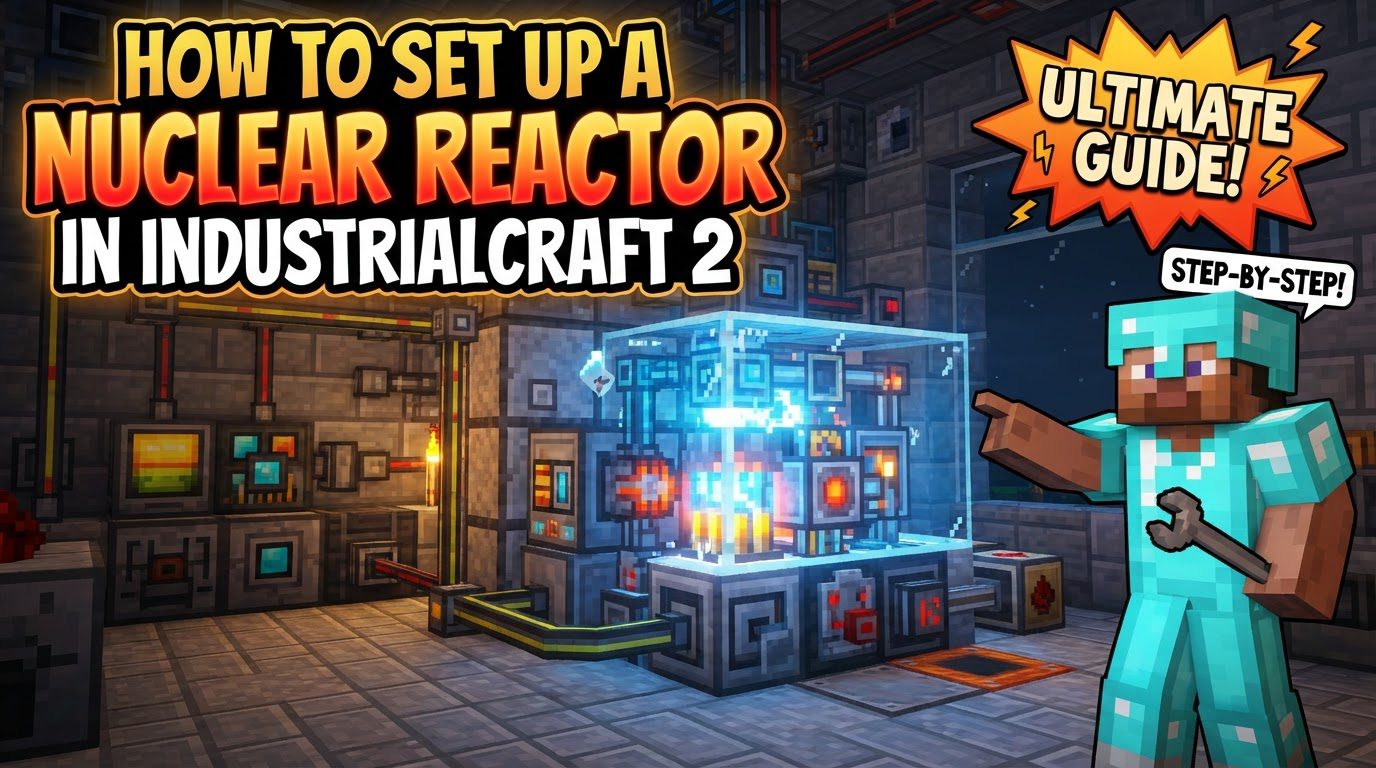
Setting up a Nuclear Reactor in IndustrialCraft 2 is an advanced undertaking that promises substantial energy generation but demands meticulous planning and constant vigilance. A reactor serves as a powerful source of Energy Units (EU) but also produces significant heat, which, if unmanaged, can lead to catastrophic explosions. Understanding its core mechanics and adhering to strict safety protocols are paramount for successful and stable operation.
Understanding Reactor Mechanics
IndustrialCraft 2 Nuclear Reactors are complex machines with specific operational principles that must be mastered for safe and efficient power generation.
- Energy Units (EU) and Heat: Nuclear reactors fundamentally generate Energy Units (EU) and heat. The core challenge is to manage this heat effectively while maximizing EU output.
- Heat Management: Heat must be effectively managed and dissipated. Failure to do so will cause the reactor to overheat and explode, leading to devastating consequences.
- Reactor Expansion: The reactor starts as a single block. Its internal inventory space, crucial for components, can be expanded by surrounding it with up to six Reactor Chambers. Each chamber adds valuable grid space.
- Fuel Rods: Fuel Rods, such as Uranium or MOX, are placed inside the reactor’s internal grid. They are the primary components that produce both heat and EU through nuclear fission.
- Neutron Pulses and Efficiency: Fuel Rods gain efficiency and produce more heat and EU when placed adjacent to other fuel rods. This is due to neutron pulses, which enhance the fission reaction.
- MOX Fuel Rods: MOX fuel rods offer increased efficiency, particularly when the reactor operates at higher temperatures. They are designed to become more potent as heat levels rise.
- Heat Vents and Heat Exchangers: These are essential internal components for cooling. Heat Vents dissipate heat, while Heat Exchangers are used for moving heat between different parts of the reactor’s internal grid.
- Coolant Systems: Coolant Cells directly absorb heat within the reactor grid. For more advanced cooling, Fluid Reactors use IC2 Coolant, which is circulated externally via Liquid Heat Exchangers.
- Redstone Activation: A redstone signal is a prerequisite to turn the reactor on, initiating the energy generation process. This provides a simple control mechanism.
- EU Extraction: Generated EU is not stored internally within the reactor. It must be immediately extracted using cables connected to external energy storage devices to prevent it from being wasted.
- Operational Modes: Reactors can operate in “EU MODE” for direct EU generation, or in “HEATING MODE,” where their primary function is to produce hot coolant for external EU generation systems.
Step-by-Step Reactor Setup Guide
Follow these sequential steps to construct and activate your IndustrialCraft 2 Nuclear Reactor safely and effectively.
- 1. Craft Reactor Components: Begin by crafting the central Nuclear Reactor block and several Reactor Chambers. The chambers are vital for expanding the reactor’s internal capacity.
- 2. Place and Expand: Place the main Nuclear Reactor block. Then, surround it with up to six Reactor Chambers. These chambers will automatically connect and expand the internal grid available for components.
- 3. Wear Radiation Protection: Always wear a Hazmat Suit or equivalent radiation protection. This is crucial when handling radioactive items like fuel rods and when working in the vicinity of the reactor to prevent radiation sickness.
- 4. Access Reactor GUI: Right-click the central Nuclear Reactor block to open its graphical user interface (GUI). This interface displays the internal grid where all operational components are placed.
- 5. Insert Fuel Rods and Cooling: Carefully insert Fuel Rods (Uranium or MOX) and various cooling components (e.g., Heat Vents, Heat Exchangers, Coolant Cells) into the internal grid. This placement must follow a pre-tested and optimized design.
- 6. Connect Energy Conduits: Connect appropriate energy conduits, such as Glass Fibre Cable for high voltage, to the reactor block. These cables will transfer the generated EU to your energy storage units. Remember, EU is not stored in the reactor itself.
- 7. Apply Redstone Signal: Provide a redstone signal to the reactor block to activate it. This can be done with a lever, redstone torch, or switch, initiating the fission process and energy generation.
- 8. Monitor Continuously: Once activated, continuously monitor the reactor’s heat levels through its GUI. For fluid reactors, ensure a consistent coolant supply and proper circulation via Liquid Heat Exchangers to prevent overheating.
Important Tips for Reactor Operation
Successful and safe reactor operation relies on careful planning and adherence to these best practices.
- Utilize an Online Reactor Planner: Always use an online reactor planner, such as TalonFiremage’s IC2 Reactor Planner. This allows you to safely design and test various reactor layouts, predicting heat generation, EU output, and stability without risking in-game explosions or resource loss. This tool is indispensable.
- Prioritize Safety and Radiation Protection: Never compromise on safety. Always wear a Hazmat Suit when dealing with radioactive materials or working near an active reactor. Design your reactor area with safety and containment in mind.
- Design for Heat Stability: Strive for a heat-neutral or, ideally, heat-deficit state in your reactor design. This means the reactor either dissipates exactly as much heat as it generates or more, ensuring stable, long-term operation and preventing meltdowns.
- Consider MOX Fuel: For higher energy output, consider using MOX fuel. MOX fuel rods become significantly more efficient at higher reactor temperatures, but this necessitates an even more robust and carefully managed cooling system. It is best utilized in a pre-heated reactor.
- Use Neutron Reflectors: Incorporate Neutron Reflectors to significantly boost the EU output from adjacent fuel rods. These components reflect neutrons back into the fuel, increasing fission rates. Be aware that Neutron Reflectors have limited durability and will wear out, requiring periodic replacement.
- Match Cable Voltage Levels: It is crucial to match the voltage levels of your energy cables to your reactor’s output and the input capacity of connected machines. Connecting high-voltage output to low-voltage cables or machines will cause those components to explode, leading to damage and resource loss.
- Robust Fluid Reactor Cooling: If operating a Fluid Reactor, ensure an exceptionally robust external cooling system. This involves Liquid Heat Exchangers and proper coolant circulation to maintain a consistent flow of IC2 Coolant. Any interruption can quickly lead to an uncontrolled heat buildup.
- Implement Easy Control: For immediate control over reactor activation and deactivation, connect a simple lever or redstone switch directly to the reactor block. This allows for quick shutdowns in emergencies or for routine maintenance.
Common Mistakes to Avoid
Preventing these common errors is paramount for safe reactor operation and to avoid catastrophic failures.
- Insufficient Cooling: This is the most frequent and primary cause of reactor explosions. Always ensure your design provides adequate heat dissipation for the generated power.
- Forgetting Radiation Protection: Neglecting to wear a Hazmat Suit or equivalent protection will lead to radiation sickness, debilitating effects, and ultimately, player death.
- Not Connecting EU Output: If generated EU has no path to storage, it is simply wasted. Ensure cables are properly connected to energy storage units.
- Placing Reactors Near Flammable Blocks: An overheating reactor can cause fires in adjacent flammable blocks. Build your reactor in a fire-resistant environment to contain potential incidents.
- Neglecting Fluid Reactor Coolant Flow: For fluid-based reactors, running out of IC2 Coolant or allowing the hot coolant buffer to become full without proper external heat exchange will inevitably lead to a meltdown. Maintain constant circulation.
- Incorrect Component Placement: Even with a good design, incorrect placement of fuel rods or cooling components in the reactor grid can lead to severe inefficiencies or catastrophic localized overheating.
- Overloading Electrical Components: Connecting the reactor’s high-voltage output to cables or machines rated for lower voltages will cause those components to explode. Match voltage tiers carefully.
- Overly Ambitious Designs Without Proper Testing: Attempting to maximize power output without first thoroughly testing the design in a planner or with a stable in-game prototype is extremely risky and often leads to explosions.
- Lack of Containment: While stable designs are safe, an explosion is devastating. Consider building your reactor within reinforced casing (e.g., reinforced stone) to mitigate damage in the event of an unforeseen meltdown.
Tags:
YOU MAY ALSO LIKE...