Detecting Reach Hacks in PvP
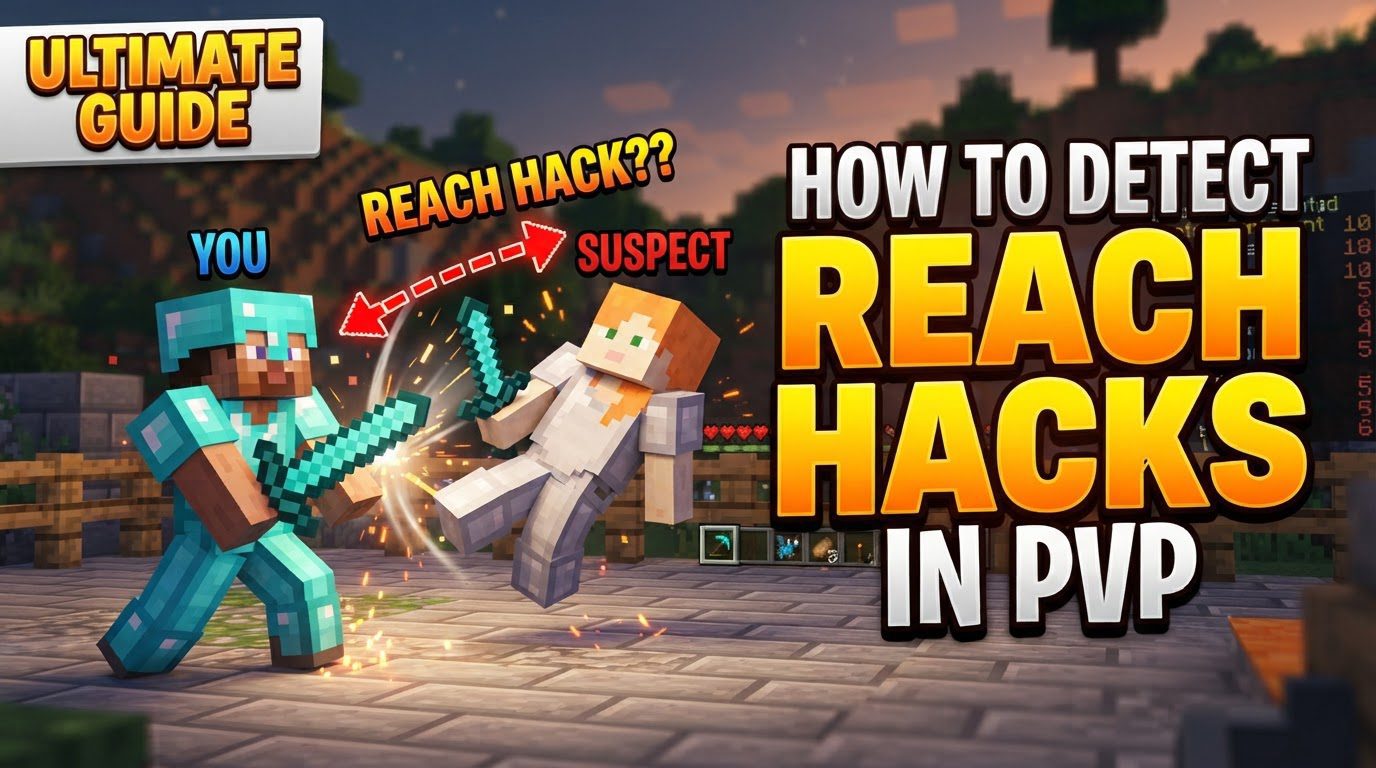
To effectively detect “reach hacks” in Minecraft PvP, a thorough understanding of the game’s intrinsic mechanics and meticulous observation of player behavior are paramount. Reach hacks represent a significant unfair advantage, allowing players to strike opponents from distances that far exceed the legitimate in-game boundaries, thereby disrupting fair play and the competitive balance of combat.
Understanding the Core Mechanics of Reach
-
Normal Reach Parameters: Within the vanilla Minecraft environment, a player’s standard maximum attack distance is established at approximately 3 blocks. This serves as the foundational benchmark for all legitimate combat interactions and is the distance against which all suspicious hits should be measured. This 3-block range dictates how close a player must generally be to successfully land a hit on an opponent.
-
Server-Side vs. Client-Side Dynamics and Hack Exploitation: While a player’s client-side perception of reach is generally limited to around 3 blocks, the server-side mechanics for hit registration can be more lenient and complex. Certain sources indicate that the server’s internal limit for registering a hit can extend up to 6 blocks. This significant discrepancy between client-side visual representation and server-side processing is precisely what hacked clients exploit. These malicious programs are designed to transmit attack packets to the server even when the player’s physical position, as seen by their own client and other legitimate clients, is well beyond the legitimate 3-block client-side range. More advanced and sophisticated forms of these hacks, often termed “teleport reach,” operate by rapidly moving the player’s hitbox to the target’s location, registering a hit, and then instantly returning the player to their original position. This entire sequence is often executed within a single game tick, making the resulting hit appear to originate from an impossibly long distance from the observer’s perspective, effectively bypassing standard reach limitations by manipulating server-side player positions momentarily.
-
Implicit Hitbox Expansion: Minecraft’s design incorporates a subtle mechanism to account for network latency and ensure a smoother gameplay experience, particularly in PvP. This involves an implicit expansion of hitboxes by approximately 0.1 blocks on each side. This minor, automatic expansion can, in turn, slightly extend the range at which a legitimate hit can be registered, adding a small margin beyond the strict 3-block visual limit. Consequently, a legitimate hit might occasionally occur slightly beyond 3 blocks, up to around 3.2 blocks, due to this server-side adjustment.
-
Factors Influencing Perceived Reach: Several legitimate game elements can significantly influence how far hits appear to land, potentially complicating the accurate detection of reach hacks. These factors include a player’s ping or network latency, the game’s movement interpolation algorithms, and differences in vertical position (Y-level) between combatants. For instance, a high ping can introduce a delay between a player’s action and the server’s response, causing the visual feedback of a hit to appear as though it occurred from a greater distance than it actually did server-side. Similarly, movement interpolation can smooth out player movements, but may also slightly desynchronize client-side visuals from server-side reality. Differences in Y-level can also affect how hit registration is perceived, as the straight-line distance might be longer than the horizontal distance.
A Step-by-Step Approach to Detecting Reach Hacks
-
Visual Observation: The initial and most fundamental step in identifying a potential reach hack involves keen visual observation during gameplay. Pay close attention to players who consistently manage to strike you or other combatants from a distance that seems unusually far. This initial “gut feeling” of abnormal distance, where hits register when an opponent appears out of range, is often the first indicator that something is amiss and warrants further investigation.
-
Record Gameplay Evidence: Capturing video evidence of suspicious activity is an absolutely crucial step for concrete detection and reporting. Recording gameplay provides an objective and reviewable account of events, allowing for slow-motion analysis and precise measurement. This footage is invaluable for detailed review and serves as the primary form of proof when reporting suspected hackers to server administrators or anti-cheat teams.
-
Analyze Distance During Playback: When reviewing recorded footage, meticulously analyze the distance between the attacker and their target at the precise moment of impact. Utilize the frames leading up to and including the hit registration. Focus on moments where a hit clearly registers. Consistent hits that occur from a distance exceeding 4 blocks are a very strong and reliable indicator that a reach hack is in use. This 4-block threshold provides a comfortable buffer beyond the legitimate 3-3.4 block range, making it a robust signal for suspicious activity that minimizes false positives.
-
Consider the Broader Context: It is vital to evaluate the suspicious player’s overall movement patterns, their positioning relative to others, and their reported ping. High network latency (ping) can genuinely create the illusion of extended reach, as the client-side visual representation of player positions might lag behind the server’s true state, making legitimate hits appear further away. Distinguishing between lag-induced visual anomalies and genuine hacking requires careful contextual analysis, looking for patterns that persist regardless of apparent latency spikes.
-
Leverage Anti-Cheat Systems: On servers equipped with anti-cheat plugins, these systems play a critical role in automated detection. Anti-cheat plugins are designed to actively monitor the precise hit distances between players by measuring the distance from the attacker’s eye level to the target’s hitbox at the moment of impact. Hits that exceed a predefined maximum distance, typically set around 3.1 blocks to account for minor legitimate variances, are automatically flagged by these systems for further review or immediate action. These systems provide an objective, server-side verification of suspicious hit distances, complementing manual observation.
Important Tips for Accurate Detection
-
Utilize Third-Person Perspective for Review: When spectating a player in-game or, more effectively, when reviewing recorded gameplay footage, switching to a third-person perspective offers a significantly more accurate assessment of distances. This view minimizes the misleading effects that can arise from lag, movement interpolation, and the inherent limitations of a first-person viewpoint, providing a clearer picture of the actual spatial relationship between players at the moment of impact.
-
Search for Consistency in Abnormalities: While legitimate players might occasionally land a hit slightly beyond the typical 3-block range due to minor server-client synchronization quirks or network fluctuations, a player utilizing a reach hack will exhibit a distinct and consistent pattern. Look for individuals who frequently and reliably manage to strike opponents from distances that are clearly abnormal and beyond the established legitimate limits. This consistent pattern of hitting from extended range is a hallmark of a hack, differentiating it from an occasional, legitimate anomaly.
-
Be Aware of Player Ping: The network latency (ping) of a player is a crucial factor in assessing suspicion. A player who consistently maintains a low ping yet is observed achieving extended reach is far more suspicious than a player experiencing high ping, who might legitimately encounter occasional lag-induced “phantom hits” that appear to originate from further away than they truly did server-side. Lower ping reduces the likelihood of legitimate network-related visual distortions, making abnormal hits more indicative of foul play.
-
Optimizing Your Own Legitimate Reach: To maximize your own legitimate attack range within the game’s mechanics, aim precisely at the center of your opponent’s hitbox for optimal hit registration. Furthermore, striving to keep your “reach vector” – the imaginary line extending from your head to your target – as parallel to the ground as possible can help ensure optimal hit registration within the legitimate limits. Understanding these legitimate techniques helps you differentiate your own optimized, fair hits from suspicious ones executed by others.
Common Mistakes to Avoid When Identifying Reach Hacks
-
Ignoring the Impact of Latency: One of the most prevalent errors in reach hack detection is mistaking hits from players experiencing significant lag for genuine reach hacks. High ping can cause legitimate hits to register from what visually appears to be a greater distance due to the delay in client-side updates and server-client desynchronization. It is crucial to consider a player’s latency and look for consistent patterns rather than isolated incidents before making an accusation.
-
Misinterpreting Advanced PvP Techniques: Certain advanced PvP maneuvers, such as “w-tapping” or “blockhitting,” are legitimate techniques designed to optimize hit registration, manage knockback, and maintain combat advantage. These techniques can sometimes create the impression of extended reach due to their effect on player positioning, movement, and timing, but they are not hacks. It’s important to distinguish between skillful, optimized legitimate play and illicit advantages provided by cheats.
-
Over-reliance on First-Person Perspective: Attempting to judge reach solely from a first-person recording or gameplay perspective can be highly deceptive. Network delays, the dynamic nature of combat, and the limited field of view inherent in first-person can easily distort perceived distances. As previously mentioned, third-person views offer a much more accurate assessment by providing a broader, more objective spatial context.
-
Setting Unrealistic Anti-Cheat Thresholds: For server administrators configuring anti-cheat systems, setting the maximum allowed reach threshold too strictly (e.g., precisely at 3 blocks) is a common pitfall. Due to Minecraft’s inherent hitbox mechanics, the implicit hitbox expansion of 0.1 blocks, and minor variances in game physics and latency compensation, legitimate hits can occasionally register up to approximately 3.4 blocks. An overly strict threshold will lead to an excessive number of false positives, unfairly flagging legitimate players and undermining the anti-cheat’s credibility.
-
Confusing Reach with Kill Aura: While some “Kill Aura” hacks may incorporate extended reach functionality, Kill Aura is a broader category of cheat. It is typically characterized by rapid, automatic attacks that target multiple entities simultaneously, often without the player needing to aim directly or even face their opponents. Reach hacks, in contrast, specifically focus on extending the attack distance, allowing a player to hit a single target from further away, even if they are still manually aiming. It is important to understand this distinction to accurately categorize the type of hack being observed and ensure appropriate counter-measures.