Dodging an Arrow Using Strafing Techniques (Step by Step)
In the dynamic and often perilous world of Minecraft, mastering movement is paramount for survival and success, especially when facing ranged threats. Among the most fundamental yet powerful defensive techniques is strafing, a skill that allows players to effectively dodge incoming projectiles, particularly arrows. This guide delves into the core mechanics, step-by-step execution, crucial tips, and common pitfalls associated with using strafing to evade arrows, transforming you from a stationary target into an unpredictable, evasive force.
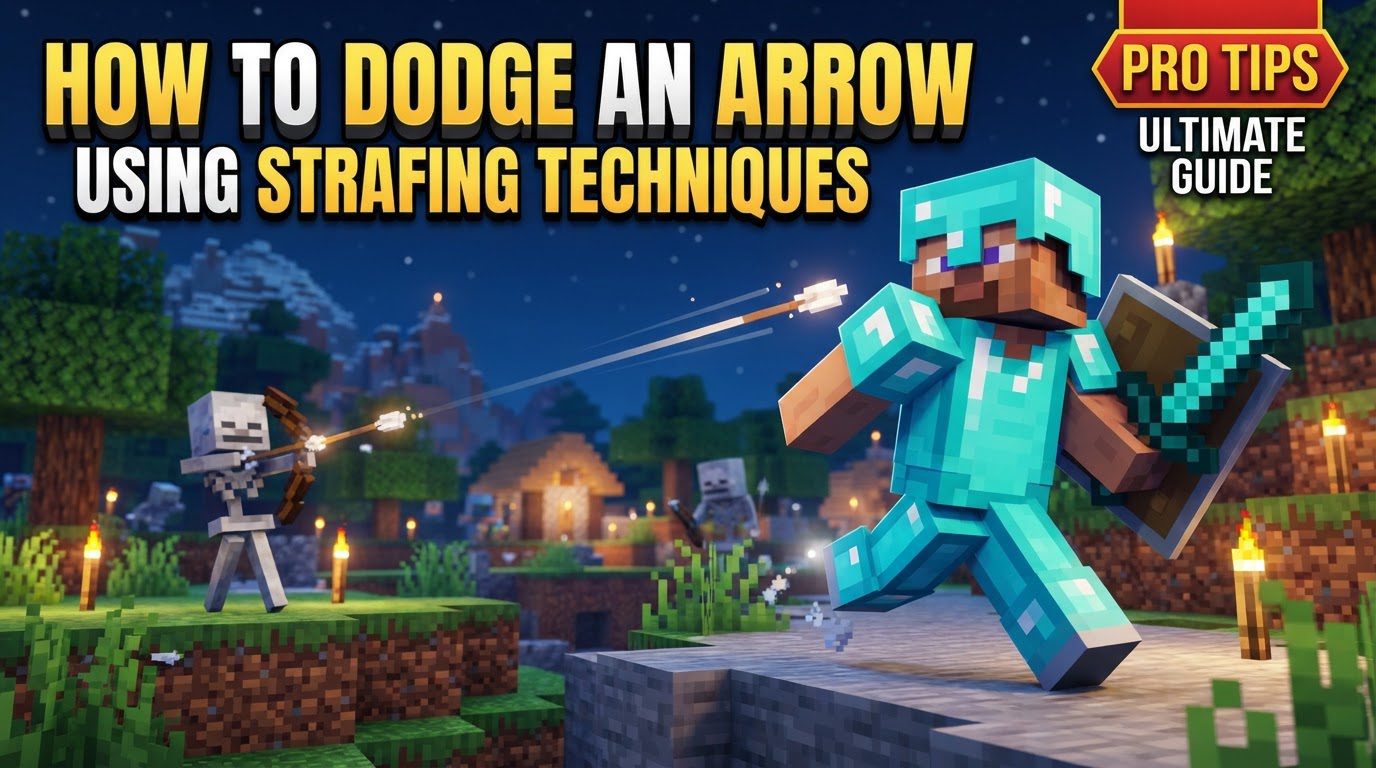
Key Mechanics of Strafing for Arrow Evasion
Strafing is more than just mindless sidestepping; it’s a calculated dance designed to disrupt an opponent’s aim. At its heart, strafing involves moving laterally, typically using the A (move left) and D (move right) keys, to make your character a moving target. This simple act significantly complicates an archer’s task of predicting your movement and leading their shots.
- Lateral Movement with A and D: The primary action of strafing is shifting your character’s position horizontally. By constantly pressing ‘A’ and ‘D’ in short, irregular bursts, you create a path that is difficult for an enemy to anticipate.
- Crucial Timing: The effectiveness of strafing hinges on timing. It’s not just about moving, but about moving at the precise moment an arrow is about to make contact. A quick jolt to the side just as the projectile is closing in can cause it to fly past your character’s original trajectory, resulting in a clean miss. This requires keen observation and quick reflexes.
- Sprinting for Enhanced Evasion: Incorporating sprinting into your strafing routine can dramatically increase your evasiveness. When you sprint while strafing, your character’s speed and momentum change, making your movement even more erratic. Skeletons, for instance, are often programmed to lead their shots based on a player’s perceived trajectory. Sprinting while strafing can sometimes cause these creatures to completely miss their intended target, as their AI struggles to adapt to the sudden shifts in your speed and direction.
- Unpredictable Movement Patterns: The true power of strafing lies in its unpredictability. Simple, rhythmic left-right movements can eventually be anticipated by skilled opponents. To truly become an elusive target, you must vary your patterns. This could involve short, sharp bursts in one direction, followed by a longer sprint in the opposite, or even mixing in diagonal movements. The goal is to avoid establishing any discernible pattern that an opponent can exploit.
- Broader Projectile and PvP Applications: While this guide focuses on arrows, the principles of strafing extend to dodging almost any projectile in Minecraft, from Ghast fireballs to Blaze fire charges. Furthermore, in player-versus-player (PvP) combat, effective strafing is not just defensive; it’s an offensive tool. By constantly moving and disorienting your enemy, you can create openings for your own attacks, making it easier to land hits and secure combat combos while simultaneously avoiding theirs.
- Wynncraft’s “walkingAngleVariation” Insight: Even in niche scenarios like the Minecraft MMORPG Wynncraft, enemy AI can exhibit “walkingAngleVariation.” This means certain enemies might face slightly away from you, influencing the precise direction of their spells. Understanding this principle, even if specific to an MMORPG, highlights how precise enemy aiming can be affected by your position and movement, making specific strafing directions more effective for dodging. It underscores the idea that even subtle shifts in an enemy’s targeting can be exploited by a well-timed strafe.
Step-by-Step Process for Dodging Arrows
Effective arrow dodging is a skill that can be broken down into a series of observable actions and reactions. By following a structured approach, you can systematically improve your ability to evade ranged threats.
- Observe and Predict: The first and most critical step is to develop an acute awareness of your surroundings and your opponent. Pay close attention to visual cues:
- Is your opponent drawing their bow?
- What is their current facing direction?
- Where is the arrow originating from?
By observing these elements, you can begin to anticipate when and where an opponent will shoot an arrow, giving you a crucial fraction of a second to react. Predicting the trajectory is key to knowing which way to move.
- Time Your Movement: Once you anticipate an arrow, the timing of your dodge is paramount. The optimal moment to move is just before the arrow is about to hit your character. This small window requires precise reflexes. Moving too early might allow the archer to adjust their aim, while moving too late will result in a hit. A sharp, decisive movement in one direction is often more effective than a prolonged, slow slide.
- Vary Movement: To truly confound your opponents, move beyond simple left-right strafing. Incorporate a diverse range of movements:
- Diagonal Strafes: By holding ‘W’ (forward) and ‘A’ (left), or ‘W’ and ‘D’ (right), you move diagonally, adding another layer of unpredictability.
- Backward Strafes: Briefly holding ‘S’ (backward) can create unexpected distance or change your angle of approach.
- Quick Changes in Direction: Instead of continuous movement in one direction, execute sudden, sharp changes. A quick burst left, then an immediate burst right, can throw off an opponent’s aim significantly.
The goal is to avoid creating any rhythm or pattern that your opponent can learn and exploit.
- Sprint and Jump (Optional): For an even more erratic movement pattern, combine strafing with sprinting and jumping. Sprinting increases your lateral speed, making you harder to track. Jumping adds a vertical component to your movement, which can sometimes cause arrows aimed at your body to fly underneath you. However, this technique comes with a caveat: jumping at the wrong time, especially in close quarters, can make you an easier target for melee combos, as your movement becomes predictable during the jump’s apex and descent. Use this combination judiciously and in appropriate situations.
- Maintain Distance: Keeping a slight to moderate distance from your opponent offers several advantages. It provides more time for you to react to incoming arrows, as the projectile has further to travel. This extra travel time translates into a larger window for observation and timing your dodge. Additionally, maintaining distance can help you with your own aiming, allowing you to line up shots without being overwhelmed by immediate threats.
Important Tips for Effective Dodging
Beyond the fundamental mechanics, several strategic tips can significantly enhance your arrow-dodging capabilities and overall combat effectiveness.
- Be Unpredictable: This cannot be stressed enough. A predictable player is an easy target. Constantly change your strafing patterns, speed, and direction. Avoid falling into a repetitive rhythm. The more varied your movement, the harder it is for an opponent to lead their shots accurately.
- Balance Aiming and Strafing: While dodging is crucial, you must also be able to retaliate. Find a balance where you can effectively evade incoming arrows while still maintaining your ability to aim and land your own hits. This often means learning to make small, precise movements with your mouse for aiming while your left hand handles the more pronounced strafing movements. Over-strafing to the point where you can’t hit your target makes you a less effective combatant.
- Practice: Like any skill, improving arrow dodging requires consistent practice. Spend time in PvP arenas, fight skeletons, or even set up custom scenarios to hone your reflexes and timing. The more you practice, the more intuitive and fluid your movements will become. Muscle memory and quick reaction times are developed through repetition.
- Utilize Terrain: The environment is your ally. Use natural cover such as trees, rocks, hills, or player-built structures to block incoming arrows. Peeking around corners or using elevated positions can give you a tactical advantage, allowing you to take shots while minimizing your exposure to enemy fire. Do not underestimate the power of a simple block to save you from a critical shot.
- Head Spin: A more advanced technique, the “head spin,” involves quickly rotating your character’s view (a quick 360-degree turn) without altering your movement direction. While your character’s hitbox generally remains consistent, this rapid camera movement can sometimes disorient opponents, especially in PvP, by making it harder for them to track your exact head position for headshots or to predict your next move based on your gaze. It’s a psychological tactic as much as a physical one.
- “Smudge Dodge”: This specific technique involves staying relatively in place, then performing a quick jump followed immediately by a sharp strafe as an arrow approaches. The jump briefly alters your vertical position, and the subsequent strafe quickly moves you horizontally. It’s a compact, rapid evasion that can be effective in situations where you don’t have much room to maneuver or need a very sudden, localized dodge.
- Shields: While this guide focuses on strafing, it’s important to acknowledge the utility of shields. Shields offer direct protection by blocking arrows entirely. However, be aware of their limitations: crossbows enchanted with “Piercing” can bypass shields, rendering them ineffective against such projectiles. Therefore, even with a shield, strafing remains a critical skill for avoiding piercing shots or when your shield is on cooldown/unavailable.
Common Mistakes to Avoid
Even experienced players can fall into bad habits. Being aware of these common mistakes will help you refine your dodging technique.
- Predictable Strafing: The most significant error is moving in easily anticipated patterns. If you consistently move left-right-left-right in a rhythmic fashion, your opponent will quickly learn to lead their shots, turning your attempted dodge into a guaranteed hit. Always strive for irregularity.
- Standing Still: This is the cardinal sin of ranged combat. Remaining stationary makes you an incredibly easy target for any archer. Every arrow fired at a static player is almost guaranteed to hit. Always be moving, even if it’s just subtle shifts.
- Not Utilizing Movement Keys: Relying solely on holding ‘W’ (forward) and neglecting the ‘A’ and ‘D’ keys for lateral movement is a common oversight. Forward movement alone does not provide the evasiveness needed to dodge arrows effectively. Incorporate all movement keys into your defensive strategy.
- Imbalance between Strafing and Aiming: If you are so focused on dodging that you can’t land any hits on your opponent, you become a frustrating, but ultimately ineffective, combatant. Your goal is to defeat your opponent, not just survive indefinitely. Find the sweet spot where you can both evade and attack.
- Jumping at the Wrong Time: While jumping can be part of an erratic movement pattern, jumping when too close to an enemy, especially in PvP, can make you susceptible to melee combos. During the apex and descent of a jump, your movement becomes highly predictable, allowing skilled opponents to easily track and hit you. Use jumping strategically and be mindful of your proximity to enemies.
Tags:
YOU MAY ALSO LIKE...