

Reducing Fall Damage Using Scaffolding, Explained
In the vast and often perilous world of Minecraft, gravity is an ever-present force, and fall damage remains one of the most common and frustrating ways to meet an untimely end. Whether you’re exploring treacherous ravines, descending into deep caves, or simply misjudging a jump from your colossal build, the sudden impact can deplete your health bar or even lead to instant defeat. Fortunately, the game offers an ingenious, yet often underutilized, solution to this age-old problem: scaffolding. This guide will delve into the mechanics of how scaffolding can be your ultimate safeguard against fall damage, allowing you to plummet from great heights with complete impunity, provided you know the trick.
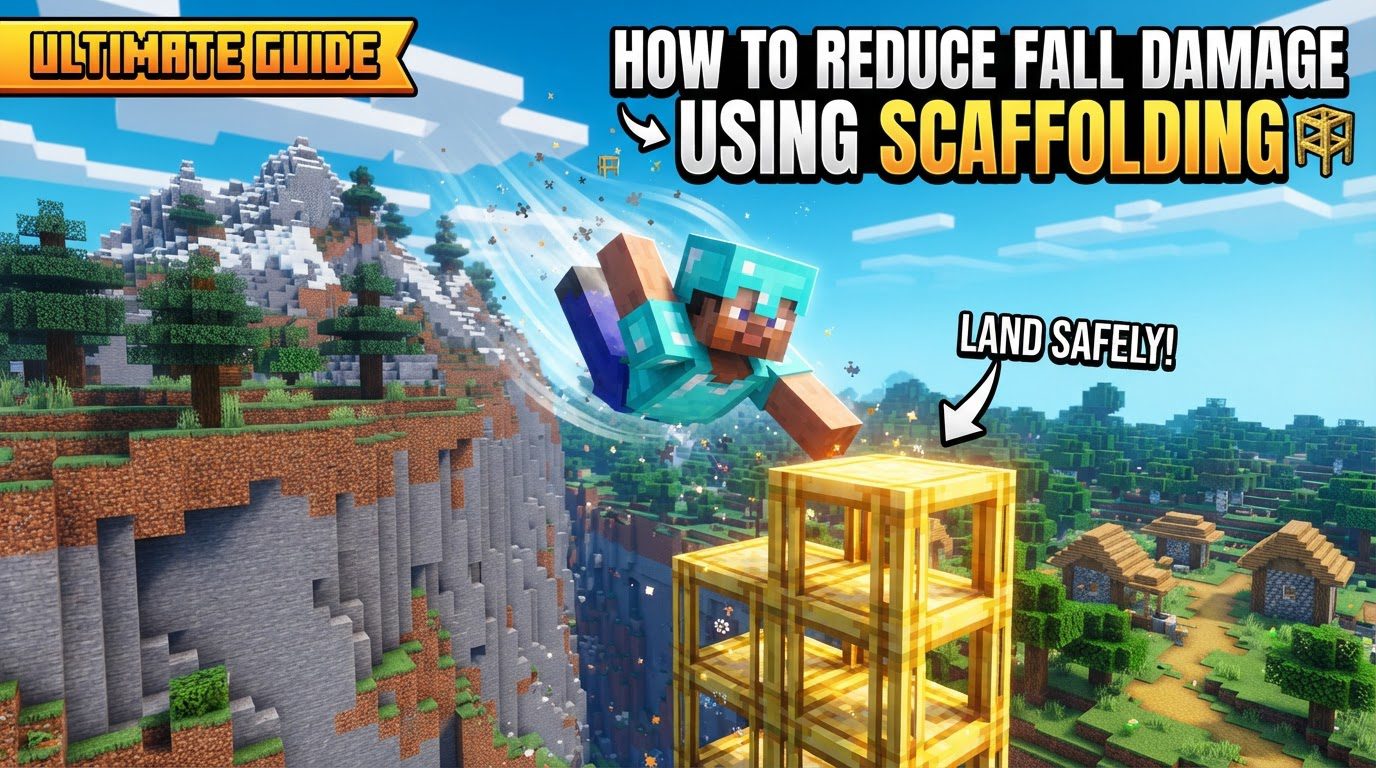
Understanding the Core Mechanism of Scaffolding for Fall Damage Reduction
Scaffolding isn’t just a simple block for vertical construction; it possesses a unique property that fundamentally alters how the game processes player interactions during a fall. This core mechanic is what makes it an unparalleled tool for fall damage prevention.
-
Scaffolding interacts with player movement to negate fall damage. Unlike solid blocks that register an impact upon landing, scaffolding’s permeable nature allows for a different kind of interaction. When a player falls onto scaffolding under specific conditions, the game’s physics engine doesn’t calculate a sudden stop and subsequent damage. Instead, it interprets the player’s state in a way that bypasses the fall damage calculation entirely.
-
When falling onto scaffolding while holding the crouch (shift) key, the game registers it as if you are climbing down, canceling all fall damage. This is the crucial trick. By holding down the crouch key, you essentially tell the game that you are attempting to descend gracefully through the scaffolding rather than impacting it. This subtle action completely overrides the fall damage mechanism, allowing you to pass through the block safely. It’s as if you’re not falling at all, but merely navigating a vertical shaft, even if you just dropped hundreds of blocks.
-
The height from which fall damage is prevented is dependent on the number of scaffolding blocks in a vertical stack. While the core mechanic involves a single block, the effectiveness of scaffolding in preventing damage from truly extreme heights is enhanced by stacking multiple blocks. This isn’t because you need more blocks to absorb impact, but rather because the game’s internal calculations for preventing fall damage when interacting with scaffolding scale with the height of the scaffolding structure itself. More blocks in the stack allow the game to register safe passage from proportionally greater distances.
Mastering the Scaffolding Landing Technique: A Step-by-Step Guide
Implementing this technique is surprisingly straightforward, requiring only a few precise actions. Once you understand the process, you’ll be able to confidently leap from any height without fear.
-
Place scaffolding: Set up at least one scaffolding block at your intended landing spot. Before embarking on your daring descent, ensure your landing zone is prepared. This involves placing at least one scaffolding block precisely where you intend to land. This block will act as your safety net. You can place it directly on the ground or on top of any solid block, offering flexibility in your setup.
-
Align and fall: Position yourself to land directly on the scaffolding. Precision is key here. You need to ensure that your character’s hitbox will intersect with the scaffolding block as you fall. While scaffolding has a forgiving hitbox, aiming for the center of the block is always recommended for maximum reliability. Once aligned, simply initiate your fall.
-
Crouch: Hold down the crouch (shift) key just before or as you land on the scaffolding. This is the most critical step. As you approach the scaffolding block, press and hold your crouch key (typically ‘Shift’ on PC). It’s best to hold it down slightly before you expect to make contact, giving the game ample time to register your crouched state. Maintaining the crouch through the moment of impact is what triggers the fall damage cancellation. You will pass through the scaffolding block as if it were air, landing safely on the block beneath it (or continuing to fall if there’s no block underneath, but critically, without taking any damage from the initial impact with the scaffolding).
Optimizing Your Scaffolding Setups: Essential Tips and Height Thresholds
While a single block of scaffolding can perform miracles, understanding its scaling capabilities allows for even greater confidence when dealing with truly extreme vertical distances.
-
A single block of scaffolding can prevent fall damage from a 30-block drop. This is an excellent baseline. For most common scenarios in Minecraft, such as falling into a deep cave, jumping from a modest tower, or descending into a ravine, a single scaffolding block is more than sufficient. This makes it incredibly resource-efficient for everyday use.
-
A two-block high scaffolding tower can prevent fall damage from up to 123 blocks. Doubling your scaffolding stack yields a significant increase in fall protection. This two-block setup is ideal for larger structures, very deep mines, or even falls from the tops of mountains. It provides a robust safety margin for many mid-to-high-level vertical challenges.
-
A three-block high scaffolding tower can prevent fall damage from up to 252 blocks, effectively from build height to bedrock. This is where scaffolding truly shines as an endgame solution. A three-block tower provides protection from virtually any fall within the standard Minecraft world boundaries, from the absolute build height limit (Y=320 in modern versions) all the way down to bedrock (Y=0). This makes it the go-to setup for ambitious sky-bases, massive excavation projects, or rapid descent into the deepest parts of the world.
-
A four-block high scaffolding tower can prevent fall damage from virtually any height, even 10,000 blocks up. For those exploring custom maps, modded worlds with expanded height limits, or simply wishing for absolute peace of mind, a four-block scaffolding tower offers unparalleled protection. The game’s mechanics allow this setup to mitigate fall damage from heights far exceeding the standard build limit, making it a universal solution for any vertical challenge imaginable.
-
Scaffolding can be placed on top of a solid block, and multiple blocks can be stacked without climbing. This tip highlights the ease of deployment. You don’t need a complex structure to set up your landing pad. Simply place a solid block, then stack your desired number of scaffolding blocks on top. The unique placement mechanics of scaffolding mean you can rapidly build a vertical stack by pointing at the top of the existing scaffolding block and placing another, without having to actually climb each block individually. This speeds up preparation significantly.
Common Pitfalls: Avoiding Mistakes When Using Scaffolding for Fall Damage
While the scaffolding fall damage trick is powerful, it’s not entirely foolproof. Awareness of potential missteps will ensure you always land safely.
-
Not crouching: Failing to crouch (hold shift) when landing on scaffolding will result in taking full fall damage, as you will hit it like a solid block. This is the most critical mistake. If you fall onto scaffolding without holding the crouch key, the game treats the scaffolding as a regular, solid block. Your fall will be abruptly halted, and all accumulated fall damage will be applied as if you had landed on stone or dirt. Always remember to hold that shift key!
-
Insufficient scaffolding for extreme heights: While effective, ensure you have enough scaffolding blocks in your tower if falling from very high distances, though a few blocks are often sufficient for most in-game falls. While the earlier tips provided specific height thresholds, it’s vital to match your scaffolding tower’s height to the magnitude of your fall. Attempting to fall from build height onto a single block of scaffolding, while sometimes successful, is less reliable than using the recommended three-block tower. For falls exceeding 30 blocks, consider at least two blocks, and for anything near the world’s vertical limits, opt for three or four blocks to guarantee safety. Underestimating the required stack height can lead to unexpected and damaging impacts.
By understanding these mechanics and diligently following the steps, scaffolding transforms from a simple building aid into an indispensable tool for safe vertical travel in Minecraft. Integrate this technique into your gameplay, and you’ll unlock unprecedented freedom and efficiency in exploration and construction, making dangerous falls a relic of the past.
Tags:
YOU MAY ALSO LIKE...


