

Why Does a Breeze Shoot Wind Charges Through Blocks
A common misconception about the Minecraft Breeze is that its powerful Wind Charges can literally phase through solid blocks, impacting targets on the other side as if the barrier didn’t exist. This perception often leads to confusion and frustration for players encountering this agile mob in the Trial Chambers. However, the reality behind this seemingly magical ability is rooted in a clever combination of Minecraft’s projectile and area-of-effect (AoE) mechanics, creating an illusion of permeation rather than actual penetration.
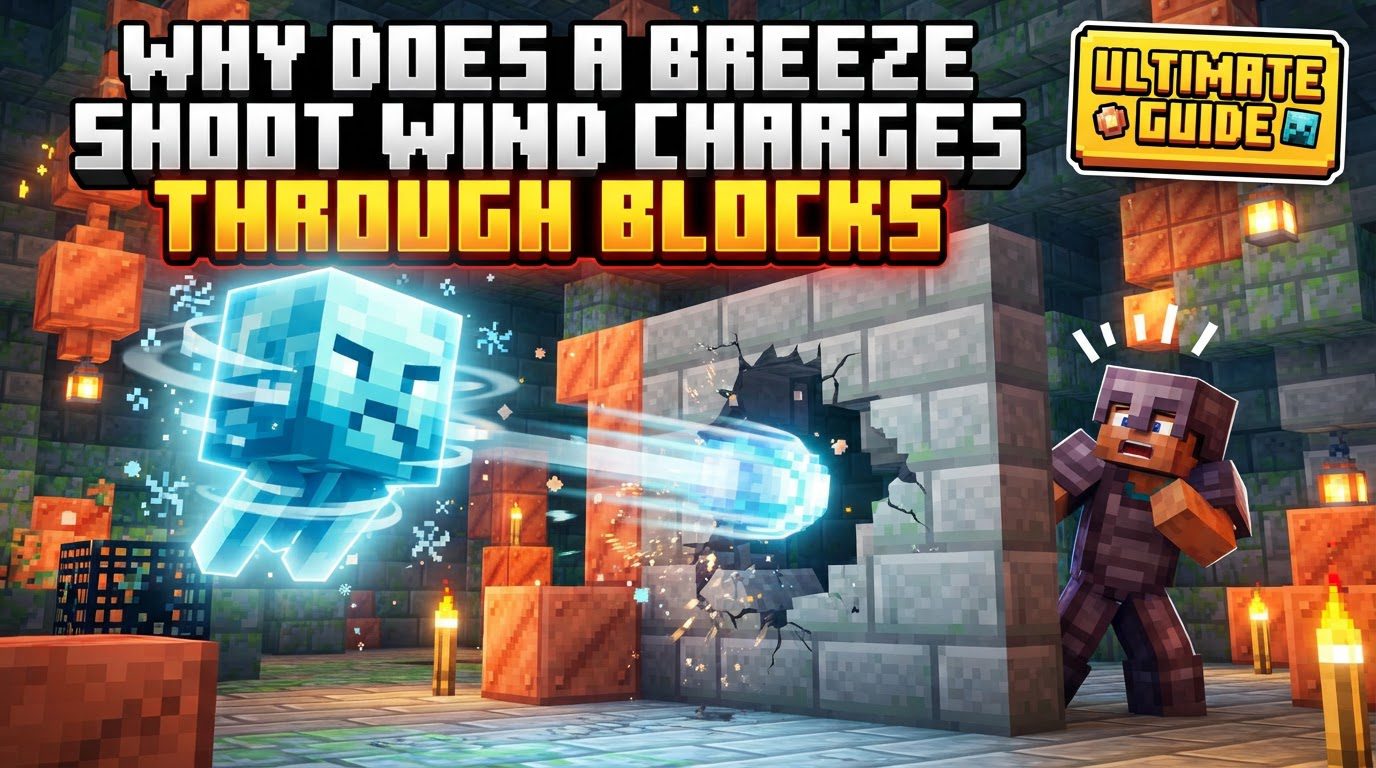
The Breeze, a hostile mob introduced in recent updates, is known for its distinctive movement patterns and its primary attack: launching Wind Charges. These projectiles are not designed to ignore solid matter. Instead, they are engineered to detonate upon contact with any block or entity, releasing a localized burst of wind. It is this subsequent wind burst, with its unique area-of-effect properties, that allows for interactions with elements positioned just beyond the initial impact point, effectively simulating an attack “through” walls.
The True Nature of Wind Charges: Detonation and Diffusion
Understanding how Wind Charges operate is key to debunking the myth of their block-penetrating capabilities. The core mechanics involved are straightforward yet powerful:
- Projectile Impact: When a Breeze fires a Wind Charge, it behaves like any other projectile in Minecraft – it travels in a straight line until it collides with something. Crucially, this “something” can be a solid block, another entity, or even the ground. Upon this collision, the Wind Charge does not vanish or pass through; it immediately “pops” or detonates.
- Area-of-Effect (AoE) Mechanics: The detonation of a Wind Charge generates a spherical “wind burst.” This burst has a defined radius, and anything within this radius can be affected, regardless of whether a thin layer of blocks separates it from the exact point of impact. Think of it like a small explosion where the force radiates outwards; if a block is thin enough, the effect can still reach what’s on the other side. This is the primary reason why players perceive the charges as shooting through walls.
- Redstone Activation: One of the most noticeable and impactful manifestations of this AoE mechanic is its interaction with redstone components. If a Wind Charge detonates on one side of a block, and a redstone-interactive item (such as a button, lever, or bell) is on the other side, within the blast radius, that component will be activated. This includes pressing buttons, flipping levers, opening and closing non-iron doors and trapdoors, ringing bells, breaking decorated pots, and extinguishing candles. This particular interaction often catches players off guard, especially in the redstone-heavy environments of Trial Chambers.
- Knockback Effect: Beyond activating redstone, the wind burst also applies a significant knockback effect. Players and mobs caught within the AoE will be pushed away or even launched into the air. This knockback can occur even if a block separates the target from the direct point of impact. The primary danger of Wind Charges isn’t their direct damage (which is minimal) but this powerful knockback, which can send players flying into environmental hazards, causing fall damage, or pushing them into other dangerous situations.
Unpacking the Mechanism: A Step-by-Step Breakdown
To illustrate this process clearly, let’s trace the path and effect of a Wind Charge from the moment it’s fired to its “through-block” interaction:
- Target Acquisition: The Breeze identifies a target, typically a player or another mob, and prepares to launch an attack.
- Projectile Launch: A Wind Charge projectile is fired from the Breeze. It travels at a high speed in a direct line towards its intended target.
- Impact and Detonation: The Wind Charge encounters an obstacle, such as a wall or a floor block. Upon contact, the projectile does not pass through; instead, it immediately “pops” or detonates on the surface of that block.
- Wind Burst Expansion: From the point of detonation, a spherical wind burst rapidly expands outwards. This burst has a specific radius, and its effects are not impeded by the single block it detonated against.
- Indirect Interaction: If an interactive redstone component (like a button, lever, or bell) or an entity (player or mob) is located on the opposite side of the block where the charge detonated, and falls within the expanding radius of the wind burst, it will be affected. For a button, it will be pressed; for a player, they will experience knockback. This is the moment the “through-block” effect is observed.
This sequence demonstrates that the projectile itself is stopped by the block, but its subsequent AoE effect is what reaches through, affecting components or entities on the other side. It’s a matter of splash damage or indirect force rather than direct penetration.
Tactical Engagements: Mastering the Breeze’s Unique Attacks
Given the Breeze’s unique attack mechanics, players need to adapt their strategies when facing this formidable foe. Understanding how its Wind Charges truly work can turn a perceived disadvantage into a tactical opportunity:
- Deflecting Wind Charges: A crucial defensive and offensive maneuver is to deflect the Breeze’s own Wind Charges. By timing a melee attack (left-click by default) just as a Wind Charge is about to hit you, you can send the projectile flying back towards the Breeze. If it hits, it deals a significant amount of damage, turning its own weapon against it. This is an incredibly satisfying and effective way to fight.
- Melee Combat is Paramount: Unlike many other hostile mobs, the Breeze is largely immune to traditional ranged attacks. Arrows and other projectiles fired at a Breeze will be deflected, making bows and crossbows ineffective. Engaging in melee combat is almost always the most viable strategy. Focus on getting close and striking it directly while dodging or deflecting its charges.
- Maintaining Mobility: The Wind Charges’ powerful knockback is a primary threat. Being launched into the air can lead to severe fall damage, or worse, push you into lava, off a cliff, or into other groups of enemies. Constant movement, strafing, and being aware of your surroundings are vital to avoid being caught off guard by the knockback.
- Using the Environment (Carefully): While cover might seem like a good idea against a projectile-shooting mob, remember the AoE effect. A thin wall might protect you from direct impact, but a button on your side could still be activated, or you could still take knockback. However, using environmental features to corner a Breeze can limit its incredible agility, making it easier to land melee hits. Always be mindful of redstone components in Trial Chambers, as the Breeze can inadvertently activate traps.
Dispelling Common Misunderstandings
Several incorrect assumptions about the Breeze and its Wind Charges persist among players. Addressing these can help refine combat strategies and reduce frustration:
- The Myth of Phasing Projectiles: The most significant misunderstanding is believing that the Wind Charge projectile itself passes through solid blocks. As established, it detonates *on* the block, and its effects propagate. This distinction is important because it means very thick walls or multiple layers of blocks *will* prevent the AoE effect from reaching you, unlike if the projectile truly phased through.
- Ineffectiveness of Ranged Attacks: Many players initially attempt to fight the Breeze with bows or crossbows, assuming it behaves like other ranged mobs. This is a common and costly mistake, as the Breeze’s immunity to projectile damage and its ability to deflect them renders such attacks useless. Prioritize melee weapons.
- Underestimating Knockback: Players often focus on the minimal direct damage of Wind Charges and underestimate the true danger: the massive knockback. This oversight can lead to unexpected deaths from fall damage or environmental hazards. Always consider the knockback as the primary threat, not the direct impact.
In conclusion, the Minecraft Breeze is a master of indirect engagement. Its Wind Charges don’t defy physics by passing through blocks; they utilize a sophisticated area-of-effect mechanic that creates the illusion of doing so. By understanding the distinction between projectile impact and wind burst diffusion, players can more effectively counter this unique mob, turning its perceived strengths into exploitable weaknesses.
Tags:
YOU MAY ALSO LIKE...


