

TNT Minecart Chain Reaction Mechanics
TNT Minecart chain reactions are among the most potent and versatile demolition tools in Minecraft, leveraging unique properties for instant, high-impact explosions that far surpass the capabilities of standard TNT blocks. Mastering these mechanics allows players to create everything from efficient mining operations to devastating traps and large-scale architectural changes.
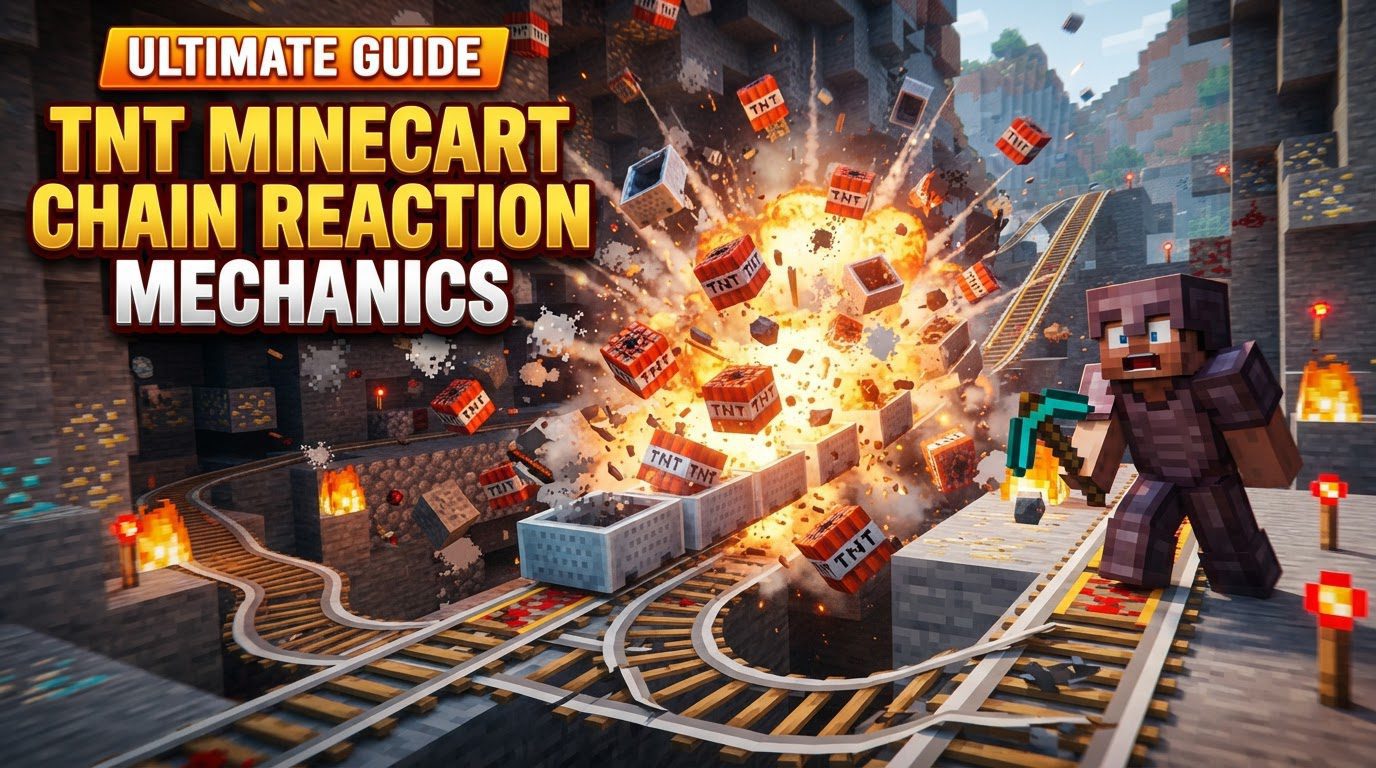
Understanding Detonation: The Fuse and the Instant Blast
Unlike its static counterpart, the TNT Minecart possesses a dual detonation mechanism: a delayed fuse and a variety of instant triggers. Grasping these differences is fundamental to harnessing their destructive potential.
- The Activator Rail Fuse: When a TNT Minecart rolls over a powered activator rail, it initiates a four-second fuse before detonating. This behavior mirrors a standard TNT block. A significant advantage of this method is that the resulting explosion will not destroy the rails themselves or the blocks directly supporting them. This makes activator rails ideal for repeatable demolition setups or controlled blasting where the track infrastructure needs to remain intact.
- Instant Detonation Triggers: Where TNT Minecarts truly distinguish themselves is their capacity for immediate explosion, bypassing the typical fuse entirely. This instantaneous detonation occurs under several specific conditions:
- Gravity’s Pull: If a TNT Minecart falls more than three blocks and impacts the ground, it will detonate instantly. The sole exception is if it lands directly onto a rail, which negates the fall damage trigger.
- High-Speed Collisions: A TNT Minecart turning on a curved track can explode instantly if it encounters a solid block or entity positioned in its previous direction of movement. This implies a forceful, high-velocity impact.
- Fiery Arrows: A flaming arrow, whether shot by a player or a dispenser, will cause an immediate explosion upon contact with a TNT Minecart.
- Compression and Velocity: If a TNT Minecart with active velocity is pressed into a solid block or another entity, the compression can trigger an instant detonation.
- Destruction in Motion: A TNT Minecart that is destroyed while it is moving will explode instantly. The only exception to this rule is if a player in Creative mode destroys it, which will simply remove the entity without a blast.
- Elemental Destruction: Exposure to environmental hazards such as fire, lava, or another explosion will also cause an immediate detonation of the TNT Minecart. This is crucial for creating chain reactions.
The Power Behind the Blast: Velocity and Stacking
The destructive force of a TNT Minecart explosion is not static; it can be significantly amplified through specific game mechanics, allowing for blasts far more powerful than a single block of TNT.
- Base Explosion Power: By default, a TNT Minecart explosion has a base power of 4. This is identical to the destructive force of a regular TNT block. However, this is merely the starting point.
- Velocity-Based Amplification: The true power of a TNT Minecart is unleashed when it detonates at high speed. The game adds a random bonus to its explosion power, directly proportional to its velocity, up to 1.5 times its current speed. This means that a fast-moving TNT Minecart can achieve a maximum total explosion power of 11.5. To put this into perspective, achieving a speed of 5 or higher upon detonation will result in an explosion power randomly ranging between the base 4 and the maximum 11.5. This makes high-velocity impacts or rapid movement crucial for maximizing destruction.
- Flaming Arrow Charge: Beyond velocity, the charge of a flaming arrow used to detonate a TNT Minecart also contributes to the final damage output. While not as significant as velocity, it adds another layer of potential for increased destruction.
- Concentrated Stacking: One of the most effective ways to create truly colossal explosions is by stacking multiple TNT Minecarts on the same rail block. Minecraft allows an arbitrary number of minecarts to occupy the identical space on a single rail. When these stacked minecarts are triggered-whether by an activator rail, falling, or any other instant detonation condition-they will explode almost simultaneously. This creates an incredibly concentrated and powerful blast, capable of clearing massive areas or instantly destroying even durable blocks like obsidian, a phenomenon often referred to as “nuclear” level demolition.
Crafting a Chain Reaction: A Basic Setup Guide
To illustrate the practical application of these mechanics, let’s walk through a basic example of setting up an instant, powerful TNT Minecart explosion, ideal for traps or concentrated demolition.
- Lay the Foundation with Rails: Begin by establishing a rail system. This system must include at least one activator rail positioned at the precise spot where you intend the explosion to occur. The surrounding blocks can be any material, but consider using blast-resistant blocks if you want them to survive the blast.
- Stack Your Explosives: This is where the magic happens. Place multiple TNT Minecarts onto a single rail block. You can achieve this by repeatedly right-clicking the same rail segment with TNT Minecarts in hand. For even greater effect, consider using a sloped rail leading into the target block; this can help ensure the minecarts are pushed tightly together and maintain velocity. The more minecarts you stack, the more devastating the eventual explosion will be.
- Power the Activator Rail: Connect the activator rail to a reliable redstone power source. Common choices include a lever, a pressure plate (particularly useful for player traps), a redstone torch, or even a detector rail if you intend to trigger it with another moving minecart. Ensure the power source is active or can be easily activated.
- Initiate the Blast: Once the stacked TNT Minecarts are propelled over the powered activator rail, or if they are triggered by any other instant detonation condition (such as being pushed into a block, falling, or hit by an arrow), they will detonate. Due to the stacking and the instant detonation property of multiple minecarts in close proximity, the result is often a massive, instantaneous explosion.
Maximizing Mayhem and Control: Advanced Tips
Beyond the basic setup, there are several strategies to optimize your TNT Minecart use for both maximum destruction and precise control.
- Amplify Damage Output: To achieve the most destructive explosions, always aim for instant detonation methods. Dropping minecarts from height, forcing them into high-speed turns that cause collisions with blocks, or using flaming arrows are excellent ways to bypass the fuse and often increase raw power. Crucially, stack as many TNT Minecarts as possible onto a single rail block to create “nuclear” proportion blasts, and ensure these minecarts have high velocity when they detonate to leverage the speed-based power bonus.
- Controlled Demolition with Activator Rails: For scenarios requiring repeated or precise blasting without destroying your infrastructure, activator rails are invaluable. Since they do not destroy the rails or their supporting blocks, you can set up a blasting zone that can be used over and over again simply by replacing the TNT Minecarts. This is perfect for clearing land in a structured manner or creating specific architectural features.
- Innovative Trapping Solutions: The instant explosion potential of TNT Minecarts makes them exceptionally effective for player traps. Consider concealing stacked TNT Minecarts under a pressure plate, activated by an observer block, or triggered by a tripwire hook. The instantaneous nature leaves players little to no time to react, making them highly lethal.
- Efficient Mining Operations: TNT Minecarts can be a highly efficient tool for large-scale mining, particularly for materials like ancient debris in the Nether. By creating long tunnels and strategically placing powered rails that trigger stacked minecarts, you can clear vast amounts of netherrack quickly, exposing valuable ores. Their ability to destroy blocks without destroying rails or supporting blocks (when using activator rails) can simplify the setup for automated mining arrays.
Avoiding Common Pitfalls
While powerful, TNT Minecarts can be unpredictable if their unique mechanics are not fully understood. Be aware of these common mistakes to prevent unexpected outcomes or wasted resources.
- The Unpowered Activator Rail Blunder: A frequent error is failing to provide redstone power to an activator rail. An unpowered activator rail will simply allow a TNT Minecart to pass over it without priming or detonating it. Always double-check your redstone connections.
- Misaligned Drops: When designing a drop-triggered trap or demolition, ensure the TNT Minecart is perfectly aligned to fall through a one-block gap. If it’s even slightly off-center, the minecart may get stuck or roll past the opening instead of falling, thus failing to detonate.
- Expecting a Standard TNT Fuse: One of the most dangerous misconceptions is assuming that TNT Minecarts will always have a 4-second fuse, like regular TNT. As detailed, many conditions lead to instant detonation. Failing to account for these can result in unexpected explosions, self-damage, or accidental destruction of your own builds. Always be mindful of the instant detonation triggers.
- Ignoring Velocity for Power: Overlooking the impact of velocity on explosion power means you’re missing out on a key advantage of TNT Minecarts. Simply detonating a stationary minecart will only yield its base power of 4. Always strive to maximize the minecart’s speed upon detonation to achieve the most powerful blasts possible.
Mastering TNT Minecart chain reactions in Minecraft opens up a world of creative destruction and efficient resource gathering. By understanding their unique detonation conditions, the power amplification through velocity and stacking, and by avoiding common mistakes, you can wield one of the game’s most potent demolition tools with precision and devastating effect.
Tags:
YOU MAY ALSO LIKE...


