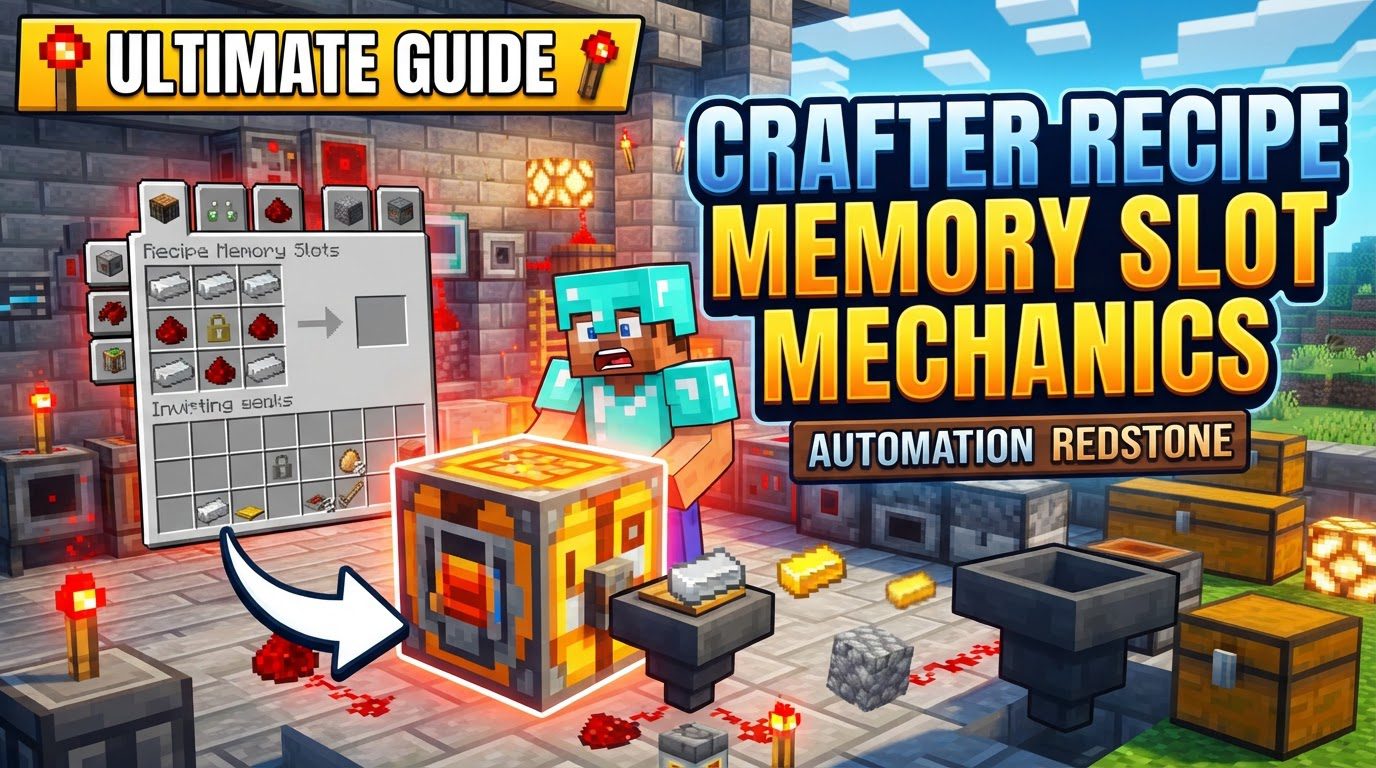
Crafter Recipe Memory Slot Mechanics
Automated crafting in Minecraft, once a dream, became a reality with the introduction of the Crafter block. This innovative addition fundamentally changed how players approach large-scale item production, moving beyond manual crafting to sophisticated, redstone-driven factories. At the heart of its efficiency and precision lies a crucial feature often referred to as “Recipe Memory Slot Mechanics” – the ability to precisely define and store a crafting recipe’s shape within the block itself.
Understanding the Core Components of Automated Crafting
The Crafter block is a marvel of redstone engineering, designed to mimic the functionality of a standard crafting table but with programmable control. Grasping its fundamental elements is key to mastering automated production.
- The 3×3 Crafting Grid: Like its manual counterpart, the Crafter features a nine-slot inventory arranged in a 3×3 grid. This familiar layout is where ingredients are placed to form specific recipes. The block checks this grid for valid recipes when activated.
- Redstone Activation: Unlike a crafting table that works instantly, the Crafter requires a redstone signal to perform its action. Crucially, it crafts exactly once per redstone pulse. A continuous signal will only trigger a single craft, necessitating pulsed signals for repeated production.
- Disableable Slots: The Recipe Memory: This is the cornerstone of the Crafter’s intelligence. Each individual slot within the 3×3 grid can be toggled on or off by simply clicking it in the Crafter’s interface. When a slot is disabled, it acts as a “memory” – the Crafter understands that this specific position should remain empty for the intended recipe. This feature is vital for shaped recipes, preventing unwanted items from being placed in empty recipe positions by automation systems.
- Item Ejection: Upon successfully crafting an item, one unit of the crafted product is automatically ejected from the Crafter’s “face” side. This directional output is similar to a dropper and allows for easy collection by adjacent hoppers or chests.
- Hopper Interaction and Input Logic: Hoppers are the primary means of automated ingredient delivery and output collection. Hoppers feeding into the Crafter prioritize filling empty slots first. Once all enabled slots have items, further items will fill the lowest stack in the enabled slots. The default filling order for items entering enabled slots is from top-left to bottom-right. This specific order, combined with disabled slots, allows for precise ingredient placement.
- Comparator Output: A redstone comparator placed next to a Crafter can read its internal state. It emits a redstone signal strength from 0 to 9, where the strength corresponds to the number of occupied or disabled slots. This allows for intelligent redstone circuits that can detect when a Crafter is full, empty, or ready to craft.
Setting Up Your Automated Crafting Station: A Step-by-Step Guide
Implementing a Crafter into your base requires a methodical approach to ensure efficiency and prevent common errors.
- Placement: Begin by placing the Crafter block in your desired location. Pay attention to its orientation, as the “face” side dictates where crafted items will be ejected.
- Access UI: Right-click the Crafter to open its intuitive inventory interface, revealing the 3×3 crafting grid.
- Define Recipe: Manually arrange the necessary ingredients into the 3×3 grid according to the specific crafting recipe you wish to automate. This initial placement serves as a template.
- Securing the Recipe Shape: Disabling Unused Slots: This is a critical step for “Recipe Memory Slot Mechanics.” For any shaped recipe, or recipes requiring fewer than nine ingredients, click on any grid slots that should remain empty. Disabling these slots tells the Crafter that they are not part of the recipe and should not be filled by incoming ingredients, effectively “remembering” the recipe’s unique shape.
- Supply Ingredients: Set up a system of hoppers, droppers, or even manual input to deliver the required ingredients into the Crafter’s enabled slots. Ensure your input system respects the filling order and disabled slots.
- Provide Redstone Pulse: Connect a redstone circuit capable of delivering a brief pulse to the Crafter. This pulse will trigger a single crafting action.
- Collect Output: Position a hopper or chest adjacent to the Crafter’s ejection face to automatically collect the crafted items.
Optimizing Your Crafter Builds: Expert Tips
To truly maximize the potential of Crafters, consider these advanced strategies.
- Fully Automate Input and Output: Design comprehensive systems using hoppers, droppers, and chests to continuously supply raw materials and collect finished products. This frees you from manual intervention and allows for truly passive production.
- Precision Crafting with Slot Control: Always, without exception, disable unused slots for shaped recipes. This ensures that only the correct ingredients enter the correct positions, preventing accidental crafting of unintended items or recipe failures. This is the core application of the “Recipe Memory Slot Mechanics.”
- Smart Redstone Logic for Activation: Employ redstone comparators to create intelligent activation circuits. For instance, a comparator can detect when all necessary slots are filled (by monitoring signal strength) and then trigger a redstone pulse to activate the Crafter, ensuring it only crafts when ready.
- Pulse, Don’t Power: Reiterate this fundamental rule: Crafters require distinct, brief redstone pulses for each crafting action. A continuous signal will only result in a single craft, wasting redstone power and failing to automate repeated production.
Avoiding Pitfalls: Common Crafter Mistakes and Considerations
Even experienced players can make errors with Crafters. Understanding these common issues will save you time and resources.
- The Hopper Underneath Trap: Placing a hopper directly underneath a Crafter is a common mistake. This hopper will attempt to pull ingredients out of the Crafter’s grid before they can be crafted, disrupting the process and leading to recipe failure. Output collection should always be from the front face.
- The Peril of Undefined Slots: Failing to disable unused slots is perhaps the most frequent cause of Crafter malfunction. If slots are left enabled, hoppers might fill them with ingredients not intended for the specific recipe. For example, if you’re crafting gold blocks from ingots and leave surrounding slots open, incoming gold ingots could accidentally fill those slots, leading to the creation of gold nuggets, pressure plates, or nothing at all, instead of the intended block. This undermines the “Recipe Memory Slot Mechanics.”
- Continuous Power Fallacy: As previously mentioned, providing a constant redstone signal to a Crafter will only activate it once. For continuous crafting, you need a circuit that generates repeated, brief pulses.
- Invalid Recipes: If the arrangement of items in the Crafter’s grid does not form a valid recipe (even with disabled slots), nothing will be crafted when activated. The items will simply remain in the Crafter.
- Understanding Item Input Order: While hoppers generally fill empty slots first, remember their specific priority: top-left to bottom-right for enabled slots. For complex recipes requiring precise ingredient placement, this order, combined with strategically disabled slots, is paramount.
- Managing Byproducts: Some crafting recipes produce additional items, such as glass bottles when crafting potions. These byproducts will also be ejected from the Crafter’s face, so ensure your collection system is designed to handle them.
- Piston Interaction: Crafters are unique blocks that cannot be moved by pistons. Plan your redstone contraptions accordingly, as they are fixed in place once positioned.
By understanding and leveraging the “Recipe Memory Slot Mechanics” – primarily through the intelligent use of disableable slots – players can design highly efficient, reliable, and compact automated crafting systems, truly revolutionizing their Minecraft industrial operations.
Tags:
YOU MAY ALSO LIKE...