

Ladder vs Vine Climbing Speed Comparison
Climbing a mere 2.35 blocks per second might not sound like a blistering pace, but in the dynamic world of Minecraft, understanding the nuances of vertical movement can be the difference between a successful expedition and an untimely fall. Players often find themselves needing to scale daunting cliffs, deep ravines, or tall structures, and for this, two primary tools stand out: ladders and vines. While both serve the fundamental purpose of ascending, their underlying mechanics, practical applications, and even their climbing speeds harbor subtle yet significant differences.
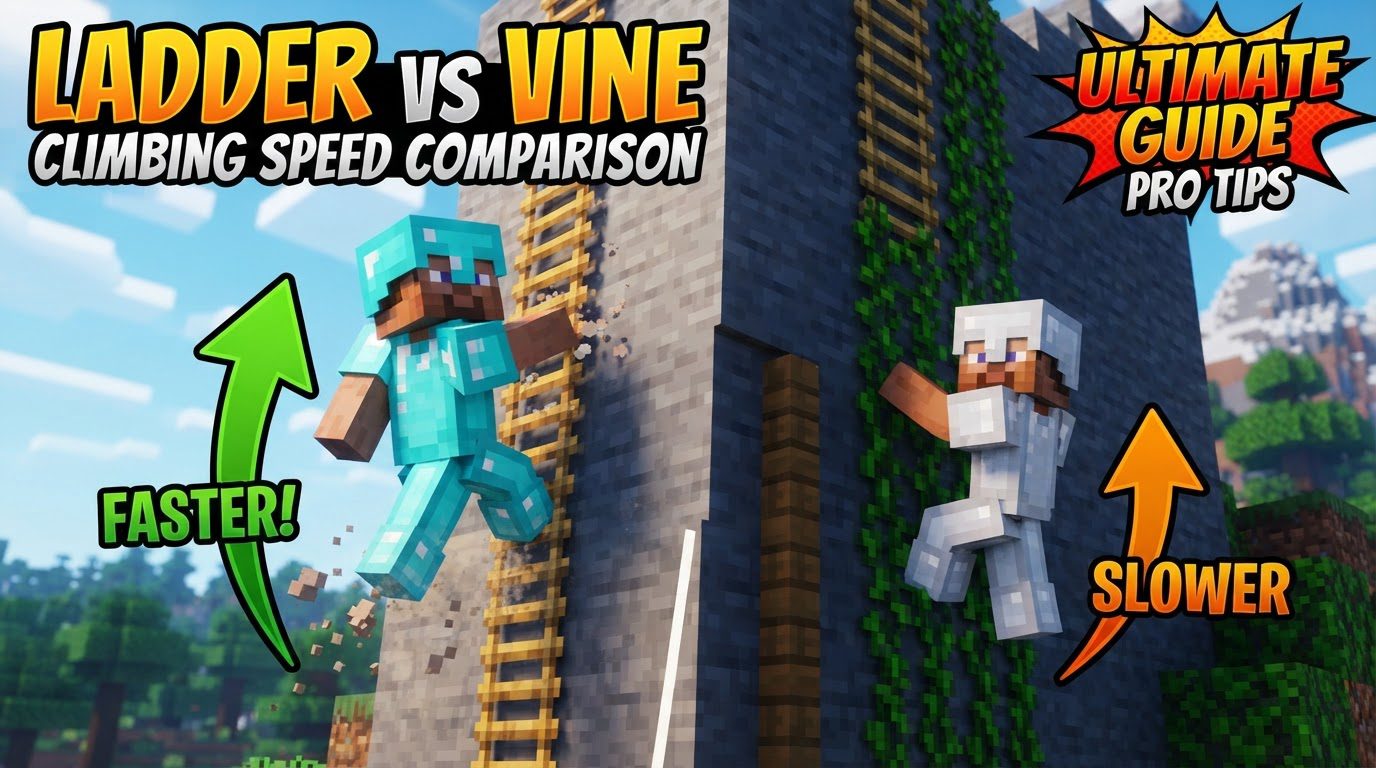
This guide delves into a comprehensive comparison of ladders and vines, dissecting their unique properties, outlining their climbing processes, and highlighting crucial tips and common mistakes. By the end, you’ll have a clear understanding of when to choose one over the other for optimal vertical navigation.
The Sturdy Ladder: A Foundation of Ascent
Ladders are a cornerstone of vertical travel in Minecraft, prized for their reliability and straightforward mechanics. They are physical, solid blocks with a defined collision box, meaning a player can stand on them, preventing falls if they momentarily let go of movement keys. This inherent solidity makes them a safe and predictable choice for building upward.
- Placement and Structure: Ladders can be placed on the face of any full solid block. Once placed, they occupy a single block space, making them highly space-efficient.
- Climbing Speed: When ascending a ladder, players typically move at approximately 2.35 blocks per second. This rate is consistent and dependable.
- Descending Speed: Interestingly, descending ladders is slightly faster than climbing, clocking in at around 3 blocks per second. This allows for quick, controlled descents.
- Fall Damage Nullification: A critical safety feature of ladders is their ability to negate fall damage. If a player makes contact with a ladder while falling, even briefly, any accumulated fall damage is immediately reset or nullified. This makes ladders excellent for emergency descents or as part of a fall-protection system.
- Platform Specifics: In Bedrock Edition, players can achieve a slight increase in ladder climbing speed by holding the jump button while ascending. This provides a minor but noticeable advantage for Bedrock players seeking to optimize their vertical climb.
Crafting ladders is also quite economical, requiring 7 sticks to yield 3 ladders, making them an accessible resource even in the early stages of survival.
The Enigmatic Vine: Intangible Pathways
Vines offer an alternative, often more natural-looking, method of vertical ascent. However, their mechanics differ significantly from ladders, primarily due to their intangible nature.
- Intangible Nature: Unlike ladders, vines themselves are intangible. They possess no collision box, meaning players can pass right through them. This characteristic is both a blessing and a curse, influencing their climbing requirements.
- Climbing Requirement: The most crucial distinction for vines is that to climb upwards, there must be a solid block directly behind them. Without this supporting block, attempting to climb will result in the player falling straight through the vine. This makes careful placement or natural generation context vital for their use as an ascent tool.
- Descent Flexibility: While climbing requires a back block, descending vines does not. Players can slide down vines even if there’s no solid block behind them, offering a flexible means of controlled descent.
- Climbing Speed: Generally, the base climbing speed on vines is considered to be the same as on ladders, around 2.35 blocks per second.
- Natural Generation and Collection: Vines naturally generate in lush biomes like Jungles and Swamps, often clinging to trees or structures. They can be collected using Shears, allowing players to relocate them for custom vertical pathways on walls or even ceilings.
The Speed Verdict: Are They Identical?
At their core, the base climbing speed for both ladders and vines is approximately the same: 2.35 blocks per second. This means that, without any special techniques, a player will ascend a given height at roughly the same pace regardless of whether they choose a ladder or a vine (assuming the vine has a solid block behind it for climbing).
However, the subtle differences lie in how these speeds can be influenced:
- Java Edition: In Java Edition, holding the jump key while climbing either a ladder or a vine can offer a slight speed increase. This allows players to actively participate in optimizing their ascent.
- Bedrock Edition: Bedrock Edition offers a similar boost, but specifically mentions that holding the jump button can increase ladder climbing speed. The research notes do not explicitly state this applies to vines in Bedrock, suggesting a potential platform-specific nuance.
It’s also important to note that while ladders and vines offer a consistent, albeit modest, climbing speed, other vertical travel options exist. For instance, scaffolding provides a significantly faster alternative for vertical movement, often reaching speeds far exceeding either ladders or vines. Therefore, while comparing ladders and vines, it’s useful to understand they occupy a similar tier of vertical efficiency, distinct from more rapid options.
Climbing Fundamentals: Your Ascent Guide
Mastering vertical movement with ladders and vines is straightforward, but understanding the precise inputs can enhance your experience.
Ascending Ladders
- Approach: Position yourself directly in front of the ladder.
- Engage: Move forward into the ladder’s block space. On PC, this typically involves holding the “W” key.
- Ascend: Continue holding the forward movement key. In Java Edition, you can also hold the jump key simultaneously to climb faster.
Ascending Vines
- Verify Support: Before attempting to climb, ensure there is a solid block directly behind the vines you intend to ascend. This is absolutely critical for successful climbing.
- Engage: Move forward into the vine’s block space, usually by holding the “W” key.
- Ascend: Keep holding the forward key. Similar to ladders, Java Edition players can also hold the jump key for a speed boost.
Optimizing Your Climb: Advanced Techniques & Safety Measures
Beyond basic movement, several techniques and safety considerations can improve your vertical travels.
- Maximizing Speed:
- Constant Forward Pressure: Simply holding the forward movement key (pushing against the wall) ensures you move upward at the consistent base rate.
- Jump Key Augmentation: As mentioned, holding the jump key while climbing can provide a speed increase. This applies to both ladders and vines in Java Edition, and specifically to ladders in Bedrock Edition.
- Enhanced Safety:
- Sneak for Security: While on a ladder or vine, holding the sneak key (Shift on PC) prevents you from falling off. This is invaluable when performing actions like placing blocks or looking around while suspended.
- Fall Damage Absorption: Ladders are excellent fall breakers. If you accidentally fall from a height, making contact with a ladder on the way down will nullify all fall damage, effectively saving you from a potentially fatal impact. Vines, due to their intangibility, do not offer this same fall-breaking capability.
- Efficiency Considerations:
- Space Economy: Ladders are exceptionally space-efficient, occupying only a single block column, making them ideal for tight shafts or compact bases.
- Resource Cost: Ladders are cheap to craft, requiring only sticks. Vines, while naturally occurring, require shears to collect and relocate, and their placement often needs more thought due to the back-block requirement.
Common Missteps for Vertical Traversal
Even seasoned players can make mistakes when navigating vertically. Being aware of these pitfalls can save you frustration and potential in-game consequences.
- Mob Interaction with Ladders: A common oversight is placing a ladder all the way down to the ground. Most hostile mobs can easily climb ladders if they can pathfind to the bottom block. To prevent unwanted guests, remove the very bottom ladder block. Players can still jump to grab the second-lowest ladder, but most mobs lack this intelligence, effectively creating a player-only access point.
- Climbing Vines Without a Back Block: This is arguably the most frequent mistake with vines. Attempting to climb vines that do not have a solid block directly behind them will invariably lead to you falling straight through. Always double-check the structural integrity behind your vine pathways.
- Mining While Climbing: While it’s possible to mine blocks while holding onto a ladder or vine, your mining speed will be significantly decreased. For efficient resource gathering, it’s always better to stand on solid ground.
Final Thoughts on Vertical Mobility
In conclusion, while both ladders and vines serve as vital tools for vertical navigation in Minecraft, their subtle differences dictate their optimal use. Ladders offer robust, tangible support, reliable fall damage negation, and consistent speed, making them a go-to for secure, man-made structures. Vines, with their intangible nature and dependency on a solid back block for ascent, are better suited for natural-looking pathways, decorative elements, or situations where their unique descent mechanics are advantageous.
Ultimately, the choice between a ladder and a vine often comes down to the specific context of your build, your aesthetic preferences, and the level of safety and reliability you require. Understanding their individual strengths and weaknesses empowers you to make informed decisions, ensuring smooth and efficient vertical travel throughout your Minecraft adventures.
Tags:
YOU MAY ALSO LIKE...


