

Optimize Your Chunk Loading for Large Multiplayer Servers
The silent killer of a smooth Minecraft server experience isn’t always complex redstone or massive farms; often, it’s the invisible, inefficient process of chunk loading. On large multiplayer servers, the constant demand to load and generate new terrain can quickly overwhelm even robust hardware, leading to frustrating lag, stuttering, and a phenomenon known as “rubber-banding.” Understanding and optimizing how your server handles these fundamental world segments is paramount to providing a stable and enjoyable environment for your players.
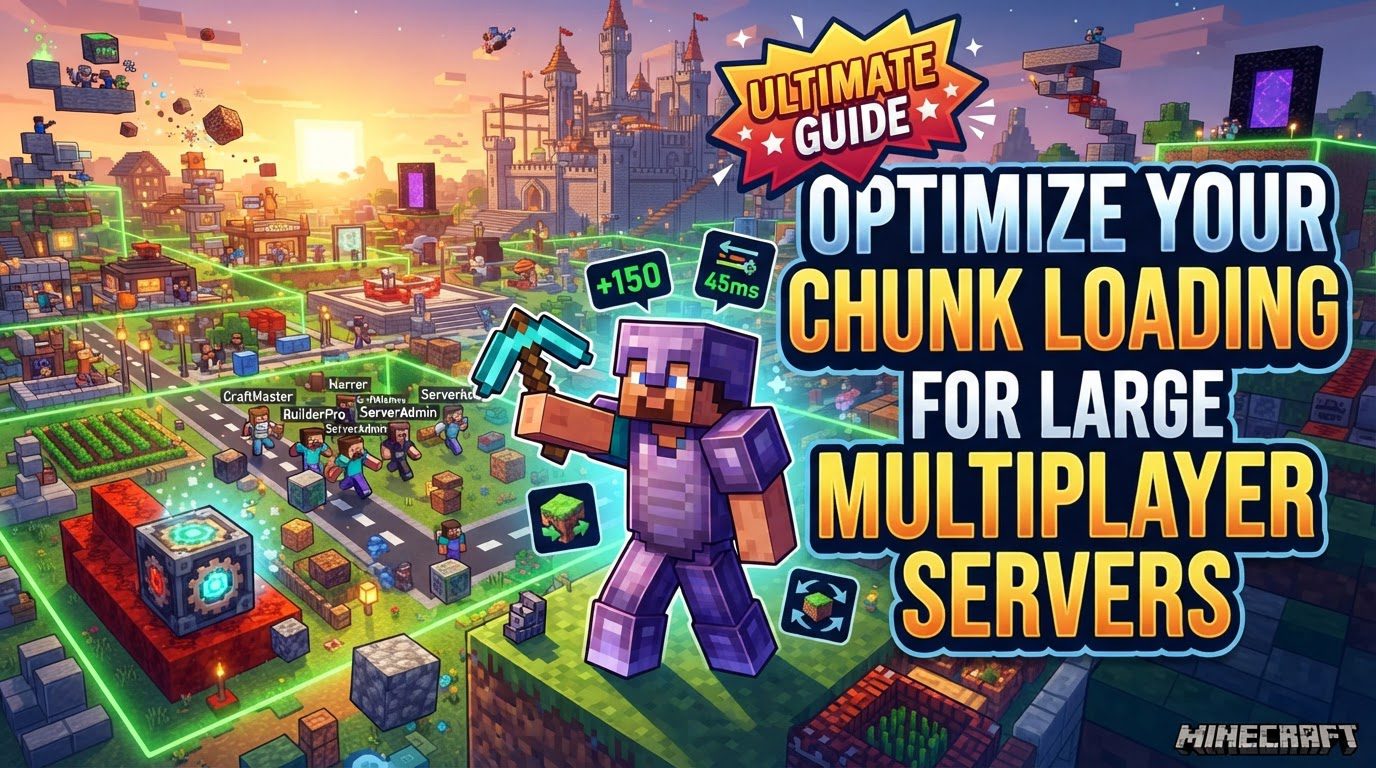
Minecraft’s world is fundamentally divided into chunks, which are 16×16 block columns extending from bedrock to the sky limit. These chunks are the building blocks of your server’s performance, loaded into memory and processed based on player proximity. When not handled efficiently, these operations become the primary bottleneck, consuming precious server resources and directly impacting the server’s Ticks Per Second (TPS).
Understanding the Core Mechanics of Chunk Management
Before diving into optimization, it’s crucial to grasp the two distinct processes involved in chunk handling and their impact:
- Chunk Loading: This is the act of reading existing chunk data from the server’s storage (disk) into its active memory. It’s a relatively quick process, especially when utilizing fast storage solutions like Solid State Drives (SSDs).
- Chunk Generation: Far more resource-intensive, generation involves calculating entirely new terrain, biomes, structures, and decorations from scratch. This process can take anywhere from 10 to 50 times longer than simply loading an existing chunk, making it a significant source of lag when players explore new, uncharted territory.
Both loading and generation consume a portion of the server’s tick budget. For a server to maintain a healthy 20 TPS (Ticks Per Second), each tick must complete its operations within 50 milliseconds. If chunk-related tasks exceed this budget, the TPS drops, leading to noticeable performance degradation and a poor player experience.
Key Distances and Their Exponential Impact
- View Distance: This setting dictates how many chunks around a player are sent to their client for rendering. While it affects what players see, it also has a significant impact on server memory usage and network traffic. Crucially, the relationship between view distance and the number of loaded chunks is exponential. For instance, a view distance of 8 loads 289 chunks per player, while merely increasing it to 10 loads 441 chunks.
- Simulation Distance: This is a critical CPU consumer. Simulation distance determines how far away from a player the server actively processes game logic. This includes crucial elements like mob AI, crop growth, redstone contraptions, and other dynamic world elements. A higher simulation distance means more active entities and logic, directly increasing CPU load.
Strategic Configuration for Optimal Performance
Effective chunk optimization begins with strategic server configuration and leveraging the right tools.
1. Pre-generate Your World: The Foundation of Stability
The single most impactful step you can take to mitigate chunk-related lag is to pre-generate your world. By doing this, you eliminate the need for live chunk generation as players explore, removing the biggest source of lag spikes. Tools like Chunky allow you to define a border and pre-generate all chunks within that area before players even join the server.
- Recommendation: Use a tool like Chunky to pre-generate a substantial area.
- Best Practice: Consider setting a world border at the edge of your pre-generated area. This prevents players from venturing into ungenerated territory and causing new chunks to be created on the fly, preserving your server’s performance.
2. Fine-Tuning Server Settings in server.properties
The server.properties file offers direct control over crucial chunk-related settings:
- Lower
view-distance: For most large survival servers, a value between 8-10 is a good balance. Remember the exponential increase in loaded chunks; reducing this by even a few points can significantly cut down on memory and network overhead. - Lower
simulation-distance: As a major CPU consumer, this should be set cautiously. A value of 6-8 is often suitable for survival servers. - Set View Distance Higher than Simulation Distance: This is a powerful optimization. For example, setting
view-distance=10andsimulation-distance=6allows players to visually perceive a larger world without the server actively ticking the game logic in those outer chunks. This balances visual appeal with CPU efficiency. - Disable Synchronous Chunk Writes: For vanilla or Spigot servers, setting
sync-chunk-writestofalseallows chunk saving to occur on a separate thread, preventing it from blocking the main game loop. However, optimized server software like Paper and its forks handle this automatically and more efficiently.
3. Leveraging Optimized Server Software: Paper and Purpur
The choice of server JAR is perhaps the most critical software decision you’ll make. Vanilla Minecraft and even basic Spigot servers often handle chunk generation and loading on the main game thread, creating severe bottlenecks. Advanced server software addresses this fundamental flaw:
- PaperMC and Purpur: These are highly optimized forks of Spigot. Their primary advantage for chunk loading is their ability to move computationally intensive tasks, including chunk loading and generation, to separate threads. This prevents these operations from blocking the main game loop, ensuring that even under heavy chunk generation, the server’s TPS remains stable.
no-tick-view-distance: Paper also introduces this invaluable setting, which allows clients to see chunks that are not being simulated by the server. This further enhances the ability to provide a visually expansive world without the corresponding CPU overhead of ticking those distant chunks.
Hardware Considerations for Optimal Performance
While software optimization is crucial, it must be supported by adequate hardware. Chunk loading is particularly sensitive to storage speed and CPU power.
1. Storage: The Need for Speed (SSD/NVMe)
This is non-negotiable for any serious Minecraft server. An SSD (Solid State Drive) or, even better, an NVMe SSD is absolutely essential.
- Benefit: Fast storage dramatically reduces the time it takes to load existing chunks from disk into memory. This minimizes lag spikes during autosaves and when players move into previously loaded areas. HDDs (Hard Disk Drives) with their slow seek times will cause noticeable delays and poor performance.
2. CPU: The Processing Powerhouse
Chunk generation is a CPU-bound task. This means the speed at which your server can generate new terrain is directly tied to the power of its processor.
- Benefit: A powerful CPU is crucial for handling the intensive computational demands of terrain generation, mob AI, and all other game logic within loaded chunks. Prioritize CPUs with high single-core performance, as Minecraft’s main thread still benefits greatly from this.
3. RAM: Efficient Caching
While RAM doesn’t directly speed up chunk generation, having sufficient memory is vital for caching.
- Benefit: Enough RAM allows the server to keep more chunks loaded in memory, reducing the need to repeatedly read them from disk. This results in smoother transitions as players move around and fewer calls to slower storage.
Advanced Tips for Sustained Performance
Beyond initial setup, ongoing management and specific strategies can further enhance your server’s performance.
- Monitor Performance with Tools like Spark: Don’t guess where your lag is coming from. Tools like Spark provide detailed profiling, allowing you to pinpoint the exact processes or plugins consuming the most resources. This data is invaluable for targeted optimization.
- Limit Player Movement and Entity Management: Rapid exploration by many players simultaneously will always stress chunk loading. Encourage players to build within established areas. Additionally, too many entities (mobs, dropped items, complex redstone machines) within actively loaded chunks can consume significant CPU resources, even if the chunks themselves are pre-generated. Implement entity limits or use plugins to manage entity lifespans.
- World Borders: Setting Boundaries for Performance: As mentioned, world borders are not just for aesthetics. They are a powerful performance tool. By limiting the playable area, you effectively cap the total number of chunks that can ever be generated, ensuring your server’s world file remains manageable and preventing rogue exploration from creating performance nightmares.
Avoid These Pitfalls: Common Chunk Loading Mistakes
Even with good intentions, several common mistakes can undermine your chunk optimization efforts:
- Relying on Live Chunk Generation: This is the cardinal sin of chunk management. Allowing players to constantly explore uncharted territory without pre-generation is the fastest way to cripple a server’s TPS.
- Not Using an SSD: Attempting to run a large multiplayer server on an HDD is a recipe for disaster. The slow seek times will cause constant delays and lag spikes when loading saved chunks.
- High View and Simulation Distances: Setting these values excessively high, particularly
simulation-distance, drastically increases the server’s workload without always providing a proportional benefit to the player experience. - Using Vanilla/Unoptimized Server Software: Sticking to vanilla or basic Spigot JARs means your server will suffer from severe performance bottlenecks as chunk processes block the main thread.
- Incorrectly Sized RAM Allocation: While important, simply throwing excessive RAM at a server won’t solve CPU-bound generation issues. Conversely, insufficient RAM will lead to constant disk access as chunks are swapped in and out of memory, causing performance degradation. Allocate enough, but don’t overdo it.
Optimizing chunk loading is an ongoing process, but by implementing these strategies-starting with pre-generation, fine-tuning settings, choosing the right software, and investing in appropriate hardware-you can transform a laggy, frustrating server into a smooth, enjoyable experience for all your players.
Tags:
YOU MAY ALSO LIKE...


