The Complete Breakdown of Structure Generation Chances
One of the most persistent misconceptions among Minecraft players is the belief that structure generation is a purely random affair. While it might feel like a roll of the dice when you’re searching for a Woodland Mansion or a Stronghold, the truth is far more intricate and predictable. Minecraft’s world generation, including the placement of every village, temple, and ruin, operates on a complex, deterministic process. This means that given the same world seed and game version, the exact same structures will always appear in the exact same locations, every single time. Understanding this underlying system is key to mastering the blocky world around you.
The Underpinnings of Structure Placement
The foundation of structure generation lies in several core mechanics, working in concert to create a cohesive and repeatable world.
- Deterministic Randomness: At the heart of it all is a pseudo-random number generator (PRNG). This PRNG is initialized by your world’s unique 64-bit seed. Because it’s “pseudo-random,” it generates a sequence of numbers that appears random but is actually entirely predictable if you know the starting seed. This guarantees that the world, and all its structures, will be identical every time that specific seed is used.
- Chunk-Based Generation: Structures aren’t just sprinkled across the world; they are generated on a chunk-by-chunk basis. Even before a player loads a chunk, the game’s internal logic, informed by the world seed, already “knows” which structures are designated to appear within that chunk’s boundaries.
- Noise Functions: The very shape of the terrain and the distribution of biomes, which are crucial for structure placement, are sculpted by mathematical functions. Perlin and Simplex noise are commonly used, and by layering multiple noise maps (fractal noise), Minecraft creates complex, realistic, and varied landscapes. These noise functions directly influence where structures can realistically fit.
- Spacing and Separation: To prevent structures from cluttering the landscape or spawning on top of each other, each structure type has defined
spacingandseparationvalues, measured in chunks.Spacingdictates the average distance between instances of the same structure type, whileseparationsets the absolute minimum distance. This ensures a natural spread of structures across the world. - Biome Suitability: Not all structures can appear in all biomes. A Desert Temple won’t spawn in a snowy tundra, just as an Igloo won’t appear in a savanna. Before a structure is placed, the game performs a check to ensure that the target location’s biome, or the surrounding biomes for larger structures, is suitable for that specific type.
- Jigsaw Block System: For structures that require modular assembly, such as villages, Pillager Outposts, or Bastion Remnants, the Jigsaw Block system is employed. A starting piece is placed, and its embedded Jigsaw Blocks act as connection points. These blocks define a “target pool” of other pieces, allowing the game to dynamically assemble the complete, often varied, structure.
- Structure Salt: To add another layer of uniqueness and prevent overly repetitive patterns, structures utilize a distinct “salt” value. This salt, combined with the world seed, further diversifies the generation and precise placement of structures, even within the same world seed.
- Gridding: Minecraft employs a gridding system to maintain consistency. This ensures that if a structure is determined to generate in a particular area, it will consistently do so, regardless of how chunks are loaded or the order in which a player explores the world. This prevents structures from appearing or disappearing based on exploration paths.
- Y-Level Constraints: Many structures have specific vertical (Y-axis) constraints. For example, Strongholds are typically found deep underground, generally below Y=0 in modern versions, while Ocean Monuments require deep water. These constraints guide structures to appropriate vertical positions.
From Seed to Structure: The Generation Algorithm
The journey from an initial world seed to a fully formed structure is a multi-step algorithmic process, constantly evaluating and placing elements.
- Seed Initialization: The process begins when the world’s 64-bit seed is used to initialize a 48-bit linear congruential generator (PRNG). This is the engine that will drive all subsequent “random” decisions.
- Biome and Terrain Determination: Next, a sophisticated multi-noise system is applied across the entire world. This system evaluates various climate parameters-Temperature, Humidity, Continentalness, Erosion, and Weirdness-for each location. These parameters are then mapped to specific biomes, and noise functions simultaneously sculpt the terrain’s height and features.
- Region Evaluation: The game doesn’t just check every single block. Instead, it evaluates larger regions of the world, often expanding in a spiral pattern outward from the world spawn point, to identify potential structure locations.
- Region Seed and Probability Test: For each evaluated region, a unique 32-bit region seed is calculated. This region seed is then used for a “probability test” to determine if a structure *should* generate in that general area, and also helps to determine slight positional offsets for variety.
- Biome Validation: If the probability test passes, a crucial check is performed: does the potential structure’s location meet the specific biome requirements for that structure type? If not, it won’t generate there.
- Spacing and Separation Check: Following biome validation, the game verifies that the proposed structure location adheres to the
spacingandseparationrules for its type. This prevents structures of the same kind from spawning too close to each other. - Placement and Assembly: If all preceding checks are passed, the structure is then “placed” in the world. For complex structures, this is where the Jigsaw Block system comes into play, assembling the various pieces to form the complete structure according to its defined blueprint.
Mastering Structure Discovery: Practical Advice
Understanding the mechanics behind structure generation isn’t just academic; it offers tangible advantages for players.
- Leverage Seed Finders/Mappers: Forget endless wandering. Online tools and websites like Chunkbase are invaluable resources. By inputting your world seed, these tools can precisely map out the locations of various structures, turning hours of searching into mere minutes of navigation. They directly exploit the deterministic nature of generation.
- Understanding Stronghold Rings: Strongholds adhere to a highly predictable generation pattern, spawning in concentric rings around the world origin. The first ring, for instance, reliably contains exactly three Strongholds, located between 1,408 and 2,688 blocks from spawn. This knowledge is precisely what makes Eye of Ender triangulation effective.
- Advanced Control with Modding: For those who delve into modding or server administration, tools like Structurify offer unprecedented control. They allow fine-tuning of structure parameters such as spacing, separation, biome restrictions, and even flatness checks, enabling highly customized world generation experiences.
- Verifying
generate_features: If you find that structures are completely absent from your world, especially in custom maps or servers, a critical first step is to check thegenerate_featuressetting in yourlevel.datfile. This boolean value must be set to1(true) for any structures to generate.
Debunking Myths: Common Generation Misunderstandings
Despite the underlying deterministic logic, several common misconceptions persist among players.
- The Myth of Pure Randomness: As established, structure generation is not purely random. Believing it is can lead to frustration and wasted time searching. The process is algorithmic, making it predictable with the right tools and understanding.
- Ignoring Spacing Rules: A common mistake is expecting structures of the same type to spawn in close proximity. The defined
spacingandseparationparameters are strict rules that prevent this, meaning you won’t find two Woodland Mansions right next to each other. - Incorrect Biome Assumptions: Structures are inherently tied to specific biomes. Expecting a structure to appear in a biome it’s not designed for, or failing to account for the biome requirements of surrounding areas for larger structures, will always lead to disappointment.
- Challenges with Custom Structures: When creating custom structures, common pitfalls include incorrectly defined bounding boxes, issues with Jigsaw Block connections leading to incomplete builds, or failing to properly assign the custom structure to suitable biomes for generation.
- Old Data and New Chunks: If a world is updated across game versions or if chunks were generated in an older version of Minecraft, structures might not generate correctly in newly loaded chunks. This is because generation algorithms often change between updates, leading to inconsistencies.
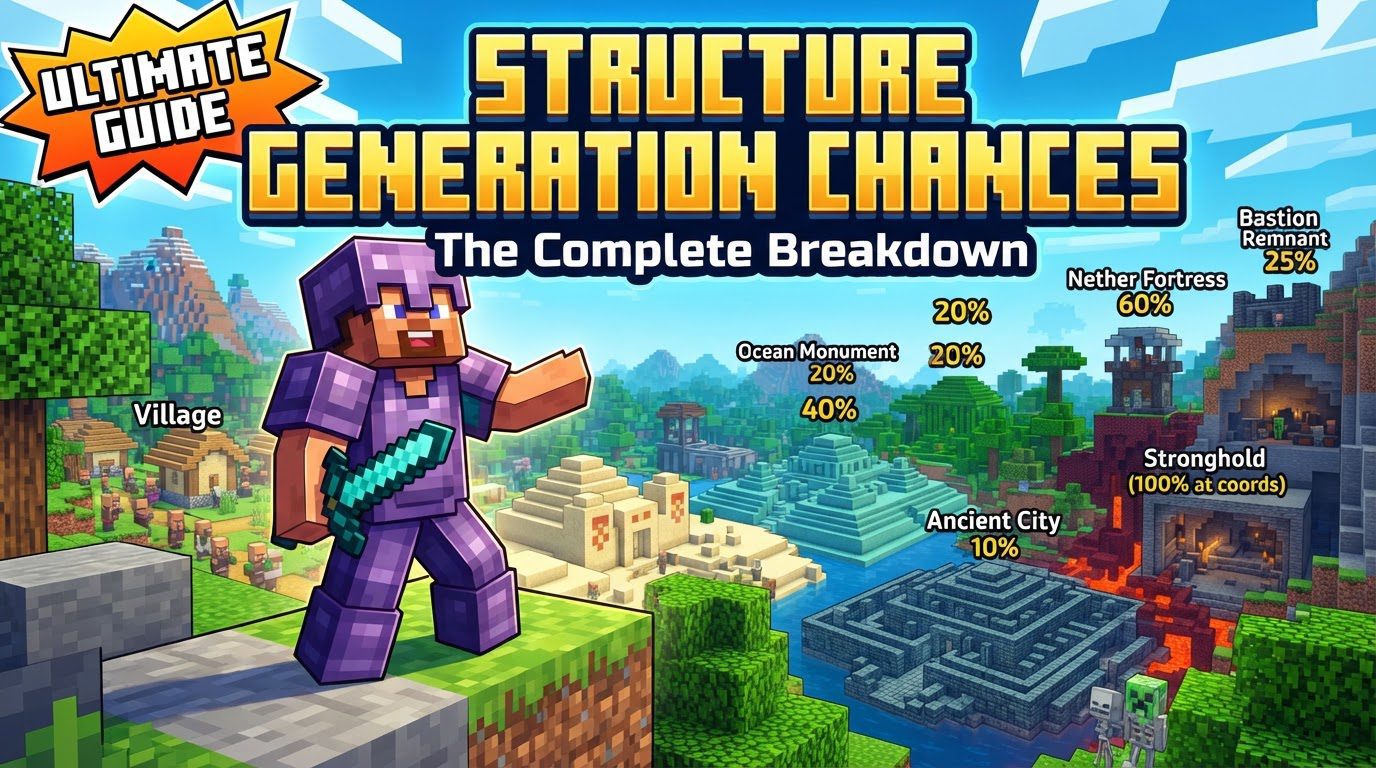
- Misinterpreting “Chance”: The “chance” of a structure appearing is not a simple percentage roll applied to every block. Instead, it’s the culmination of the PRNG, the biome suitability checks, the spacing rules, and other algorithmic evaluations that determine if a valid placement exists within a processed region of chunks. It’s a conditional outcome, not a dice roll.
Ultimately, Minecraft’s structure generation is a testament to sophisticated algorithmic design. Far from being a chaotic free-for-all, it’s a meticulously planned system that ensures every world is unique yet entirely reproducible, allowing for both discovery and mastery.
Tags:
YOU MAY ALSO LIKE...