

Minecraft Enchant 30
Many aspiring Minecraft enchanters make a critical error early on, unknowingly limiting their potential to imbue items with the most potent magical enhancements. They might craft an enchanting table, but fail to understand the precise requirements for unlocking the highest tier of enchantment: Level 30. This seemingly simple number represents the pinnacle of magical power available directly from an enchanting table, offering the best possible odds for obtaining top-tier enchantments on your weapons, tools, and armor. Mastering this process is not just about having the right materials; it’s about understanding the mechanics, meticulous preparation, and strategic application of your hard-earned experience.
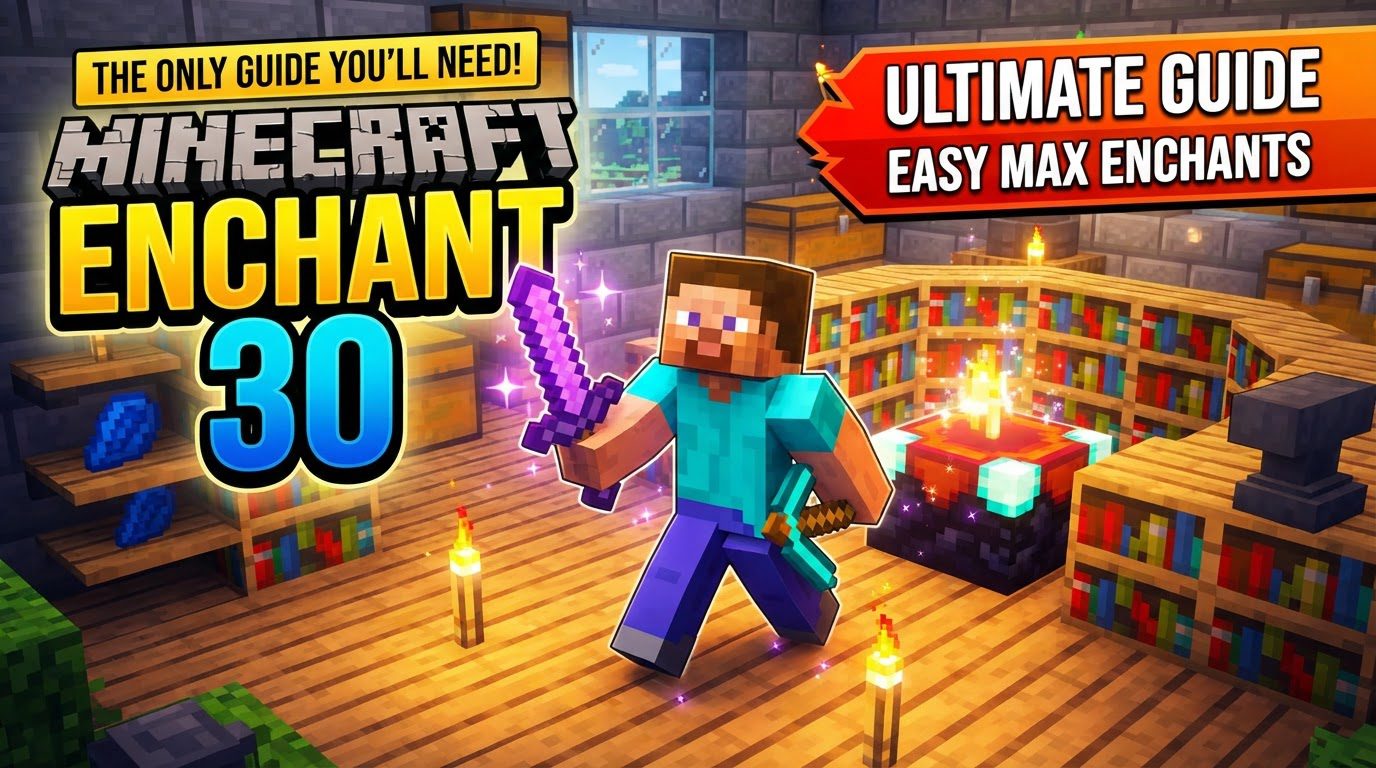
The Arcane Core: Understanding Level 30 Enchantments
At its heart, “Enchant 30” refers to the maximum enchantment level achievable through an enchanting table. This isn’t merely a higher number; it’s the gateway to the most powerful and desirable enchantments, significantly boosting the capabilities of your gear. While lower-level enchantments are easier to obtain, they rarely offer the same potency or combination of effects. Reaching Level 30 requires a perfect confluence of resources, player experience, and a precisely configured enchanting setup.
The enchanting table acts as your conduit to these magical effects. When you interact with it, you’ll see three slots, each offering a different enchantment option. The top slot typically offers the lowest level, while the bottom slot, when fully powered, will present the Level 30 enchantment. It’s crucial to understand that these options are randomized. The enchantments offered will only reroll if you apply one to an item or if you remove and then replace the item in the table’s slot. This randomness is part of the challenge and excitement, but ensuring you always have access to that coveted Level 30 option is the first step.
Forging Your Arcane Core: The Enchanting Table
Your journey to Level 30 enchantments begins with the crafting of the enchanting table itself. This block is surprisingly simple to make, yet its power is immense. To craft one, you’ll need a few fundamental resources:
- 1 Book: Crafted from 3 pieces of paper and 1 leather.
- 2 Diamonds: Precious gems, typically found deep underground.
- 4 Obsidian: A tough, dark block formed when water flows over lava. A diamond pickaxe is required to mine obsidian.
Once you have these materials, head to a crafting table. The standard recipe for an enchanting table involves placing three obsidian blocks along the bottom row of the 3×3 crafting grid. In the middle row, place one diamond on the left, one obsidian in the center, and another diamond on the right. Finally, place your single book directly in the middle of the top row. This specific arrangement will yield your very own enchanting table, the centerpiece of your future enchantment chamber.
Cultivating Knowledge: Books and Bookshelves
While the enchanting table is the core, it cannot reach its full potential in isolation. To unlock the coveted Level 30 enchantments, it demands the presence of knowledge, manifested in the form of bookshelves. Specifically, your enchanting table requires exactly 15 bookshelves to achieve the maximum enchantment level. Each bookshelf acts as a conduit for magical energy, allowing the table to offer more powerful enchantments.
Crafting 15 bookshelves is a significant undertaking, requiring a substantial amount of raw materials. Each bookshelf requires 3 books and 6 wooden planks. Therefore, for 15 bookshelves, you will need:
- 45 Books: Each book requires 3 paper and 1 leather. This means you’ll need 135 pieces of paper and 45 pieces of leather.
- 90 Wooden Planks: This translates to 23 logs of any wood type.
Gathering these materials efficiently is key. For paper, establishing a sugar cane farm is highly recommended, as 3 sugar cane yields 3 paper. For leather, farming cows is the most common and effective method, though horses and llamas also drop leather, and rabbit hides can be crafted into leather. Once you have your paper and leather, combine them in a crafting grid to make books. With your books and planks ready, craft the bookshelves by placing three planks along the top row, three books along the middle row, and three more planks along the bottom row in a crafting table.
The Sacred Arrangement: Optimizing Your Enchantment Chamber
Having the 15 bookshelves is only half the battle; their placement is equally, if not more, critical. The bookshelves must be arranged around the enchanting table with a specific spatial relationship to properly contribute to its power. They must be placed exactly one block away from the enchanting table, with an empty air block in between. Bookshelves placed directly adjacent to the table, or too far away, will not be counted towards the total, preventing you from reaching Level 30.
A common and highly effective setup is to arrange the bookshelves in a 5×5 square, with the enchanting table positioned precisely in the center. One block in this square can be left open to serve as an entrance to the enchanting table, or you can place a temporary block there and remove it when you need to access the table. Bookshelves can also be stacked up to two blocks high if space is limited, as long as they maintain the one-block air gap from the enchanting table on all sides. Ensure no other blocks (like torches, flowers, or even snow layers) are in the air gap, as they will obstruct the magical flow and prevent the bookshelves from registering.
Channeling the Magic: Applying Enchantments
With your enchanting table set up and surrounded by 15 correctly placed bookshelves, you’re ready to channel the magic. To enchant an item, simply open the enchanting table interface. You’ll see two slots: one for the item you wish to enchant and another for Lapis Lazuli. Lapis Lazuli acts as the magical catalyst for the enchantment process; it is consumed with each enchantment. For a Level 30 enchantment, you will need 3 pieces of Lapis Lazuli.
Place your tool, weapon, or armor into the first slot and the Lapis Lazuli into the second. The three enchantment options will now appear, displaying their respective experience level costs and the magical glyphs (which are merely decorative and don’t reveal the enchantment). The bottom-most option will represent the Level 30 enchantment. Select this option, and both your experience levels and Lapis Lazuli will be consumed, imbuing your item with powerful new properties. While a Level 30 enchantment requires you to be at least player Level 30, it only consumes 3 experience levels from your current pool.
Remember that the enchantments offered are random. If you don’t see an enchantment you desire, you can either enchant a cheap item (like a wooden shovel) to refresh the options, or simply remove and re-place your item in the enchanting table to reroll the selection.
Beyond the Table: Treasure Enchantments
It’s important to understand that not all enchantments can be obtained directly from an enchanting table, even at Level 30. Certain rare and powerful enchantments, known as “treasure enchantments,” are exclusive to other acquisition methods. These include highly sought-after effects like Mending (repairs items using experience), Frost Walker (freezes water into ice), Soul Speed (boosts movement on soul sand/soil), Swift Sneak (increases sneak speed), and Wind Burst (launches you into the air), as well as all curse enchantments. These special enchantments can only be found as enchanted books through various means such as looting chests in structures, trading with librarian villagers, or fishing. To apply these to your gear, you’ll need an anvil.
Mastering the Craft: Strategic Enchantment Advice
- Mine Obsidian Efficiently: Always use a diamond pickaxe to mine obsidian. If you don’t have one, prioritize getting diamonds.
- Establish Resource Farms: Create dedicated farms for sugar cane (for paper) and cows (for leather) to ensure a steady supply of books for your bookshelves and future enchanting needs.
- Embrace Bonus Enchantments: Even when selecting a single Level 30 enchantment, there’s a chance your item will receive additional, unlisted enchantments. This is a pleasant bonus that can further enhance your gear.
- Prioritize Important Gear: Save your experience levels and Lapis Lazuli for enchanting your most critical tools, weapons, and armor. Applying Level 30 enchantments to diamond or netherite gear will yield the best long-term benefits.
Avoiding Arcane Pitfalls: Common Enchanting Errors
Even with a solid understanding, players often stumble into common mistakes that can hinder their enchanting efforts:
- Insufficient Bookshelves: The most frequent error is not having the full 15 bookshelves. Each missing bookshelf reduces the maximum enchantment level offered. Always double-check your count.
- Incorrect Bookshelf Placement: Bookshelves must have a one-block air gap between them and the enchanting table. Placing them directly adjacent or having any other block in that air gap will prevent them from contributing, effectively reducing your available enchantment level.
- Not Prioritizing Enchantments: With random options, it’s easy to pick a less useful enchantment. Research which enchantments are most beneficial for each item type (e.g., Unbreaking, Mending, Efficiency for tools; Sharpness, Sweeping Edge for swords; Protection, Mending for armor) and prioritize those.
- Using Thorns on Armor: While seemingly useful, Thorns causes your armor to take extra durability damage when it reflects damage. This can lead to your armor degrading much faster, often outweighing the minimal damage reflected. Many experienced players avoid Thorns for this reason.
- Confusing Similar Enchantments: Be careful not to mix up enchantments with similar names or effects. For example, Aqua Affinity (speeds up underwater mining) is distinct from any hypothetical “Aqua Immunity.” Always read the enchantment description if you’re unsure.
- The “Too Expensive!” Anvil Error: While not directly from the enchanting table, this error is common when combining enchanted books or repairing highly enchanted items on an anvil. It occurs when an item accumulates too many “prior work” penalties, making further modifications impossible. To avoid this, combine enchantments strategically, starting with the most valuable enchantments on the base item and then adding others.
By diligently following these guidelines and avoiding common pitfalls, you will master the art of “Minecraft Enchant 30,” unlocking the full magical potential of your gear and significantly enhancing your adventures in the vast world of Minecraft.
Tags:
YOU MAY ALSO LIKE...


