

Minecraft Boss Ideas
Many aspiring Minecraft creators believe that designing a custom boss is merely a matter of summoning a powerful mob with high health. This fundamental misunderstanding often leads to repetitive, unengaging encounters that quickly bore players. In reality, crafting truly memorable Minecraft bosses involves a sophisticated blend of mechanics, careful planning, and precise command execution, transforming a simple mob into an epic challenge.
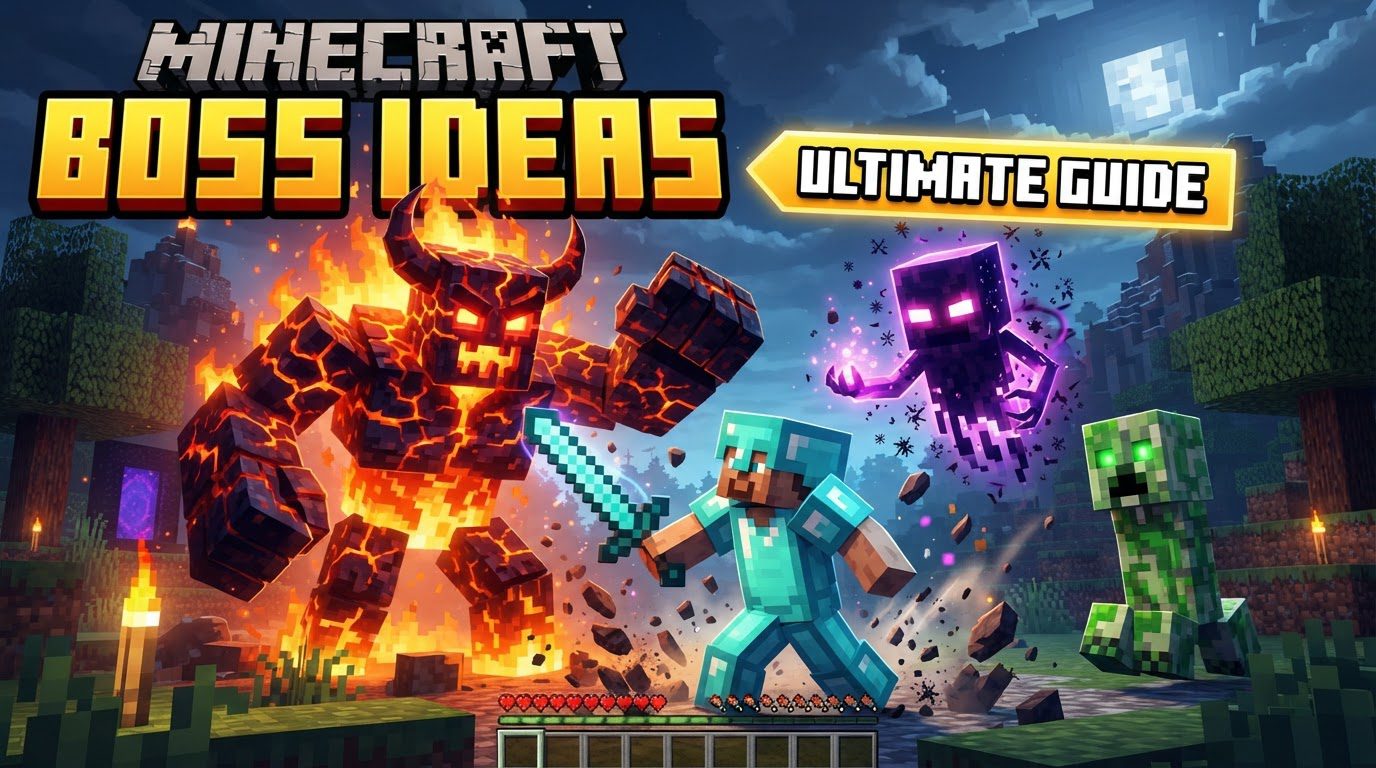
The Core Pillars of a Compelling Boss Fight
A well-designed Minecraft boss is more than just a formidable opponent; it’s an interactive experience. Several key mechanics work in concert to elevate a basic mob into a true boss, demanding strategic thinking and rewarding perseverance.
- Boss Bar Synchronization: Essential for player feedback, custom bosses can feature a dedicated boss bar at the top of the screen. This bar dynamically displays the boss’s current health, updating in real-time as it takes damage. Commands like
/bossbar addand/execute store result bossbarare crucial for setting this up, providing players with a clear visual representation of their progress. - Phased Combat: To prevent monotony, boss fights can be structured into multiple distinct phases. These phases typically trigger based on the boss’s remaining health, introducing new attacks, abilities, or changes in behavior. This keeps players on their toes and adds layers of strategy to the encounter.
- Custom Attacks and Abilities: Beyond standard mob attacks, custom bosses can unleash unique abilities. This includes casting spells, applying various status effects to players (e.g., Slowness, Levitation, Darkness), or even buffing themselves with effects like Regeneration, Strength, or Speed.
- Minion Summoning: To increase complexity and challenge, bosses can summon additional mobs to fight alongside them. These minions can distract players, add extra damage, or force players to manage multiple threats simultaneously.
- Custom Movement AI: Bosses don’t have to move predictably. Their movement patterns can be tailored, allowing them to always face the nearest player, teleport around the arena, or follow specific patrol routes, making them harder to pin down.
- Visual and Audio Feedback: The player experience is greatly enhanced through sensory cues. Particle effects can signify powerful attacks, sounds can announce phase changes or special abilities, and on-screen titles can mark significant moments like a boss’s arrival or defeat.
- Custom Drops/Rewards: Defeating a challenging boss should yield satisfying rewards. This can include unique items not found elsewhere, a significant amount of experience, or even trigger a custom victory sequence that affects the game world.
- Customizable Stats: Every aspect of a boss’s base statistics can be modified. This includes its maximum health, attack damage, knockback resistance, and even the equipment it wears or holds, allowing for fine-tuning of difficulty and appearance.
Constructing Your Behemoth: A Step-by-Step Blueprint
Bringing a custom boss to life in Minecraft requires a structured approach, often leveraging the power of command blocks or data packs for intricate logic.
- Choosing a Foundation Mob: The first step is to select an existing Minecraft mob. This “base mob” (e.g., a Wither Skeleton for a ranged boss, a Breeze for an agile one) will serve as the visual and behavioral template upon which your custom boss is built.
- Summoning with Precision: The
/summoncommand is your primary tool here. By incorporating extensive NBT (Named Binary Tag) data, you can customize virtually every aspect of your boss, including its custom name, health, unique tags for targeting, specific equipment in hand or armor slots, and various other attributes. - Implementing the Boss Bar: Once summoned, the boss needs its health bar. Use
/bossbar addto create the bar. Then, repeating command blocks, often combined with/execute store result bossbar, are used to continuously query the boss’s health and update the boss bar’s value, ensuring players always see an accurate representation. - Crafting Combat Logic: This is where the boss truly comes alive.
- Data Packs: For complex designs, data packs are highly recommended. They allow you to organize your boss’s logic into separate functions (e.g.,
spawn.mcfunctionfor initial setup,stages.mcfunctionfor phase transitions,tick_logic.mcfunctionfor continuous actions, andvictory.mcfunctionfor defeat). This modularity is ideal for intricate logic. - Command Blocks: For simpler bosses or specific sequences, chains of command blocks (repeating, conditional, chain) can execute commands based on various conditions, such as the boss’s health or proximity to a player. The
/executecommand is fundamental for targeting specific entities and triggering actions.
- Data Packs: For complex designs, data packs are highly recommended. They allow you to organize your boss’s logic into separate functions (e.g.,
- Designing Special Abilities: Commands like
/effectare used to apply status effects to players or the boss itself./damagecan inflict direct damage,/replaceitemcan change the boss’s equipment mid-fight, and/summonis used to bring in minions. The/playanimationcommand can even add unique visual flair to specific actions. - The Grand Finale: Victory Sequences: Upon the boss’s defeat, a custom victory sequence should be triggered. This involves detecting the boss’s death, removing its boss bar, displaying a celebratory message, playing triumphant sounds, and distributing custom rewards to the victorious players.
Mastering Boss Creation: Expert Tips
To ensure your custom boss is both engaging and functional, consider these invaluable tips during development:
- Strategic Planning is Paramount: Before writing a single command, meticulously plan your boss. Outline its appearance, define each combat phase, detail its attack patterns, and set your desired difficulty level. A clear vision prevents wasted effort.
- Leveraging External Tools: Don’t reinvent the wheel. Tools like MCStacker can significantly expedite the process of generating complex
/summoncommands with extensive NBT data, saving you time and reducing errors. - The Power of
/execute: Understand and master the/executecommand. It is incredibly versatile, allowing you to trigger commands based on a multitude of conditions, specific positions, and targeted entities, forming the backbone of most boss logic. - When to Choose Data Packs: For bosses with intricate logic, multiple phases, or extensive custom behaviors, data packs are almost always the superior choice. They offer a more organized, scalable, and manageable solution compared to unwieldy command block contraptions.
- The Importance of Iterative Testing: Develop your boss in stages and test frequently. This iterative approach helps you identify and fix bugs early, allowing for continuous fine-tuning of mechanics and difficulty until the fight feels just right.
- Ensuring Clear Player Cues: Players need to understand what’s happening. Provide clear visual and audio indications for boss attacks, special abilities, and phase transitions. This communication prevents frustration and allows players to react strategically.
Avoiding Pitfalls: Common Mistakes to Sidestep
Even experienced creators can stumble. Being aware of common pitfalls can save you significant time and frustration.
- Over-reliance on Command Blocks: While useful, relying solely on long, unorganized command block chains for complex bosses quickly becomes difficult to manage, debug, and expand. For sophisticated designs, data packs are a far more organized and efficient alternative.
- Lack of Phase Variation: Bosses that repeat the same attacks and behaviors throughout the entire fight quickly become tedious. Without distinct phases that introduce new challenges, the encounter will feel repetitive and less engaging.
- Boss Bar Management Issues: Forgetting to properly synchronize the boss bar with the boss’s actual health, or neglecting to remove it after the boss is defeated, can lead to a messy and confusing player experience.
- Unsatisfying Rewards: A challenging boss fight should culminate in meaningful and unique drops, achievements, or progression. If the rewards don’t feel commensurate with the effort, players may feel their time was wasted.
- Poorly Communicated Mechanics: If players struggle to understand the boss’s actions, what its abilities do, or what strategies are required to defeat it, the fight can quickly devolve into a frustrating and unfair experience rather than a fun challenge.
Creating a custom boss in Minecraft is a journey of creativity and technical execution. By understanding these core mechanics, following a structured development process, and heeding expert advice, you can transform your imaginative concepts into truly epic and memorable encounters that will challenge and delight players for countless hours.
Tags:
YOU MAY ALSO LIKE...


