

Cobblemon Grepa Berry
A common mistake many Cobblemon trainers make when first encountering the concept of EV-reducing berries is assuming they can simply find a Grepa Berry bush in the wild. Unlike many other resources in the blocky world, the coveted Grepa Berry is not a naturally occurring plant you stumble upon. Instead, its existence is a testament to the intricate and rewarding agricultural system within Cobblemon, primarily emerging through a process of careful cultivation and berry mutation. Mastering its acquisition and growth is a key step for any serious trainer looking to fine-tune their Pokémon’s stats or craft essential items.
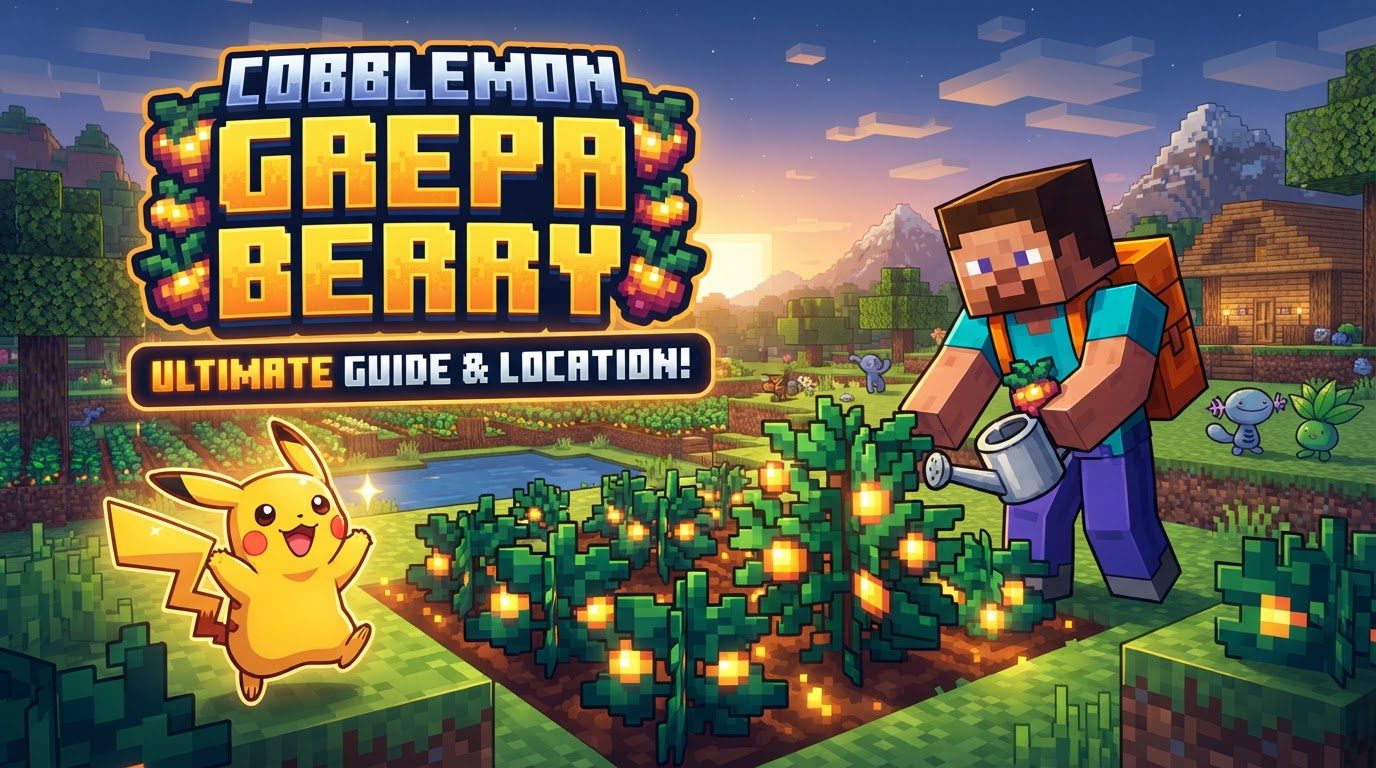
The Grepa Berry: A Trainer’s Essential Tool
The Grepa Berry holds a significant role in a Cobblemon trainer’s arsenal, primarily due to its unique properties concerning Effort Values (EVs) and friendship. At its core, the Grepa Berry is an EV-reducing berry. Specifically, when consumed by a Pokémon, it lowers that Pokémon’s Special Defense Effort Values. This function is invaluable for trainers who may have accidentally over-trained a Pokémon in a particular stat, or for those who wish to completely reset their Pokémon’s Special Defense EVs for competitive breeding or training purposes. Beyond its stat-altering capabilities, the Grepa Berry also bestows a boost in friendship with the Pokémon that consumes it, making it a dual-purpose item for both competitive optimization and nurturing your companions.
But the utility of the Grepa Berry extends beyond direct consumption. It serves as a crucial ingredient in the campfire pot, a versatile crafting station for various beneficial items. With Grepa Berries at hand, trainers can craft:
- Clever Mochi: An item that likely influences a Pokémon’s stats or abilities in a clever way, often related to Special Attack or Special Defense.
- Courage Candy: Suggests an item that could boost a Pokémon’s Attack or Defense, or perhaps even its resolve in battle.
- Coward Candy: An intriguing item that might reduce certain aggressive stats or enhance evasiveness.
These crafting recipes underscore the Grepa Berry’s importance, transforming it from a simple stat-reducer into a foundational component for advanced item creation within Cobblemon.
Cultivating Grepa: Growth Mechanics and Environment
Once you’ve obtained a Grepa Berry, either through mutation or trade, cultivating your own supply becomes a straightforward, albeit patient, endeavor. Like other berries in Cobblemon, Grepa Berries thrive under specific conditions:
- Preferred Biome: Grepa Berries grow best in forest biomes. Planting them in their preferred environment can significantly increase your harvest yield, making your efforts more efficient.
- Growth Duration: From seedling to fully grown, a Grepa Berry plant takes approximately 50 to 60 minutes to mature. This is real-time, meaning you’ll need to check back periodically on your farm.
- Harvest Yield: A single mature Grepa Berry plant typically yields 1 to 2 Grepa Berries per harvest. While this might seem modest, a well-managed farm with multiple plants can provide a steady supply.
- Planting Medium: All berries, including Grepa, must be planted on Farmland blocks. This requires a hoe to prepare the soil and a water source nearby to keep it hydrated.
- Growth Stages: Berry plants progress through four distinct stages of growth. Once they reach the final stage, they produce fruit that replenishes over time, allowing for multiple harvests from a single plant without needing to replant the entire bush.
Understanding these fundamental growth mechanics is crucial for establishing and maintaining an efficient Grepa Berry farm, ensuring a consistent supply for your Pokémon’s needs.
The Mutation Method: Your Path to Grepa
Since Grepa Berries don’t naturally spawn, the primary method of obtaining your first few is through berry mutation. This fascinating mechanic involves combining two specific parent berries under precise conditions to yield a new, mutated berry. For the Grepa Berry, this process is as follows:
- Obtain Parent Berries: Your journey begins with acquiring two specific types of berries: a Nomel Berry and a Yache Berry.
- Nomel Berries are typically found growing in desert biomes.
- Yache Berries are commonly located in taiga biomes.
You’ll need to explore these distinct environments to gather enough of these parent berries to initiate your mutation attempts.
- Plant Parent Berries: Once you have your Nomel and Yache Berries, prepare your Farmland blocks. It is absolutely critical that you plant the Nomel Berry and the Yache Berry adjacent to each other. This means they must share a border (north, south, east, or west). Planting them diagonally will not work and will prevent any mutation from occurring.
- Wait for Mutation: After planting, the parent berries will grow and produce their usual fruit. However, with each harvest of the parent berries, there is a 12.5% chance for a mutated Grepa Berry to appear on one of the parent berry trees instead of its usual fruit. This is where patience becomes key. The mutation is not guaranteed on every harvest, so consistent farming of your parent berries increases your chances over time.
- Harvest Your Grepa: Once a Grepa Berry appears on one of your parent plants, harvest it immediately. This freshly acquired Grepa Berry can then be planted on its own Farmland block, allowing you to cultivate a dedicated Grepa Berry farm and bypass the mutation process for future yields.
This mutation process is an exciting aspect of Cobblemon agriculture, turning basic foraging into a scientific endeavor to unlock new resources.
Optimizing Your Grepa Farm for Maximum Efficiency
To truly master Grepa Berry cultivation, understanding how to optimize your farm is essential. These tips will help you maximize yields, speed up growth, and increase mutation chances:
- Increase Yield with Preferred Conditions: As mentioned, planting Grepa Berries in their preferred forest biome will naturally lead to higher yields. Additionally, using the berry’s preferred mulch, which for Grepa Berries is peat, can further boost your harvest. Combining both the correct biome and mulch creates the ideal growing environment.
- Speed Up Growth (with caveats): While bone meal generally does not work on berry trees by default in Cobblemon, there’s a potential alternative. Some server configurations might allow water placed within 4 blocks of the berry plants to slightly speed up their growth. It’s worth experimenting on your specific server, but don’t rely on bone meal as you would for other Minecraft crops.
- Maximizing Mutation Chances: If you’re still in the process of generating your initial Grepa Berries, you can enhance your mutation rate. Using “Surprise Mulch” on your parent berry plants (Nomel and Yache) can increase the probability of a mutation occurring. Furthermore, consistently and regularly harvesting the parent berries provides more opportunities for the 12.5% mutation chance to trigger. The more often you harvest, the more rolls of the dice you get.
- Protect Your Investment: Especially on multiplayer servers, berry farms can be vulnerable. Berry trees can be broken by other players, leading to loss of your valuable crops. It is highly advisable to protect your farm with claims or other protective measures available on your server to prevent theft or griefing.
Implementing these optimization strategies will transform your berry patch from a simple garden into a high-efficiency Grepa Berry production facility.
Avoiding Common Pitfalls in Grepa Cultivation
Even experienced trainers can fall prey to common mistakes when dabbling in berry farming. Being aware of these pitfalls can save you time, effort, and frustration:
- Incorrect Placement for Mutation: This is perhaps the most frequent error. Many trainers plant their Nomel and Yache Berries diagonally, assuming adjacency. However, for mutation to occur, they must be planted directly adjacent (sharing a side, not just a corner). Double-check your planting pattern to ensure they are side-by-side.
- Expecting Immediate Mutation: The 12.5% chance per harvest for mutation means it’s a game of statistics, not a guarantee. Mutation is not guaranteed on the first try, or even the tenth. Patience is paramount. Continue harvesting your parent berries, and eventually, the mutation will occur. Giving up too soon is a common mistake that prevents many from obtaining Grepa Berries.
- Ignoring Biome and Mulch Benefits: While Grepa Berries will still grow outside a forest biome or without peat mulch, neglecting these factors will result in significantly lower yields. This means more time spent waiting and fewer berries harvested per cycle. Understanding and utilizing the preferred conditions is key to an efficient farm, and ignoring them is a missed opportunity for higher productivity.
By sidestepping these common errors, you can streamline your Grepa Berry farming process and avoid unnecessary setbacks, ensuring a smoother and more rewarding experience.
The Grepa Berry, though initially elusive, is a cornerstone of advanced Pokémon training and item crafting in Cobblemon. Its acquisition through mutation is an engaging challenge, rewarding trainers with a powerful tool for EV management and friendship building. By understanding its unique growth mechanics, mastering the mutation process, and optimizing your farm with careful attention to detail, you can ensure a consistent supply of this invaluable resource. From fine-tuning your competitive team’s Special Defense to crafting essential candies, the Grepa Berry empowers you to elevate your Pokémon journey to new heights.
Tags:
YOU MAY ALSO LIKE...


