

Assembler Modern Industrialization
One of the most frequent frustrations for new players delving into Modern Industrialization is the slow pace of crafting complex components. The solution, and indeed a cornerstone of efficient industrial expansion, is the Modern Industrialization (MI) Assembler. This powerful machine is specifically engineered to automate the production of intricate items, transforming your manual crafting grind into a streamlined, high-output operation.
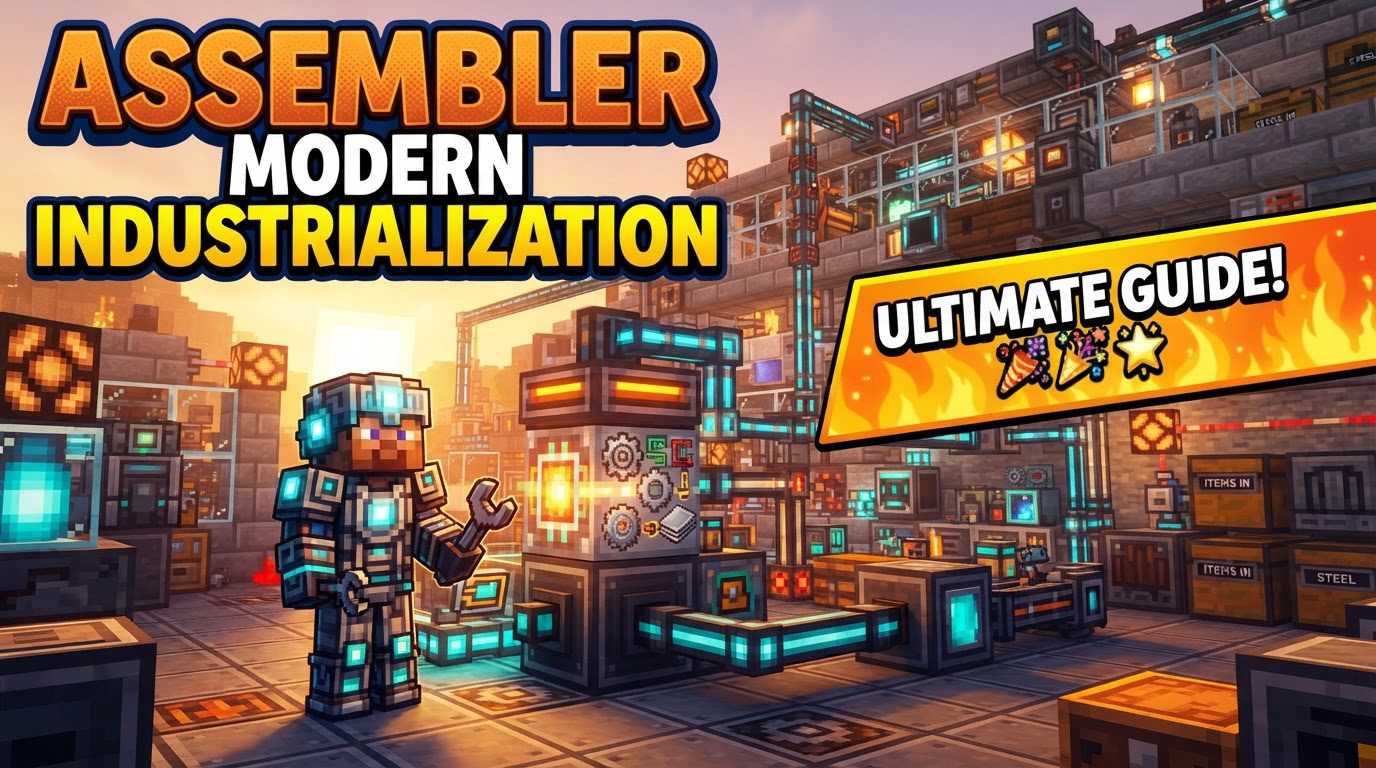
The Heart of Automation: What the Assembler Does
The MI Assembler is a crucial piece of machinery designed for automating complex crafting recipes within the Modern Industrialization mod. While it excels at autocrafting MI-specific items, its utility often expands significantly in modpacks, where it can handle a broader range of recipes. Think of it as your dedicated, tireless crafter, capable of producing items that would otherwise demand significant manual effort and time. Unlike simpler crafting stations, the Assembler focuses on industrial-scale production, making it indispensable for any serious MI setup.
Understanding the Assembler’s Core Principles
To effectively integrate the Assembler into your industrial empire, it’s vital to grasp its fundamental operational mechanics:
- Autocrafting Focus: At its core, the Assembler is built for automatic item production. It takes raw or semi-processed materials and transforms them into finished goods without player intervention, making it ideal for high-volume manufacturing.
- Recipe Discovery: All recipes compatible with the Assembler can be easily found and reviewed using popular in-game interfaces such as Just Enough Items (JEI), Roughly Enough Items (REI), or EMI. These tools are indispensable for planning your production lines and understanding ingredient requirements.
- Input and Output Dynamics: Operation is straightforward: supply the necessary ingredients into the Assembler’s input slots, and it will process them to produce the corresponding output item, which then appears in its output slots.
- Efficiency and Overclocking: Assemblers feature a dynamic efficiency system. They begin with a base power consumption per tick. However, as an Assembler repeatedly crafts the same recipe, it gains “efficiency points.” This accumulation allows the machine to process items at a significantly faster rate, albeit by utilizing more energy. This mechanic strongly encourages dedicated Assemblers for specific tasks.
- Electrical Power: As an advanced industrial machine, the Assembler requires electricity to function. Specifically, it operates on Low Voltage (LV) power, which must be supplied to it for any processing to occur.
- Recipe Overrides and Efficiency: For certain items, utilizing an Assembler can be demonstrably more resource-efficient than traditional crafting table methods. This often applies to complex MI components, where the Assembler might condense steps or optimize material usage.
Setting Up Your First Assembler
Deploying an Assembler is a straightforward process, paving the way for automated production:
- Crafting the Unit: Your first step is to gather the required materials and craft the Modern Industrialization Assembler itself. The recipe can, of course, be found in JEI/REI/EMI.
- Supplying Power: Once placed, the Assembler needs power. Connect it to a reliable Low Voltage (LV) electricity source. Without power, the machine will remain inert.
- Identifying the Target Recipe: Open your preferred recipe viewer (JEI/REI/EMI) and locate the specific item you wish to automate. Ensure the recipe explicitly states it can be crafted in an Assembler.
- Loading Ingredients: Place all the necessary input items for your chosen recipe into the Assembler’s designated input slots.
- Initiating Production: With power supplied and ingredients present, the Assembler will automatically begin processing. You’ll often see a progress bar or animation indicating its activity.
- Collecting Products: Once crafting is complete, the finished items will appear in the Assembler’s output slots, ready for collection or further automation.
Maximizing Your Assembler’s Potential
To truly leverage the Assembler’s capabilities and scale your industrial output, consider these advanced strategies:
- Strategic Slot Locking: The Assembler’s interface includes a powerful slot locking feature. This allows you to designate specific input or output slots for particular items. For instance, you can lock an output slot to empty, then drag the desired output item directly from JEI into that slot. This is invaluable for preventing unintended crafting, setting up multiple recipes within a single Assembler (though often less efficient), or ensuring dedicated production lines only accept specific components.
- Automate Complex Components: Prioritize using Assemblers for the production of intricate Modern Industrialization components. Items like Analog Circuits, Motors, Pistons, Conveyors, and Robot Arms are frequently required in large quantities for advanced machines and infrastructure. Automating their creation with Assemblers frees up your time for more complex tasks.
- Dedicated Machines for Peak Efficiency: For continuous, high-volume production of a single item, it is highly recommended to dedicate an Assembler to that specific recipe. This approach allows the machine to rapidly accumulate efficiency points, leading to significantly faster processing times and a more consistent output stream. Avoid constantly switching recipes if efficiency is paramount.
- Scaling Automation Over Time: While Assemblers are powerful tools, especially in the mid to late-game for complex items, early-game automation might start with a smaller setup. As your resource generation improves and your industrial needs grow, gradually scale up your Assembler usage. Building a dedicated Assembler for each major component will eventually become crucial for truly advanced automation.
Troubleshooting and Avoiding Common Pitfalls
Even experienced players can encounter issues. Being aware of common mistakes can save you significant time and resources:
- Insufficient Power: A frequently overlooked issue is simply a lack of power. An Assembler that isn’t receiving enough Low Voltage (LV) electricity will not function. Always double-check your power connections and generation capacity.
- Incorrect Recipe Input: The Assembler is precise. If the items placed in its input slots do not exactly match a valid recipe, it will not initiate crafting. Use JEI/REI/EMI to confirm the exact ingredients and their quantities.
- Inefficient Multi-Crafting: A common trap is attempting to use a single Assembler to craft many different items by constantly changing its inputs. Modern Industrialization machines, including the Assembler, are not designed for this. They can become inefficient, get “stuck,” or drastically slow down when switching recipes frequently. Dedicate machines for optimal performance.
- Neglecting JEI/REI/EMI: Failing to consult an in-game recipe viewer is a recipe for frustration. These tools are essential for understanding what can be crafted in an Assembler, what ingredients are needed, and even how to configure slot locking effectively.
- Ignoring Slot Locking: Overlooking the slot locking feature can lead to chaotic inputs and outputs. Without it, items can be placed in incorrect slots, or the Assembler might attempt to craft unintended recipes if a different set of inputs becomes available. Proper slot locking is key to stable and predictable automation.
The Modern Industrialization Assembler is more than just another crafting block; it’s a gateway to truly advanced automation. By understanding its mechanics, applying smart setup strategies, and avoiding common missteps, you can transform your Minecraft world into a powerhouse of automated production, allowing you to focus on the next grand engineering challenge.
Tags:
YOU MAY ALSO LIKE...


