

Minecraft Level 30 Enchantment Setup
Achieving the most potent enchantments in Minecraft boils down to one critical number: 15. This specific count of bookshelves, meticulously arranged, is the gateway to unlocking Level 30 enchantments – the highest tier available at an enchanting table. These powerful enchantments can transform your basic tools, weapons, and armor into legendary items, granting unparalleled efficiency, protection, and combat prowess. However, reaching this pinnacle of arcane power requires a precise setup and an understanding of the underlying mechanics. Deviating from the established rules, even slightly, can prevent you from accessing these coveted upgrades.
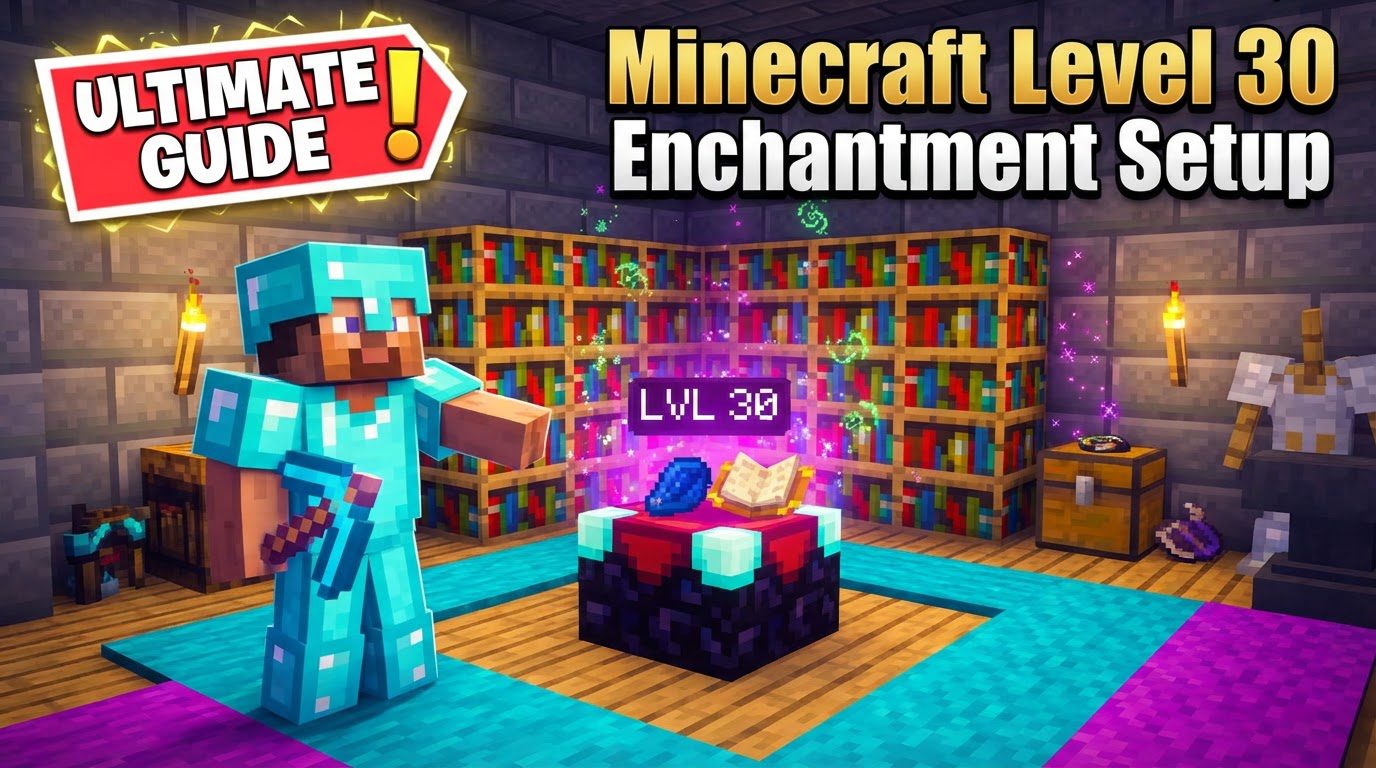
The Foundation: Understanding Level 30 Enchantments
To truly harness the magic of the enchanting table, it’s essential to grasp the core principles that govern its operation. The table’s ability to offer high-level enchantments is directly tied to its surroundings, specifically the presence and arrangement of bookshelves. Without the correct environment, the table will only present lower-tier enchantments, significantly limiting your potential for powerful gear.
- Bookshelf Requirement: The absolute cornerstone of a Level 30 enchantment setup is the presence of exactly 15 bookshelves. These magical blocks amplify the enchanting table’s power. It’s crucial to understand that exceeding 15 bookshelves offers no additional benefit; the table caps its power at this specific number.
- Precise Placement: Bookshelves are not merely decorative. They must be positioned one block away from the enchanting table itself. This creates a magical aura that the table draws upon. Think of it as a circuit; each bookshelf needs to be within direct magical range to contribute.
- Clear Space is Paramount: The one-block gap between the enchanting table and the surrounding bookshelves must remain entirely unobstructed. Any block, be it a torch, a carpet, a flower, or even a stray piece of dirt, placed within this critical space will sever the connection between the enchanting table and the bookshelves, effectively reducing the available enchantment level. This is a common pitfall that often frustrates players.
- Experience Cost and Player Level: While Level 30 enchantments offer the best results, they come with a cost. Each high-tier enchantment typically consumes 3 experience levels from your player’s total and requires Lapis Lazuli as a material component. Furthermore, to even *see* the Level 30 enchantment options, your player character must have accumulated at least 30 experience levels. The table won’t display the highest tier if your personal level is below this threshold.
- The Role of Randomness: The enchantments offered by the table are not entirely predictable. There’s a significant element of randomness involved. While the table will always present three options, their specific enchantments and levels are generated somewhat randomly. Selecting any enchantment, even a low-cost one, will cause the available options to re-roll for your next attempt, a mechanic crucial for seeking specific enchantments.
Building Your Enchantment Hub: A Step-by-Step Guide
Setting up your Level 30 enchantment station is a straightforward process once you know the requirements. Follow these steps to create your powerful enchanting hub.
- Gather Essential Materials: Before you begin construction, you’ll need a significant amount of resources.
- Enchanting Table: This central piece requires 4 Obsidian, 2 Diamonds, and 1 Book. Obsidian is typically found near lava sources or created by combining lava and water. Diamonds are rare ores found deep underground. A book is crafted from 3 Paper and 1 Leather.
- Bookshelves (15 Total): This is where the bulk of your material gathering will go. Each bookshelf requires 3 Books and 6 Wood Planks. To craft 15 bookshelves, you will need a grand total of 45 Books. This, in turn, translates to 135 Paper (made from Sugarcane) and 45 Leather (obtained from cows, horses, or hoglins). You’ll also need 90 Wood Planks, easily acquired from any type of tree.
- Lapis Lazuli: This blue dye ore is a crucial ingredient for every enchantment. You’ll need at least 3 pieces for a Level 30 enchantment, so stock up.
- Accumulate Experience Levels: Enchanting consumes experience. You’ll need to reach at least level 30 yourself to access the highest tiers. This can be achieved through various activities like mining, defeating hostile mobs, breeding animals, or smelting large quantities of items in a furnace.
- Craft Your Enchanting Table: Once you have the raw materials, head to a crafting table. Arrange 3 Obsidian in the bottom row, place 2 Diamonds on the left and right sides of the middle row, and put the single Book in the center slot of the top row.
- Place the Enchanting Table: Choose a suitable location for your enchantment setup. This can be in your base, a dedicated magic room, or anywhere you prefer. Place the enchanting table on the ground.
- Arrange the Bookshelves: This is the most critical step for achieving Level 30 enchantments. Place all 15 bookshelves around the enchanting table, ensuring there is a single block of air space between the table and the bookshelves. A highly effective and common arrangement is a 5×5 square layout, with the enchanting table positioned directly in the center. This leaves one side open for player access. Bookshelves can also be stacked two blocks high to conserve floor space, provided they maintain the one-block air gap directly next to the table.
- Enchant an Item: With your setup complete and your player at or above level 30, it’s time to enchant.
- Open the enchanting table interface by right-clicking it.
- Place the item you wish to enchant (tool, weapon, or armor) into the left-hand slot.
- Place Lapis Lazuli into the right-hand slot. For Level 30 enchantments, you will typically need 3 pieces.
- Observe the three enchantment options presented. The bottom option will generally be the highest tier available, often costing 3 experience levels and 3 Lapis Lazuli. Select it to apply the enchantment.
Mastering the Arcane Arts: Advanced Tips for Enchanting
While the basic setup provides access to Level 30 enchantments, understanding a few advanced techniques can significantly improve your chances of getting the specific enchantments you desire and managing your resources efficiently.
- Strategic Re-rolling of Enchantments: If the enchantments offered are not what you’re looking for, you don’t have to settle. A common strategy is to enchant a cheap, disposable item (like a wooden shovel or even a single book) using the lowest experience cost option. This “refreshes” the enchanting table, causing it to generate a new set of random enchantments for your next attempt on a valuable item.
- The Grindstone’s Utility: The grindstone is an invaluable tool for enchantment management. It allows you to remove unwanted enchantments from items, which can be useful for clearing an item for a new enchantment or simply cleaning up a tool. As an added bonus, removing enchantments with a grindstone will refund a small amount of experience, making it a sustainable choice.
- Dynamic Level Control with Temporary Blocks: Remember the critical one-block gap? You can strategically exploit this. By temporarily placing a block (or a torch) in the gap between the enchanting table and a bookshelf, you can intentionally reduce the number of active bookshelves. This lowers the maximum enchantment level offered, allowing you to access lower-tier enchantments for specific purposes or for more targeted re-rolls. Remove the block to restore the Level 30 options.
- Anvil Alchemy: Combining Enchantments: The anvil is where true enchantment mastery shines. It allows you to combine enchantments from books onto items, or even combine two identical enchanted items to create one item with higher-level enchantments (e.g., two Efficiency IV books can create one Efficiency V book, which can then be applied to a tool). To avoid the dreaded “Too Expensive!” message, which makes further modifications impossible, always combine enchantments in pairs. For example, if you have four enchanted books (A, B, C, D) for an item, combine A+B, then C+D, and finally combine the resulting (A+B) with (C+D) onto your item.
- Maintaining High Experience Levels: Enchanting, especially with re-rolls, is an experience-intensive process. It is highly beneficial to maintain your experience levels significantly above 30. This buffer ensures you can perform multiple enchantments or re-rolls without constantly needing to grind for more experience. Consider setting up an efficient XP farm to support your enchanting endeavors.
Avoiding Common Enchantment Pitfalls
Even seasoned players can make mistakes when setting up or using an enchanting table. Being aware of these common errors can save you time, resources, and frustration.
- Incorrect Bookshelf Count: A very frequent mistake is not having exactly 15 bookshelves. Too few, and you won’t get Level 30 enchantments. More than 15, and you’ve wasted resources without gaining extra power. Always double-check your count.
- Obstructed Gap Between Table and Bookshelves: This is arguably the most common and frustrating error. Placing anything in the one-block air gap – be it torches for light, carpets for aesthetics, flowers, or even a stray block from mining – will break the connection and prevent the adjacent bookshelves from contributing to the table’s power. Ensure this space is completely clear.
- Insufficient Player Experience: Attempting to access Level 30 enchantments when your player character is below level 30 will simply not work. The highest-tier options won’t even appear. Always check your experience bar before attempting a high-level enchantment.
- Misunderstanding Enchantment Randomness: Expecting specific enchantments every single time is a recipe for disappointment. The system is inherently random. Patience, along with strategic re-rolling, is often required to obtain the desired enchantment. Don’t get discouraged if you don’t get Mending on the first try.
- Anvil “Too Expensive!” Error: Repeatedly adding individual enchantments to an item on an anvil without strategic combining can quickly lead to the “Too Expensive!” message. This hard cap prevents further modifications to the item. To avoid this, always combine enchantments in groups (e.g., A+B, C+D, then combine the results) to keep the prior work cost down.
- Incompatible Enchantments: Certain enchantments simply cannot coexist on the same item. For example, Mending and Infinity cannot both be on a bow, nor can Riptide and Loyalty be on a trident. Trying to combine these will result in an error or prevent one of the enchantments from being applied. Always be aware of these fundamental incompatibilities.
With a properly configured setup and a solid understanding of these mechanics, you’ll be well-equipped to forge powerful, enchanted gear that will serve you faithfully through all your Minecraft adventures.
Tags:
YOU MAY ALSO LIKE...


