

Why Your Automatic Chicken Farm Stops Producing Eggs
Did you know that a single Minecraft update can instantly render your meticulously designed automatic chicken farm completely useless? Many players spend hours perfecting their automated food sources, only to return later and find the egg production has ceased, the cooked chicken supply has dwindled, or the farm has simply stopped working altogether. The frustration is real, but often, the solutions are simpler than you might think. From subtle game mechanic changes to overlooked redstone quirks, here are the most common reasons why your automatic chicken farm might be experiencing a dry spell.
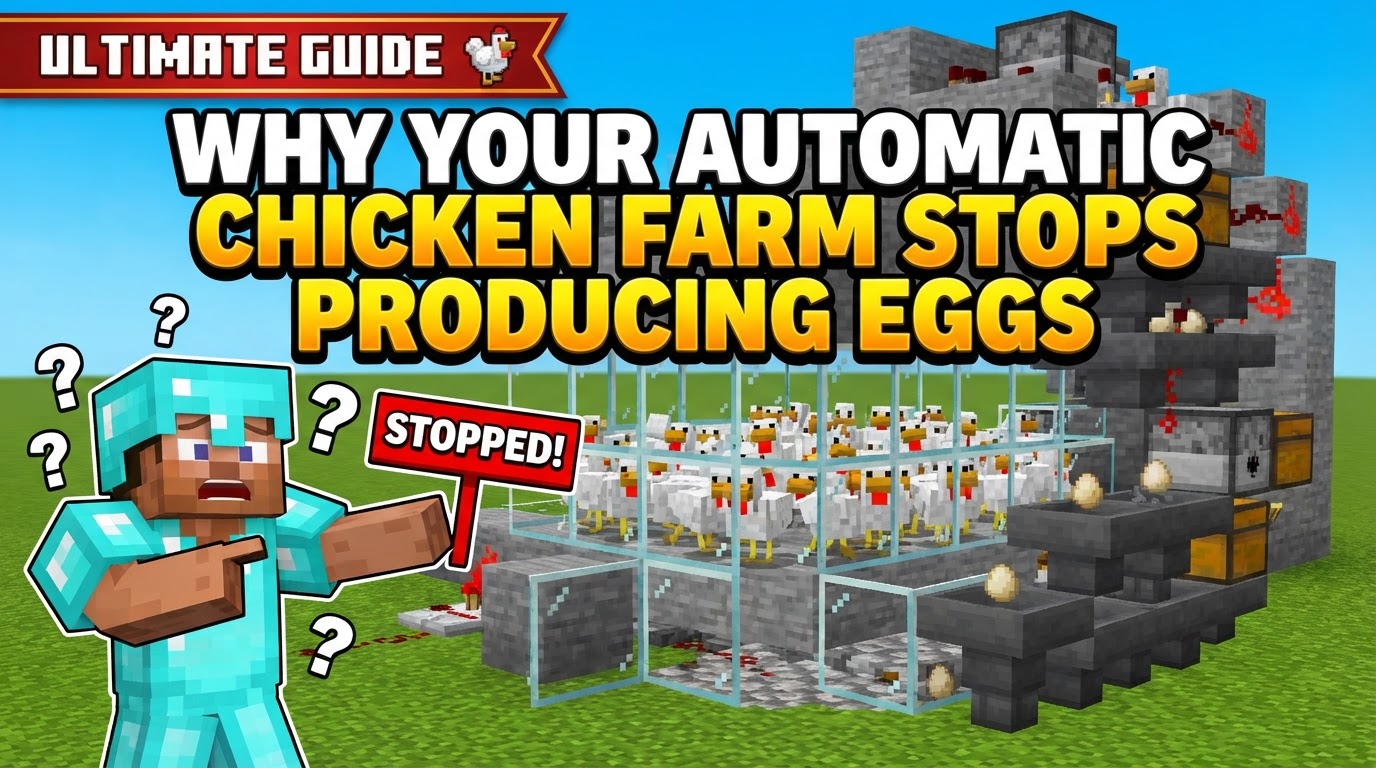
The 1.21.10 Update’s Unforeseen Consequences: Baby Chick Death
One of the most recent and impactful reasons for a sudden farm failure stems directly from the Minecraft 1.21.10 update. This version introduced a new entity collision behavior that has profoundly affected traditional automatic chicken farm designs. Specifically, when an egg is dispensed from your farm’s mechanism, the resulting baby chick is now momentarily knocked one block upward. If your farm utilizes an open lava source directly above the chicks to cook them as they grow, this upward knock-back proves fatal. The baby chick instantly touches the lava and dies, without dropping any feathers or raw chicken. This means your farm, which once reliably produced cooked chicken and feathers, now yields absolutely nothing.
The implications of this change are severe: zero output. Your collection chests will remain empty, giving the impression that your farm has completely broken. Thankfully, the fix is often straightforward and doesn’t require a complete overhaul of your redstone. Replacing the open lava with a solid block (if the lava is meant for cooking adult chickens) or, more effectively, using a lava-filled cauldron in place of open lava, can mitigate this issue. A cauldron provides the necessary heat for cooking adult chickens without posing an immediate threat to newly spawned chicks due to its contained nature. This simple adjustment can bring your farm back to full production without extensive modifications.
Redstone Timing Glitches: The Egg Overflow Conundrum
Even the most perfectly constructed redstone circuits can sometimes falter under specific conditions. In some automatic chicken farm designs, particularly those relying on comparators to detect eggs in a dispenser, a subtle timing issue can lead to significant problems. If your adult chickens lay two eggs within an extremely short timeframe – specifically, within 0.4 seconds of each other – the comparator might only register and activate once. This means that while two eggs were laid and entered the dispenser, only one is actually dispensed.
Over time, this discrepancy causes eggs to accumulate within the dispenser. As the dispenser fills, it eventually overflows. Once eggs start spilling out of the dispenser and into the hopper below (which is usually meant for collecting processed items), it can create a loop where the hopper constantly feeds items back to the dispenser or keeps the comparator perpetually active, confusing the farm’s logic. This reduces the farm’s efficiency drastically, as not all eggs are processed, and can ultimately lead to a complete halt in operation, leaving you wondering why your steady supply of eggs has suddenly dried up.
Item Incineration: Lava’s Double-Edged Sword
Lava is a crucial component in many automatic chicken cooker designs, providing an efficient way to cook adult chickens and sanitize unwanted drops. However, it’s also a common culprit for a lack of output. A frequent issue in cooker farms is that the valuable drops – cooked chicken and feathers – can burn up in the lava before hoppers have a chance to collect them. This leads to a significantly reduced yield, or in severe cases, no output at all in your collection chests.
This problem was particularly prevalent in earlier designs, but solutions exist that offer near-perfect item recovery. One highly effective method, similar to the fix for the 1.21.10 update, involves using a lava-filled cauldron instead of an open lava block. The cauldron contains the lava, preventing items from directly touching it while still providing the heat to cook chickens. Another robust solution is to employ a hopper minecart positioned underneath the collection point. Hopper minecarts have a larger item pickup range and are known for their 100% reliability in collecting drops, ensuring that almost nothing goes to waste. Furthermore, some builders have found that using a stonecutter block instead of a regular slab at the collection point can improve item pickup rates, as its hitbox allows for better interaction with falling items.
Misaligned Components: The Hopper and Redstone Puzzle
Automatic farms, by their nature, rely on precise placement and functionality of every component. One of the most fundamental yet frequently overlooked issues is incorrect hopper or redstone placement. Hoppers are the veins of any item transport system in Minecraft, and they must be pointing in the correct direction to function. A hopper needs to be aimed directly into a chest, dispenser, or another hopper for items to flow. If a hopper is pointing into a solid block, or simply not aligned correctly with its intended destination, items will get stuck, bringing your farm to a standstill.
Similarly, redstone components are the brains of the operation. Redstone torches, repeaters, comparators, and dust all have specific behaviors and placement requirements. An incorrectly placed redstone torch (e.g., powering a block it shouldn’t, or not powering one it should), a repeater facing the wrong way, or even a single piece of redstone dust broken or misplaced can prevent the entire mechanism from activating or cause it to malfunction. For instance, if a hopper that’s supposed to feed eggs into a dispenser is covered by a full block, items cannot pass through. Thoroughly double-checking the direction of every hopper and the precise placement of all redstone components against a reliable tutorial is often the first step in diagnosing and fixing a non-producing farm.
Overpopulation Hazards: Entity Cramming and Suffocation
While the goal of a chicken farm is to have plenty of birds, there’s a point where “too many” becomes a problem. Having an excessive number of chickens (typically more than 24) in a single small enclosed space can lead to a phenomenon known as entity cramming. When too many entities occupy the same block space, they start taking damage and eventually die. Chickens can push each other into walls or corners, leading to suffocation and mysterious disappearances from your farm. This directly reduces your egg-laying population, which in turn diminishes your farm’s output.
Baby chickens are also particularly vulnerable. Due to their small size, they can drown in shallow water sources that adult chickens would simply walk over, or be instantly killed if a dispenser is firing items directly at their hitbox. To prevent these issues, ensure that your chicken enclosure provides adequate space for your birds. Using non-solid blocks like fences or glass for walls can sometimes mitigate suffocation risks, as chickens are less likely to get stuck. Carefully designing water flows or adjusting the dispenser’s position can also protect fragile baby chicks from accidental harm, maintaining a healthy and productive flock.
The Waiting Game: Initial Setup and Patience
Sometimes, the farm isn’t broken; it just needs time. For newly constructed automatic chicken farms, especially those designed to cook adult chickens, patience is a virtue. Adult chickens don’t lay eggs instantly; they have a natural cooldown period. Furthermore, when a dispenser fires an egg, there’s only a chance (typically 1 in 8) that it will spawn a baby chicken. This means that establishing a healthy, egg-laying population can take a significant amount of real-world time.
If your farm is built to grow chicks into adults for cooking, those baby chickens need to mature first, which takes 20 minutes of in-game time. During this initial phase, the output will naturally be low or non-existent. It’s easy to assume the farm is malfunctioning when it’s simply awaiting the natural game mechanics to play out. The solution here is straightforward: ensure you have a sufficient number of adult chickens in your egg-laying pen to guarantee a steady supply of eggs, and then simply wait. The farm will eventually reach its full production capacity as the cycles complete.
Most automatic chicken farms in Minecraft are relatively simple in their core design: chickens lay eggs, a hopper collects them, a dispenser fires them, and a mechanism either collects the eggs or grows/cooks the resulting chickens. The beauty of these farms lies in their automation, but their vulnerability often comes from slight misalignments, unexpected game updates, or an incomplete understanding of their internal mechanics. By systematically checking these common issues, you can often diagnose and fix your farm, restoring it to its clucking, clucking, productive glory.
Tags:
YOU MAY ALSO LIKE...


