

The Science of Water Elevator Speed Variation
The notion of fine-tuning the speed of a Minecraft water elevator is largely a misconception; a perfectly constructed bubble column elevator operates at a consistent, inherent velocity. While older, less efficient vertical water transport methods offered varying degrees of sluggishness, the modern bubble column, introduced in the 1.13 Update Aquatic, delivers a fixed, rapid ascent or descent, approximately 11 blocks per second, when built correctly. Any perceived “variation” in speed almost invariably points to a fundamental flaw in its construction, preventing it from reaching its optimal, fixed potential.
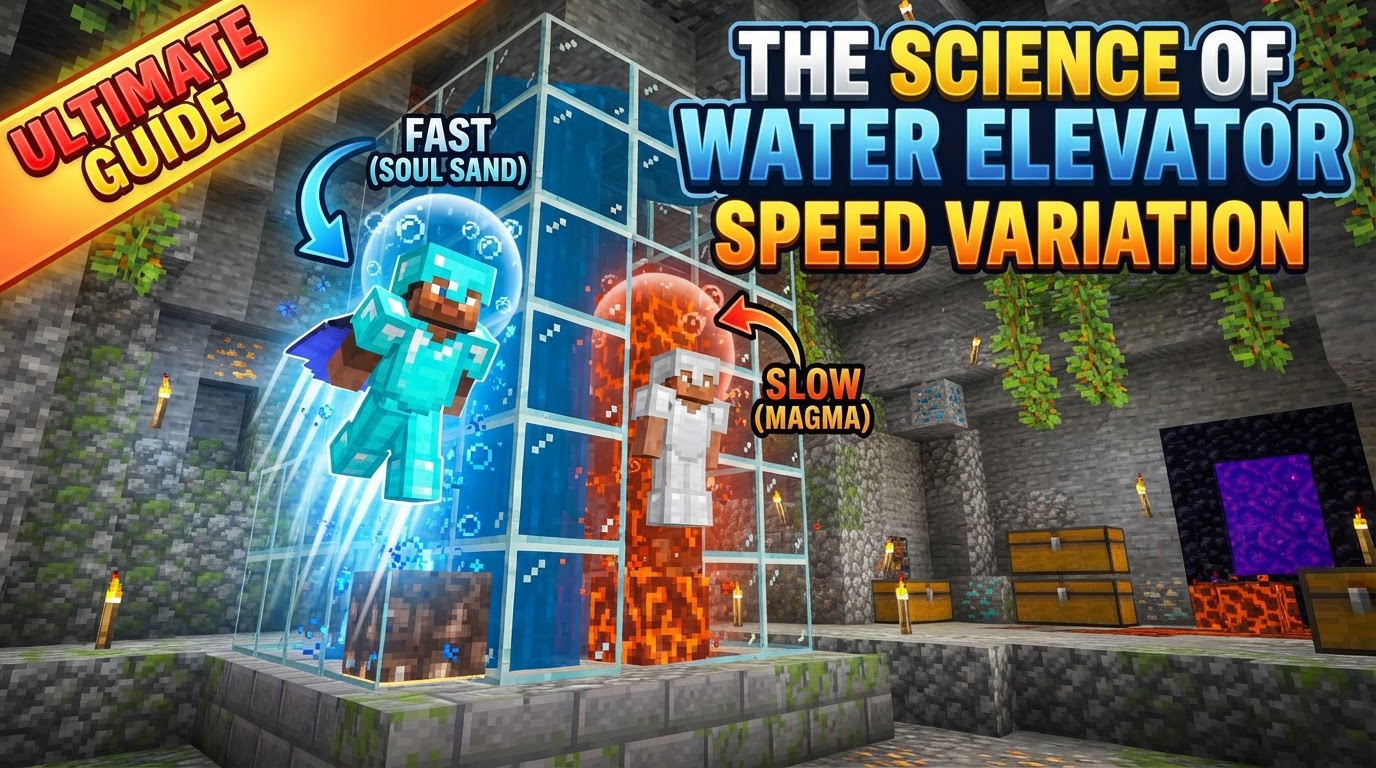
This guide delves into the science behind these incredibly efficient vertical transport systems, explaining precisely how they function and, crucially, how to ensure yours consistently achieves maximum speed by avoiding common pitfalls that lead to suboptimal performance.
The Core Mechanics of Vertical Travel
At the heart of every high-speed water elevator lies the ingenious bubble column. These dynamic forces are generated by specific blocks placed at the bottom of a column of water, creating either an upward or downward pull. Understanding these foundational elements is paramount to mastering vertical travel.
- Soul Sand: The Upward Thrust
When a block of Soul Sand is submerged at the base of a vertical water column, it generates an upward-pulling bubble column. This powerful current propels any entity – be it a player, a mob, or an item – rapidly towards the surface. It’s the go-to block for efficient ascent in any base or build requiring quick vertical movement. - Magma Block: The Downward Descent
Conversely, placing a Magma Block at the bottom of a water column creates a downward-pulling bubble column. This force swiftly pulls entities towards the base. While incredibly effective for descent, Magma Blocks do inflict minor damage upon contact, a detail that requires a specific countermeasure for players, as discussed later. - The Non-Negotiable Requirement: Water Source Blocks
This is perhaps the single most critical factor in water elevator functionality and speed. For a bubble column to form and operate at its maximum efficiency, every single block in the vertical column must be a water source block. Flowing water, which naturally occurs when water is placed and spreads, will not generate a functional bubble column. The distinction between a source block (which doesn’t flow away) and a flowing water block (which does) is absolute for this mechanic. - Oxygen Restoration: A Lifesaving Feature
A significant quality-of-life improvement offered by bubble columns is their continuous restoration of a player’s oxygen supply. Whether ascending or descending, being enveloped by the bubbles prevents drowning, irrespective of the elevator’s height. This eliminates the need for enchantments like Respiration or carrying water breathing potions, making vertical travel completely safe and worry-free.
Understanding “Speed Variation”: The Optimal Constant
As established, the inherent speed of a perfectly constructed bubble column elevator is remarkably consistent, clocking in at approximately 11 blocks per second. This speed is hardcoded into the game’s mechanics and cannot be altered or “varied” through different construction techniques, block choices (beyond Soul Sand or Magma), or redstone contraptions. When players observe what they perceive as “speed variation,” they are almost always encountering one of two scenarios:
- Suboptimal Construction: The most common reason for a slower-than-expected water elevator is that it hasn’t been built correctly. Lacking a full column of water source blocks, or using the wrong base block, will either prevent the bubble column from forming entirely or result in a significantly reduced, erratic pull. In these cases, the elevator isn’t “varying” its speed; it’s simply not functioning as intended.
- Comparison to Older Methods: Before the 1.13 Update Aquatic, vertical water elevators were clunky and slow. Players had to constantly jump while ascending through water, or rely on complex, slower piston-based systems. Compared to these archaic methods, the bubble column’s speed is a revolutionary constant, making any discussion of “variation” within the modern context moot for optimal builds.
Blueprint for Velocity: Constructing an Optimal Water Elevator
Achieving that consistent, rapid 11 blocks/second speed requires adherence to a precise construction method. Follow these steps to guarantee your water elevator performs flawlessly:
- Build the Enclosure: Begin by constructing a vertical shaft. A 1×1 internal dimension is standard and efficient. Use sturdy, solid blocks for the walls; transparent blocks like glass are excellent for visibility. Ensure the shaft is fully enclosed to contain the water.
- Securing the Entrance/Exit: At the very bottom of your shaft, create an entrance that prevents water from flowing out. The simplest and most effective method is to place a sign or an open door at the opening. These blocks block water flow but allow player passage.
- Initial Water Fill: Go to the very top of your newly built shaft. Place a single water bucket into the shaft. Allow this water to flow completely down to the bottom. At this stage, the column will consist mainly of flowing water blocks.
- The Kelp Conversion Technique: This is the crucial step for converting flowing water into source blocks. Descend to the bottom of your water-filled shaft. Begin planting kelp on the base block. Continuously plant kelp upwards, one block at a time, until the kelp stalk reaches the very top of the water column. As kelp grows, it automatically converts all flowing water blocks it occupies into water source blocks.
- Clearing the Kelp: Once the kelp reaches the top, break the very bottom-most kelp block. All the kelp above it will instantly break and float upwards as items. This leaves you with a perfect column of 100% water source blocks.
- The Foundation Block: Soul Sand or Magma: Finally, replace the bottom-most block of your shaft (where you initially planted the kelp) with either a Soul Sand block for an upward elevator or a Magma Block for a downward elevator. The moment you place the correct block, the bubble column will instantly form, ready for use.
Maximizing Efficiency and Player Experience
Beyond the core construction, a few practical tips can enhance the usability and safety of your water elevator:
- Visibility and Aesthetics: Using Transparent Blocks: Constructing the shaft walls with glass, stained glass, or even barriers allows players to see their surroundings during travel. This not only improves aesthetics but can also prevent disorientation.
- Safe Landing: The Top Buffer: For upward Soul Sand elevators, build a small buffer zone or platform slightly above the exit point. This prevents players from being shot out too high and potentially taking fall damage or landing awkwardly. A 1-2 block high ceiling above the exit point is often sufficient.
- Mitigating Damage: Crouching on Magma: If you’re using a downward Magma Block elevator, remember that contact with the Magma Block itself inflicts minor damage. To completely negate this, simply hold the crouch (sneak) button as you reach the bottom. This prevents the damage while still allowing the downward pull.
- Water Containment: Signs and Doors: As mentioned, signs and doors are invaluable for containing the water at the entrance and exit points without impeding player movement. They are simple, effective, and require no redstone.
Common Obstacles to Optimal Speed
Many players encounter issues that lead them to believe their water elevator is “slow” or “varying” in speed. These are almost always due to easily correctable errors:
- The Scourge of Flowing Water: This is by far the most frequent mistake. If even one block in your vertical column is flowing water instead of a source block, the bubble column will not form correctly, if at all. The kelp method is foolproof for ensuring all blocks are sources.
- Incorrect Base Block Placement: Forgetting to place either Soul Sand or a Magma Block at the bottom, or accidentally placing the wrong one for the desired direction, will obviously prevent the elevator from working. Double-check your foundation.
- Subtle Version Discrepancies: While the core mechanics for bubble columns are consistent across Minecraft Java and Bedrock editions, minor behavioral differences can sometimes exist. These are rarely significant enough to affect core speed but might influence player interaction with the bubbles or specific niche block placements. Always verify behavior in your specific game version if you encounter unexpected issues.
- Preventing Player Entrapment: Ensure the water column is fully sealed. Gaps in the walls can cause water to flow out, breaking the source block chain. Similarly, accidentally placing a Soul Sand block while falling through an unformed column can cause players to get stuck in the block itself.
In conclusion, the science of water elevator speed variation in Minecraft boils down to a singular, consistent truth: optimal performance is fixed. There is no secret trick to making a bubble column faster or slower once it’s correctly built. The “speed variation” players perceive is merely the difference between a perfectly constructed, rapid ascent/descent and a flawed, non-functional, or sluggish imitation. By understanding the critical role of water source blocks, utilizing the kelp method, and correctly placing Soul Sand or Magma Blocks, you can ensure your vertical transport systems are always operating at peak, unwavering efficiency.
Tags:
YOU MAY ALSO LIKE...


