The Complete Breakdown of Anvil Repair Cost Calculation
Many players believe that if an item becomes “Too Expensive!” to repair in an anvil, simply crafting a new anvil will reset its hidden costs. This is a common misconception that can lead to frustration and wasted resources. In reality, the intricate system governing Minecraft’s anvil repair costs is designed to prevent players from indefinitely creating and maintaining “god items” without significant investment, and it hinges on factors inherent to the item itself, not the anvil it’s placed upon.
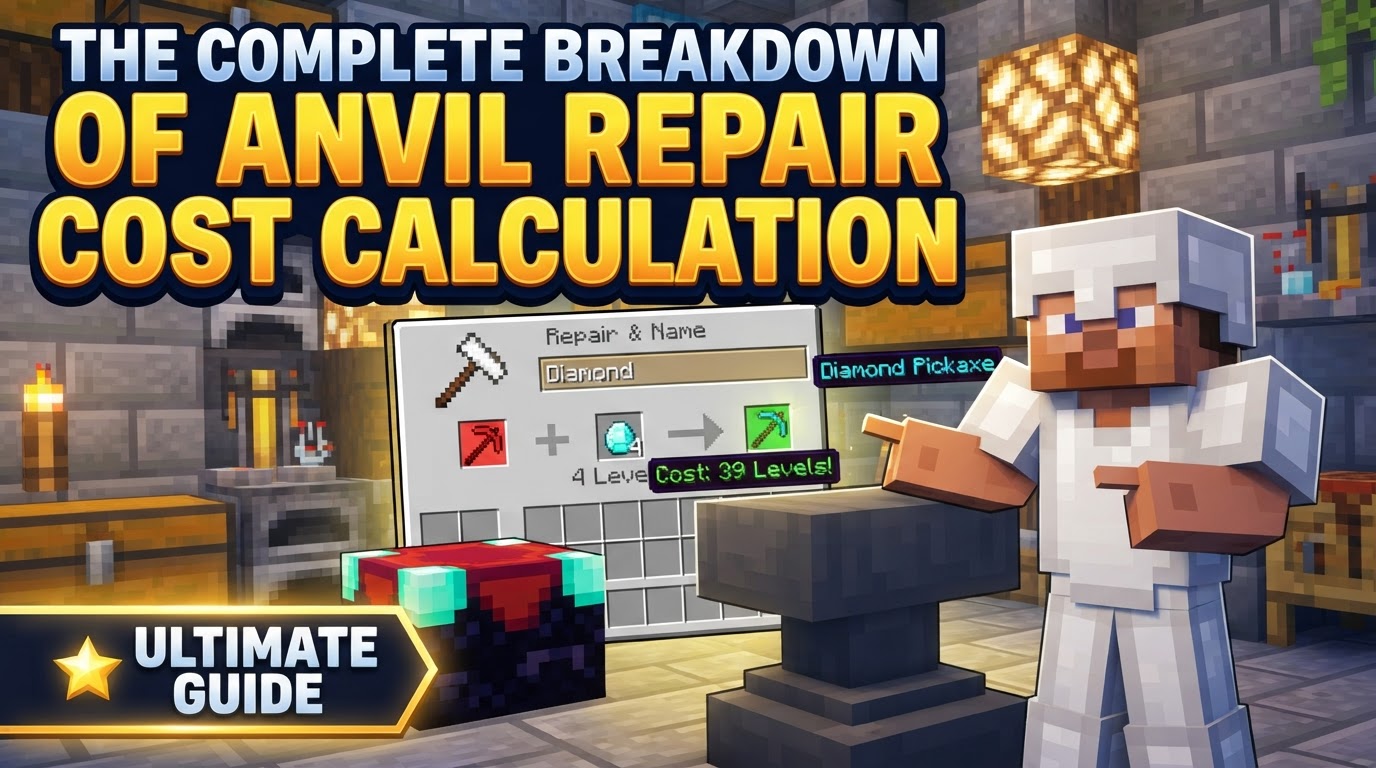
Understanding this complex calculation is paramount for any seasoned Minecraft player. It allows for efficient gear maintenance, prevents beloved enchanted tools from becoming unusable, and ultimately saves precious experience levels. This comprehensive guide will dissect every aspect of the anvil cost system, from the notorious Prior Work Penalty to strategic repair methods.
Core Mechanics of Anvil Costs
The anvil system is a delicate balance between utility and resource management. Every interaction with an anvil contributes to an item’s history, influencing future repair and enchantment costs. Several fundamental mechanics underpin this system:
- Prior Work Penalty (PWP): This is arguably the most impactful factor. Each time an item is processed in an anvil-whether repaired, combined, or even just renamed-it accumulates a hidden “prior work penalty.” This penalty increases exponentially with subsequent operations, making later repairs significantly more expensive.
- “Too Expensive!” Cap: A critical limiter in Survival and Adventure modes. If the calculated cost for an anvil operation reaches 40 or more experience levels, the item will display “Too Expensive!” and the operation cannot be performed. This cap does not apply in Creative mode.
- Cost Components: The total experience level cost is an aggregate of several distinct values: a base cost, prior work penalties from both input items, repair costs for durability, enchantment costs for new or combined enchantments, and renaming costs.
- Anvil Use Count for Combined Items: When two items are combined in an anvil, the resulting item inherits its prior work count from the higher of the two input items, and then adds one to that count. This is crucial for planning multi-enchantment operations.
- Anvil Degradation: Anvils themselves are not infinite. Each use carries a 12% chance of degrading the anvil, moving it through stages (Anvil, Chipped, Damaged) until it breaks. A damaged anvil cannot be repaired and must be replaced. Crucially, replacing the physical anvil block has no effect on an item’s inherent prior work history.
The Prior Work Penalty: The Exponential Culprit
The Prior Work Penalty (PWP) is the primary driver of escalating anvil costs. It’s a hidden integer associated with every item that has ever been placed in an anvil. The formula governing its cost contribution is 2^n - 1, where ‘n’ represents the number of times an item has been processed in an anvil.
- A brand-new, untouched item has a PWP of 0.
- After its first anvil operation, ‘n’ becomes 1, and the PWP cost added is
2^1 - 1 = 1. - After a second operation, ‘n’ becomes 2, and the PWP cost added is
2^2 - 1 = 3. - After a third, ‘n’ becomes 3, and the PWP cost added is
2^3 - 1 = 7. - This exponential growth means that after just a few operations, the PWP alone can consume a significant portion of the “Too Expensive!” cap. Both the target item and the sacrifice item (if applicable) contribute their respective PWP values to the total cost.
Unpacking the Cost Components
Beyond the PWP, several other factors contribute to the total experience cost of an anvil operation:
- Base Value: A small, minimum experience cost is always included in any anvil operation. This is a foundational cost regardless of other factors.
- Repair Cost: If the target item is damaged, a base cost of 2 levels is added for repair. Additionally, if the repair uses materials (e.g., diamonds for a diamond pickaxe), each unit of material repairs 25% of the item’s maximum durability, adding further cost based on the material’s value.
- Enchantment Cost: This is a variable cost that depends on the number, level, and rarity of enchantments being added or combined. Enchantments have inherent “weights” or “rarity multipliers.” Applying enchantments from books is generally more economical than combining two already enchanted items, as the latter incurs PWP from both items and a potentially higher base enchantment cost for merging.
- Renaming Cost: Initially, renaming an item costs 1 experience level. This cost can increase slightly if the item has been renamed multiple times. Renaming can often be performed concurrently with other operations, potentially saving an anvil use count if planned carefully.
Step-by-Step Calculation Explained
To understand how the total cost is derived, let’s follow the calculation process Minecraft uses:
- Identify Target and Sacrifice: The item placed in the left slot of the anvil is the primary “target” item. The item, material, or enchanted book in the right slot is the “sacrifice” item.
- Calculate Prior Work Penalty: Determine the PWP for both the target item and the sacrifice item based on their individual histories of anvil uses (using the
2^n - 1formula). Both these calculated penalties are added to the running total. - Calculate Repair Cost: If the target item is damaged and materials or another item are used for repair, the base 2-level repair cost plus any additional costs for materials (based on quantity and type) are added.
- Calculate Enchantment Cost: If enchantments are being added from a book or combined from another item, their specific costs (influenced by level, rarity, and number of enchantments) are factored in and added to the total.
- Calculate Renaming Cost: If a custom name is being applied, the renaming cost (initially 1 level) is added.
- Sum All Costs: All the individual costs-PWP from both items, repair cost, enchantment cost, and renaming cost-are summed together to arrive at the total experience level cost for that specific operation.
- Check “Too Expensive!” Cap: The final calculated total is then compared against the 40-level cap. If the total is 40 or greater, the operation is blocked, and the item cannot be modified.
Strategic Anvil Management: Tips for Efficiency
Mastering anvil costs involves strategic planning to keep the “Too Expensive!” message at bay:
- Binary/Tree Combining Method: When merging multiple enchantment books onto a final item, adopt a “tree-like” or “binary” combining strategy. Instead of adding books one by one to your main tool, combine two books together, then combine another two, and then combine the results of those operations, and so on. This minimizes the number of times your final, valuable gear is placed in the anvil, thus dramatically reducing its Prior Work Penalty.
- Combine Books First: Always consolidate enchantment books to their highest desired levels or combine multiple enchantments onto a single book before applying them to your primary tool or armor piece. This ensures the target item’s prior work penalty remains as low as possible for as long as possible.
- Mending Enchantment: Apply Mending to all your valuable tools, weapons, and armor as early as possible. Mending allows items to repair themselves using experience orbs collected from various activities, effectively bypassing the need for repeated, costly anvil repairs altogether once applied. This is the ultimate long-term solution for item longevity.
- Prioritize Renaming: If you plan to rename an item, try to do it during one of its earliest anvil operations. While renaming does add to the overall cost, incorporating it into an initial enchantment or repair step can prevent it from being a standalone operation that needlessly increases the item’s prior work count later on.
- Repair Before Enchanting: Some players find it beneficial to fully repair an item’s durability before applying new enchantments. While not always a massive saving, it can sometimes optimize the cost calculation slightly by not adding repair costs to an already complex enchantment merge.
Pitfalls to Avoid: Common Anvil Mistakes
Even experienced players can fall into common traps that quickly make gear “Too Expensive!”:
- Applying Enchantments One by One: This is perhaps the most common and costly mistake. Adding each individual enchanted book sequentially to a tool or armor piece will rapidly increase its Prior Work Penalty, almost guaranteeing it hits the “Too Expensive!” cap after just a few enchantments. Always use the binary combining method for books.
- Ignoring Prior Work Penalty: Failing to understand that every single anvil use contributes to an item’s hidden history and future costs is a recipe for disaster. This leads to items becoming unusable much faster than anticipated.
- Using a Grindstone to Reset PWP: A grindstone can remove enchantments from an item, giving back some experience. However, it is crucial to understand that a grindstone does not reset an item’s hidden prior work history or penalty. Once an item has been in an anvil, its PWP count is permanent.
- Replacing a Damaged Anvil: As mentioned, anvils degrade and break. Crafting and placing a new anvil block does absolutely nothing to reset the prior work history of an item. The item’s history is intrinsic to the item itself, stored as NBT data, and is not tied to the physical anvil block used.
By internalizing these mechanics, strategies, and common pitfalls, you can master the anvil, efficiently maintain your most valuable gear, and keep your experience levels where they belong: in your pockets, ready for the next adventure.
Tags:
YOU MAY ALSO LIKE...