

Understanding Sculk Catalyst Infection Spread Patterns
One of the most persistent misconceptions surrounding Minecraft’s Deep Dark biome is the fear of unleashing a Warden through every sculk-related interaction. While the terrifying Warden is indeed synonymous with this dark realm, it’s crucial to understand that not all sculk activity leads to its summoning. Specifically, the sculk shriekers generated by a Sculk Catalyst, the true engine of sculk infection, pose no threat of summoning the Warden, regardless of how often they are triggered. This single fact empowers players to harness the Catalyst’s power without constant dread, opening up vast possibilities for automation and resource generation.
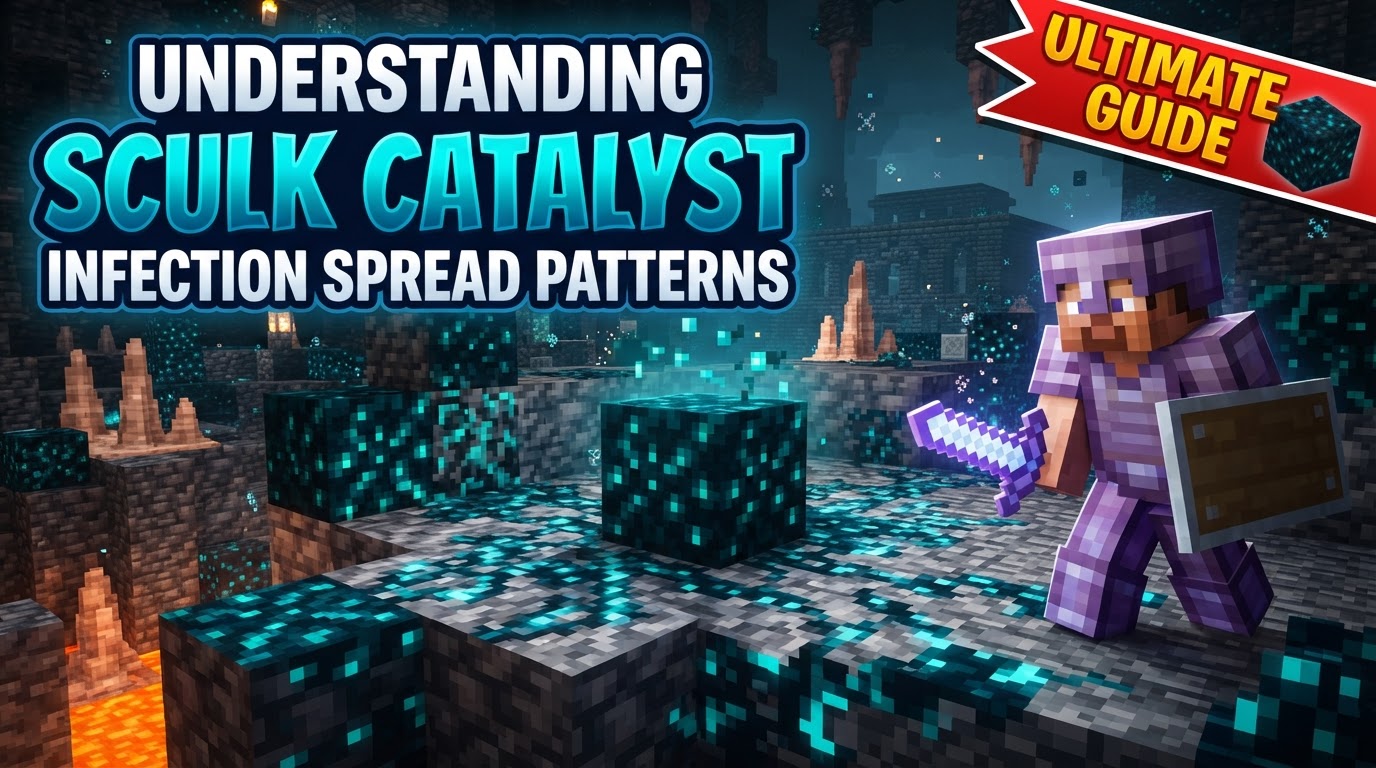
The Genesis of Growth: Understanding the Sculk Catalyst
The Sculk Catalyst is a remarkable block found deep within the Overworld, primarily in the Deep Dark biome and Ancient Cities. Its primary function is to convert nearby blocks into various sculk-related blocks, fueled by the experience points (XP) of dying mobs. This unique mechanic makes the Catalyst a cornerstone for both advanced farming operations and for understanding the eerie, organic spread of sculk throughout its natural habitat.
A Sculk Catalyst activates whenever a mob, including a player, perishes within an 8-block spherical radius of it. Upon activation, the Catalyst consumes the experience points that the dying mob would normally drop. This consumption is not just a trigger; it’s the very fuel for the sculk’s expansion. The more XP a mob yields, the more extensive and intense the resulting sculk spread will be. This direct proportionality between XP and spread range is a fundamental principle for anyone looking to control or optimize sculk growth.
The Dynamic Process of Infection: From Death to Bloom
The sculk infection process is a fascinating chain of events. It begins with the simple presence of a Sculk Catalyst, either naturally generated or placed by a player. When a mob meets its end within the Catalyst’s 8-block sphere of influence, the Catalyst immediately absorbs the mob’s XP. This absorption is visually represented by soul particles emanating from the Catalyst, a clear indicator that the “blooming” process has begun.
Following this, the Catalyst begins to convert susceptible blocks in its vicinity. This conversion spreads outwards, transforming ordinary blocks into sculk blocks, sculk veins, sculk sensors, and occasionally, sculk shriekers. An interesting aspect of this spread is the “bubbling charge”: if a mob dies on existing sculk blocks, this charge can travel through the sculk to the nearest replaceable blocks, extending the infection further from the initial Catalyst point. This allows for more dynamic and potentially larger-scale sculk growth than just the initial activation.
Each Sculk Catalyst possesses an internal storage capacity of 1,000 experience points. This means it can accumulate XP from multiple mob deaths before it reaches its maximum potential for a single bloom event. Understanding this capacity can help in designing efficient sculk farms that maximize the Catalyst’s conversion potential.
Environmental Transformation: What Blocks Succumb to Sculk
Not all blocks are equally susceptible to the Sculk Catalyst’s transformative power. The infection primarily targets “weak” or easily breakable blocks. Common examples include dirt, stone, deepslate, gravel, sand, and various types of terracotta. These blocks are readily converted into sculk blocks, sculk veins, sculk sensors, or sculk shriekers. The resulting sculk often forms intricate patterns, resembling an organic growth that consumes its surroundings.
However, many blocks are immune to this full conversion. Harder blocks, such as ores (like iron or gold ore), obsidian, and certain crafted blocks, cannot be turned into sculk blocks. While these blocks resist full transformation, they are not entirely immune to the sculk’s influence; sculk veins can still appear on their surfaces, giving them a sculk-covered appearance without changing their underlying block type. This distinction is vital for planning containment strategies and understanding the aesthetic impact of sculk spread.
During the sculk generation process, there’s a specific probability for special sculk blocks to form. A Sculk Shrieker has a 9% chance of generating, while a Sculk Sensor has a 1% chance. It’s imperative to reiterate that shriekers generated by a Sculk Catalyst will *never* summon a Warden. This crucial difference allows players to freely cultivate sculk without the looming threat of the Deep Dark’s most formidable guardian.
Strategic Control and Efficient Utilization
The Sculk Catalyst is not just an environmental oddity; it’s a powerful tool. Its XP-consuming nature makes it ideal for creating efficient experience point farms. By setting up mob grinders near a Catalyst, players can convert mob drops into sculk blocks and simultaneously gain XP by breaking the sculk, or simply use the Catalyst to collect XP from mob deaths without having to manually pick it up.
Controlling the spread of sculk is equally important. The infection is not infinite; it is limited by the amount of XP consumed and the availability of replaceable blocks. To prevent unwanted sculk growth, strategic placement of immune blocks is key. Hard blocks like obsidian, bedrock, or even certain crafted blocks can act as effective barriers, stopping the sculk from spreading further. Interestingly, farmland is also known to halt the progression of sculk, offering another option for containment.
Harvesting sculk resources requires specific tools. Sculk blocks can be collected as items only with a Silk Touch enchanted tool. Without Silk Touch, breaking sculk blocks will simply yield experience points. Similarly, a Sculk Catalyst itself requires Silk Touch to be picked up as an item; otherwise, it will be destroyed and drop a modest 20 XP. Finding Catalysts naturally involves venturing into the Deep Dark, particularly Ancient Cities, where they often appear around Y: -52. They can also be found in Ancient City chests, or rarely dropped by a Warden upon defeat, though the latter is an extremely perilous endeavor.
Dispelling Common Sculk Misconceptions
The mystique of the Deep Dark has led to several misunderstandings about sculk. Perhaps the most significant is the belief that any Sculk Shrieker can summon a Warden. As established, only naturally occurring shriekers that are intrinsically linked to Ancient Cities possess this terrifying ability. Shriekers generated by a Sculk Catalyst are harmless in this regard, functioning merely as sound detectors.
Another common misconception is the idea of sculk infecting an entire world uncontrollably. This is far from the truth. Sculk spread is inherently limited by the amount of XP consumed and the presence of susceptible blocks. Without continuous mob deaths and available blocks to convert, the spread will naturally cease, ensuring it remains a localized phenomenon rather than an apocalyptic plague.
Furthermore, the specifics of mob death are often overthought. The method by which a mob dies (e.g., player kill, fall damage, environmental hazards, other mobs) is irrelevant to the Catalyst’s activation, as long as the mob drops experience points within the Catalyst’s range. The critical factor is the XP. Conversely, baby mobs, which do not drop XP, will not trigger a Sculk Catalyst, regardless of how or where they die.
Finally, while sculk veins can coat almost any surface, it’s important to remember that not all blocks can be converted into sculk blocks. Harder blocks and certain crafted blocks are immune to full transformation, providing reliable ways to build and contain sculk without fear of structural integrity loss.
Understanding the Sculk Catalyst’s mechanics transforms it from an enigmatic Deep Dark feature into a powerful and predictable tool. By recognizing its XP dependency, block conversion patterns, and the crucial distinction regarding Warden spawning, players can confidently integrate sculk into their builds, farms, and explorations, harnessing its unique properties for their benefit.
Tags:
YOU MAY ALSO LIKE...


