Why Certain Enchantment Combinations Refuse to Combine
Many a seasoned adventurer has stared in frustration at the anvil, only to be met with the dreaded “Too Expensive!” message or a silent refusal to combine seemingly beneficial enchantments. The world of Minecraft enchanting, while powerful, operates under a set of specific rules designed to maintain game balance and prevent items from becoming overwhelmingly powerful. Understanding these underlying mechanics is crucial for efficiently upgrading your gear and avoiding costly mistakes.
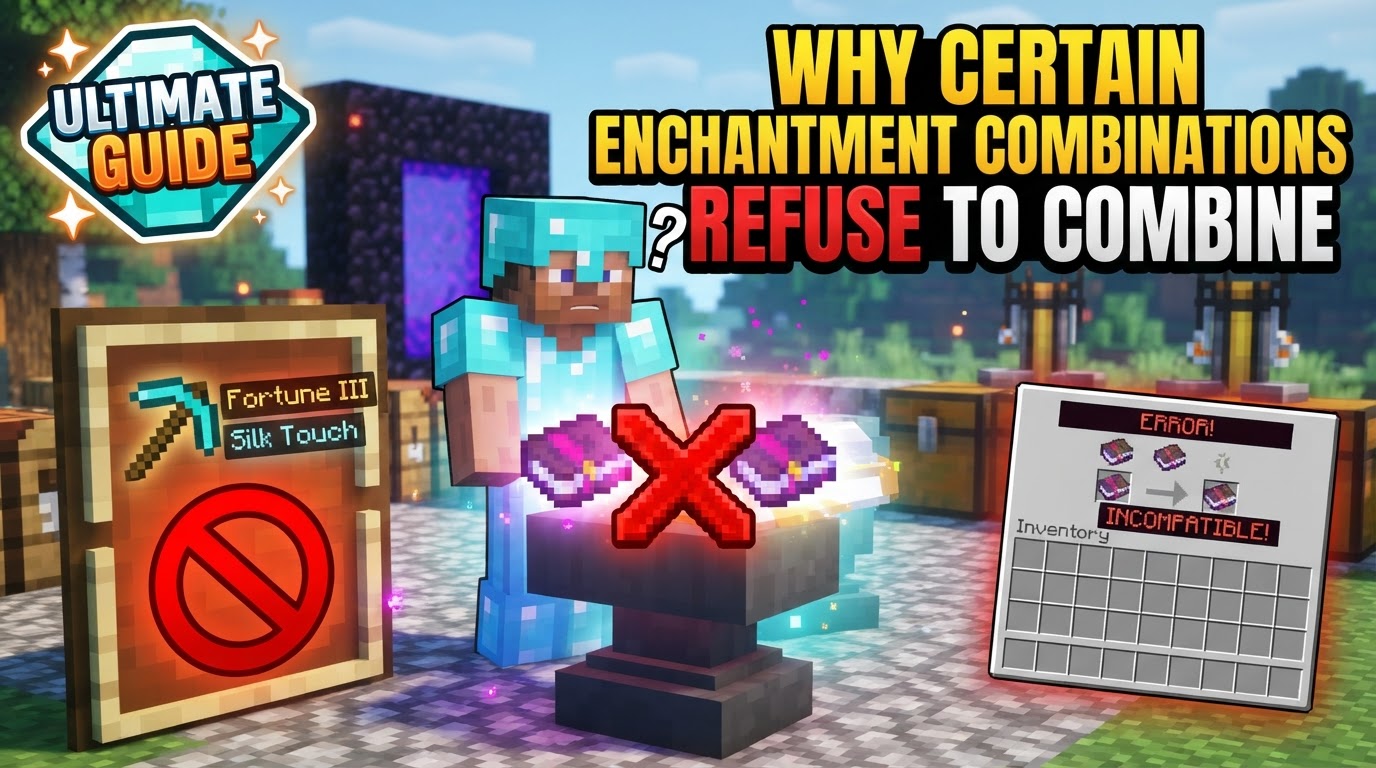
The primary reasons certain enchantment combinations refuse to merge boil down to two core principles: inherent incompatibilities between enchantments and a hard limit on the experience cost for any single anvil operation. These systems ensure that players must make strategic choices about their equipment, rather than simply stacking every possible advantage onto one item.
The Strict Rules of Incompatibility
At the heart of many failed enchantment attempts lies the concept of mutually exclusive enchantment groups. Minecraft’s design dictates that certain enchantments simply cannot coexist on the same item. This is often implemented to force players to specialize their gear or to prevent game-breaking power levels. When you try to combine two items or an item and an enchanted book containing conflicting enchantments, the game will simply refuse to apply the incompatible one.
Here are the key categories of incompatible enchantments:
- Tools: For pickaxes, you cannot have both Fortune and Silk Touch. Fortune increases block drops, while Silk Touch allows you to mine blocks themselves (like ore blocks or glass). These are fundamentally different functions that cannot be on the same tool.
- Armor: On any single piece of armor (helmet, chestplate, leggings, boots), the various types of protection enchantments are mutually exclusive. You can only have one of Protection, Fire Protection, Blast Protection, or Projectile Protection. This prevents a single armor piece from offering comprehensive defense against all damage types.
- Swords: For offensive melee weapons, the primary damage-boosting enchantments are exclusive. You must choose between Sharpness (general damage increase), Smite (increased damage to undead mobs), and Bane of Arthropods (increased damage to arthropod mobs like spiders and cave spiders).
- Boots: Utility enchantments for boots also have their conflicts. Frost Walker, which turns water into frosted ice, cannot be combined with Depth Strider, which increases underwater movement speed.
- Bows: The fundamental resource management enchantments for bows are incompatible. You cannot have both Infinity (which allows unlimited arrows with one arrow in your inventory) and Mending (which repairs items using experience orbs). This forces a choice between infinite ammunition and self-repairing gear.
- Crossbows: Similar to bows, crossbows have mutually exclusive firing modes. Multishot (fires three arrows at the cost of one) and Piercing (arrows pass through multiple entities) cannot be on the same crossbow.
- Tridents: The unique properties of tridents also come with limitations. You cannot combine Loyalty (returns the trident after throwing) with Riptide (propels the player when thrown in water/rain). Similarly, Channeling (summons a lightning bolt during a thunderstorm) is also incompatible with Riptide. These enchantments fundamentally alter how the trident is thrown or used, making their combination impossible.
The Silent Killer: “Too Expensive!”
Beyond explicit incompatibilities, many players encounter the dreaded “Too Expensive!” message, which halts combinations even when enchantments are technically compatible. This is not a bug, but a deliberate game mechanic tied to the anvil’s hard experience cost limit. If the total experience levels required for an anvil operation exceed 39, the combination is rejected, regardless of the enchantments involved. This limit is primarily influenced by the “Prior Work Penalty.”
Understanding the Prior Work Penalty (PWP)
Every time an item or an enchanted book is placed in an anvil and successfully modified (be it combining, repairing, or renaming), it incurs a “Prior Work Penalty.” This penalty stacks, making each subsequent anvil operation on that item progressively more expensive. The cost increment isn’t linear; it grows exponentially. The penalty can be approximated by the formula (2^n) – 1, where ‘n’ represents the number of previous anvil operations performed on that specific item or book. This means an item that has been through the anvil a few times will quickly become “Too Expensive!” for further modifications, even if the enchantments being added are simple.
Mastering the Anvil: How Combinations Work (and Fail)
To effectively use the anvil, it’s important to understand the step-by-step process it follows when you attempt a combination:
- Identify Target and Sacrifice: The first item placed in the anvil’s left slot is the “target” – this is the item you want to keep and modify. The second item, placed in the right slot, is the “sacrifice” – its enchantments will be transferred, and the item itself will be consumed.
- Enchantment Transfer: The anvil attempts to apply enchantments from the sacrifice item to the target item.
- If the target already has the same enchantment, its level may increase (e.g., Sharpness III + Sharpness III = Sharpness IV, up to the maximum level).
- If the target does not have the enchantment, it gains all levels of that enchantment from the sacrifice, provided it’s compatible.
- If an enchantment from the sacrifice is incompatible with an existing enchantment on the target, it will simply not be applied.
- Cost Calculation: The anvil then calculates the experience cost. This cost is a complex sum based on several factors: the enchantments being combined (higher level and more enchantments cost more), the number of enchantments, and crucially, the Prior Work Penalty of both the target and the sacrifice items. Renaming an item also adds to the cost, though it does not contribute to the Prior Work Penalty itself.
Strategic Enchanting for Success
Given the complexities of incompatible enchantments and the “Too Expensive!” limit, intelligent enchanting requires careful planning:
- Plan Ahead: Before you even begin, know exactly which enchantments you want on your final item and verify their compatibility. Don’t waste valuable enchanted books or experience levels on impossible combinations.
- Optimal Combining Order: To minimize the impact of the Prior Work Penalty, especially when dealing with many enchanted books, combine them in an optimal order. The most efficient method is often to pair up books (e.g., combine Book A with Book B, and Book C with Book D), then combine the resulting AB book with the CD book, and finally apply the fully combined book to your gear. This reduces the number of times any single item/book accumulates penalty.
- Combine Books First: It is almost always more efficient and cost-effective to combine enchanted books with each other first, creating powerful, multi-enchantment books, before applying them to your final piece of gear. This keeps the Prior Work Penalty on your main item lower for longer.
- Prioritize Vital Enchantments: Understand that you may not be able to get every desired enchantment on a single item. Prioritize the most crucial enchantments for your playstyle and item type, accepting that some minor benefits might be sacrificed.
- Fresh Items/Books: Always try to start with items or books that have no prior work penalty. These “fresh” items will have the lowest base cost for their first anvil operation, giving you more room to add enchantments later before hitting the “Too Expensive!” threshold.
Common Pitfalls to Avoid
Even experienced players can fall into common enchanting traps:
- Attempting Incompatible Combinations: This is the most straightforward mistake. Trying to put conflicting enchantments on the same item will simply result in the game disallowing the operation, wasting your time and potentially valuable books.
- Inefficient Combining Order: A major cause of hitting the “Too Expensive!” limit is combining enchantments one by one onto an item. Each individual operation increases the Prior Work Penalty, quickly escalating costs.
- Ignoring the “Prior Work Penalty”: Not understanding how repeated anvil use increases costs is a common oversight. Many players are surprised when an item that was cheap to enchant initially suddenly becomes “Too Expensive!” after a few modifications.
- Combining Lower-Level Books Inefficiently: While combining two Level I books to make a Level II book is possible, continuously doing this for many books can be more expensive in the long run than acquiring higher-level books directly (e.g., through villager trading, fishing, or dungeon loot), especially due to the stacking Prior Work Penalty.
By understanding these core principles of enchantment incompatibility and the anvil’s cost mechanics, you can navigate Minecraft’s enchanting system with greater confidence and efficiency, crafting truly powerful and specialized gear for your adventures.
Tags:
YOU MAY ALSO LIKE...