

Why Your Enchantment System Sometimes Produces Incompatible Books
Did you know that despite Minecraft’s seemingly limitless possibilities, there’s a hard cap that often prevents you from combining certain enchantments on an item or even on an enchanted book? Many a seasoned adventurer has scratched their head, wondering why their perfectly good enchanted book refuses to merge with another, or why an anvil declares an operation “Too Expensive!” This isn’t a bug; it’s a fundamental aspect of Minecraft’s design, meticulously crafted to maintain balance, prevent overpowered gear, and ensure logical consistency within the game world.
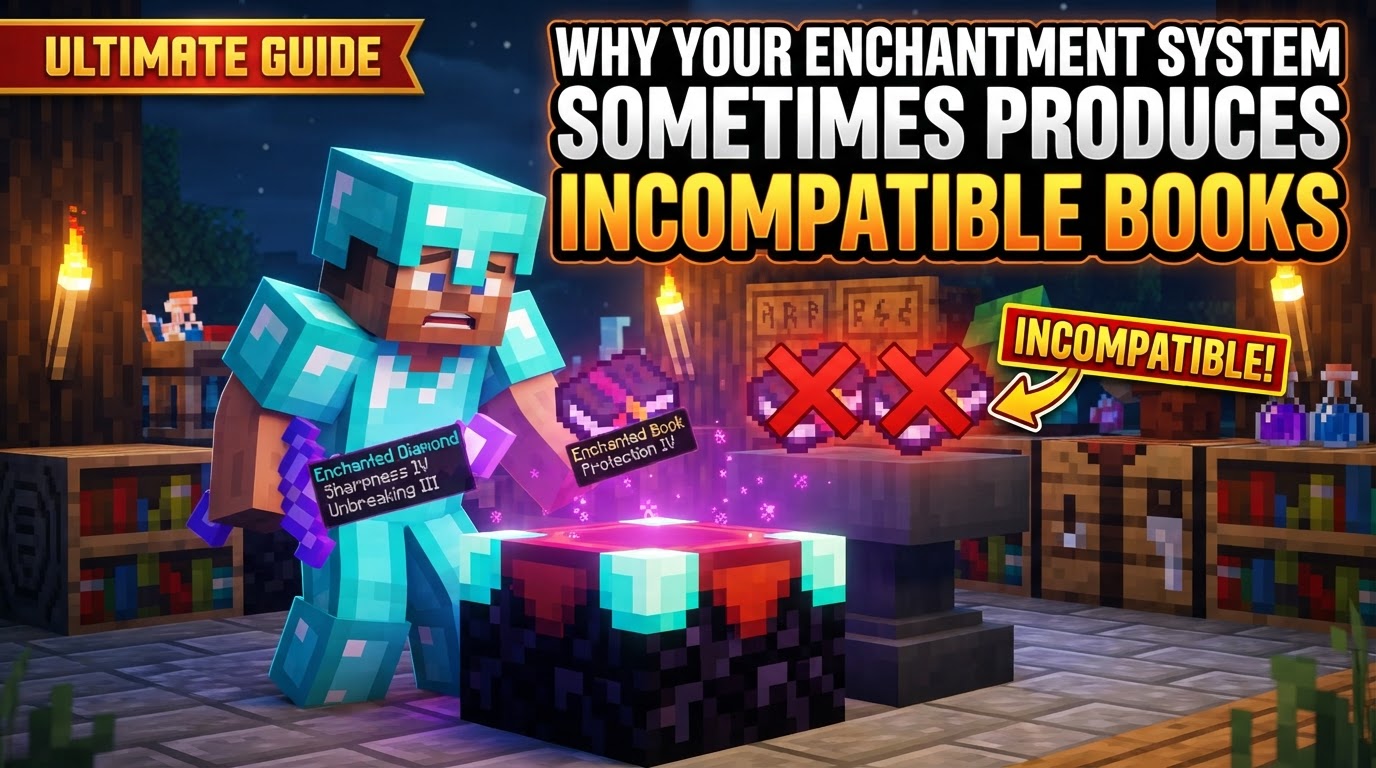
Understanding these underlying mechanics is crucial for any player looking to master the art of enchanting. It’s about knowing not just what enchantments exist, but which ones can coexist, and how the game calculates the cost of every magical fusion. Without this knowledge, you’re bound to waste precious experience levels, valuable resources, and the irreplaceable enchanted books you’ve diligently acquired.
The Core Principle: Why Incompatibilities Exist
At its heart, Minecraft’s enchantment system is governed by a set of strict incompatibility rules. These rules dictate that certain enchantments cannot exist on the same item simultaneously. The primary reasons behind this are twofold:
- Game Balance: Allowing every enchantment to stack would quickly lead to items of absurd power, trivializing challenges and diminishing the sense of progression. Imagine a sword with Sharpness, Smite, and Bane of Arthropods all at once, dealing maximum damage to every mob type. Or a pickaxe that could both mine entire veins with Fortune and preserve rare blocks with Silk Touch. These combinations would break the game’s intended difficulty curve.
- Logical Consistency: Some enchantments perform mutually exclusive functions. For instance, you can’t logically have a pickaxe that both increases the drop rate of items (Fortune) and ensures blocks drop themselves (Silk Touch). They serve different purposes, and the game enforces this distinction.
These rules apply whether you’re trying to combine two enchanted items or an item with an enchanted book. The game performs a rigorous check for these conflicts every time you use an anvil.
The Anvil: Where Enchantments Collide
The anvil is the primary tool for combining enchantments. It allows players to merge the magical properties of two items or apply an enchanted book’s powers to a piece of gear. The process seems simple, but it’s where the incompatibility checks truly come into play.
- You place the “target” item – the one you wish to enchant – in the first slot.
- You then place the “sacrifice” item – either another enchanted item or an enchanted book – in the second slot. This item will be consumed.
- The anvil then attempts to combine the enchantments.
During this combination, if the target item already possesses an enchantment that is inherently incompatible with an enchantment on the sacrifice item or book, the conflicting enchantment from the sacrifice is simply ignored. In Java Edition, a small experience cost might still be incurred, but the incompatible enchantment will not transfer. Only compatible enchantments will be added to the target item or upgraded if a higher level of the same enchantment is present on the sacrifice.
Navigating the Maze of Mutually Exclusive Enchantments
Familiarizing yourself with the specific groups of incompatible enchantments is paramount. This knowledge will save you countless hours of frustration and wasted resources. Here’s a breakdown of the most common conflicts:
- Tools (Pickaxes, Shovels, Axes):
- Fortune and Silk Touch: These two are the quintessential example. Fortune increases the number of drops from blocks, while Silk Touch causes blocks to drop themselves instead of their usual items (e.g., ore blocks instead of raw ore). They are fundamentally opposed. (Note: As of Java 1.12.2, you can place both on a tool via an anvil, but the incompatible enchantment from the sacrifice item will be lost. On books, they remain incompatible, meaning you cannot create a single book with both.)
- Armor (Helmets, Chestplates, Leggings, Boots):
- Protection, Fire Protection, Blast Protection, Projectile Protection: Only one “Protection” type enchantment can be applied to a single piece of armor. General Protection offers broad damage reduction, while the others specialize in specific damage types. You must choose which type of protection you prioritize for each armor piece.
- Swords:
- Sharpness, Smite, Bane of Arthropods: These are all damage-increasing enchantments, but they target different mob types. Sharpness boosts damage against all mobs, Smite targets undead mobs (zombies, skeletons), and Bane of Arthropods targets arthropods (spiders, cave spiders, bees, silverfish, endermites). Only one of these can be on a sword at a time.
- Boots:
- Frost Walker and Depth Strider: Frost Walker allows you to walk on water by turning it into ice, while Depth Strider increases your movement speed when submerged in water. Their functions conflict, making them incompatible.
- Bows:
- Infinity and Mending: Infinity allows you to fire arrows without consuming them (as long as you have at least one in your inventory), while Mending repairs your item using experience orbs. The infinite arrows provided by Infinity remove the need for Mending on a bow, creating an incompatibility for balance.
- Crossbows:
- Multishot and Piercing: Multishot fires three arrows at once, consuming one arrow from your inventory. Piercing allows arrows to pass through multiple entities and shields. These distinct firing mechanics are mutually exclusive.
- Tridents:
- Loyalty and Riptide: Loyalty causes your trident to return to you after being thrown. Riptide allows you to propel yourself through water or rain by throwing the trident. You cannot have both, as Riptide’s core mechanic involves you moving with the trident, not having it return independently.
- Channeling and Riptide: Channeling calls down a lightning bolt on hitting a mob during a thunderstorm. Like Loyalty, it cannot be combined with Riptide for similar reasons of conflicting mechanics.
- Maces:
- Density, Breach, Smite, Bane of Arthropods: The Mace, a newer weapon, also has its specific incompatibilities. Density and Breach are its unique damage-boosting enchantments. Like swords, Smite and Bane of Arthropods are specific damage types. A Mace can only have one of these four damage-modifying enchantments at a time.
- Enchanted Books:
- Silk Touch and Looting: While Looting is a sword enchantment, you cannot create an enchanted book that contains both Silk Touch and Looting.
- Silk Touch and Luck of the Sea: Similarly, you cannot create an enchanted book containing both Silk Touch and Luck of the Sea (a fishing rod enchantment). These are often overlooked incompatibilities for books specifically.
The “Too Expensive!” Barrier: Prior Work Penalty
Beyond direct incompatibilities, many players encounter the dreaded “Too Expensive!” message at the anvil. This isn’t an incompatibility of enchantments, but rather a cost barrier. Each time an item or book is worked on in an anvil – whether combining, repairing, or renaming – it incurs a “prior work penalty.” This penalty increases the experience cost for all subsequent anvil operations involving that item.
If the cumulative experience cost for an operation exceeds 39 levels, the anvil will deem it “Too Expensive!” and prevent you from performing the action in Survival mode. This mechanism prevents players from endlessly upgrading a single item, encouraging the creation of new tools and armor and adding another layer of resource management to the game.
Mastering the Enchantment System: Strategic Approaches
Becoming an enchantment master requires more than just knowing the rules; it demands strategic planning:
- Internalize Incompatibility Rules: The first and most crucial step is to memorize or keep a reference for the mutually exclusive enchantment groups. This will prevent wasted enchantments and resources from the outset.
- Optimize Anvil Combination Order: To circumvent the “Too Expensive!” penalty, plan your enchantment path. Combine enchantments on books first, then apply these max-level books to your items. A common strategy is a “playoff bracket” pattern: combine two level I books to get a level II, then combine two level IIs to get a level III, and so on. Combine lower-level enchantments together before applying them to your main item. Always start with an unenchanted item if possible, and combine the most expensive enchantments last, or combine them on books before applying to the item.
- Villager Trading for Max-Level Books: Villager trading, particularly with librarians, is an excellent way to acquire max-level enchanted books, which can then be strategically combined with minimal prior work penalty compared to enchanting items directly.
- Understand Modded vs. Vanilla: If you play on modded servers or with custom plugins, be aware that enchantment rules might be altered. Always check server-specific guides or ask fellow players if something seems off.
- Creative Mode Exceptions: In Creative mode or with cheats enabled, you can bypass these restrictions using commands like
/giveor/enchant. This allows for experimentation or simply creating “perfect” items without survival limitations.
Common Pitfalls to Avoid
Even experienced players can fall into these traps:
- Directly Combining Incompatibles: Attempting to put two mutually exclusive enchantments directly onto an item via an anvil will not result in an error message until you try to apply it, at which point one of the enchantments will simply be ignored, wasting the sacrifice item/book.
- Ignoring the Prior Work Penalty: Repeatedly combining items without a strategic plan for enchantment order will quickly lead to the “Too Expensive!” message, rendering your item un-enchantable through normal means.
- Expecting Enchantment Separation: Once enchantments are combined onto an enchanted book, they form a single unit. It is not possible to separate enchantments from a book or an item once they are combined.
Minecraft’s enchantment system, while sometimes frustrating, is a meticulously designed element that contributes significantly to the game’s depth and longevity. By understanding the rules of incompatibility and the mechanics of the prior work penalty, you can transform from a novice enchanter into a master crafter, always prepared with the perfectly enchanted gear for any adventure.
Tags:
YOU MAY ALSO LIKE...


