

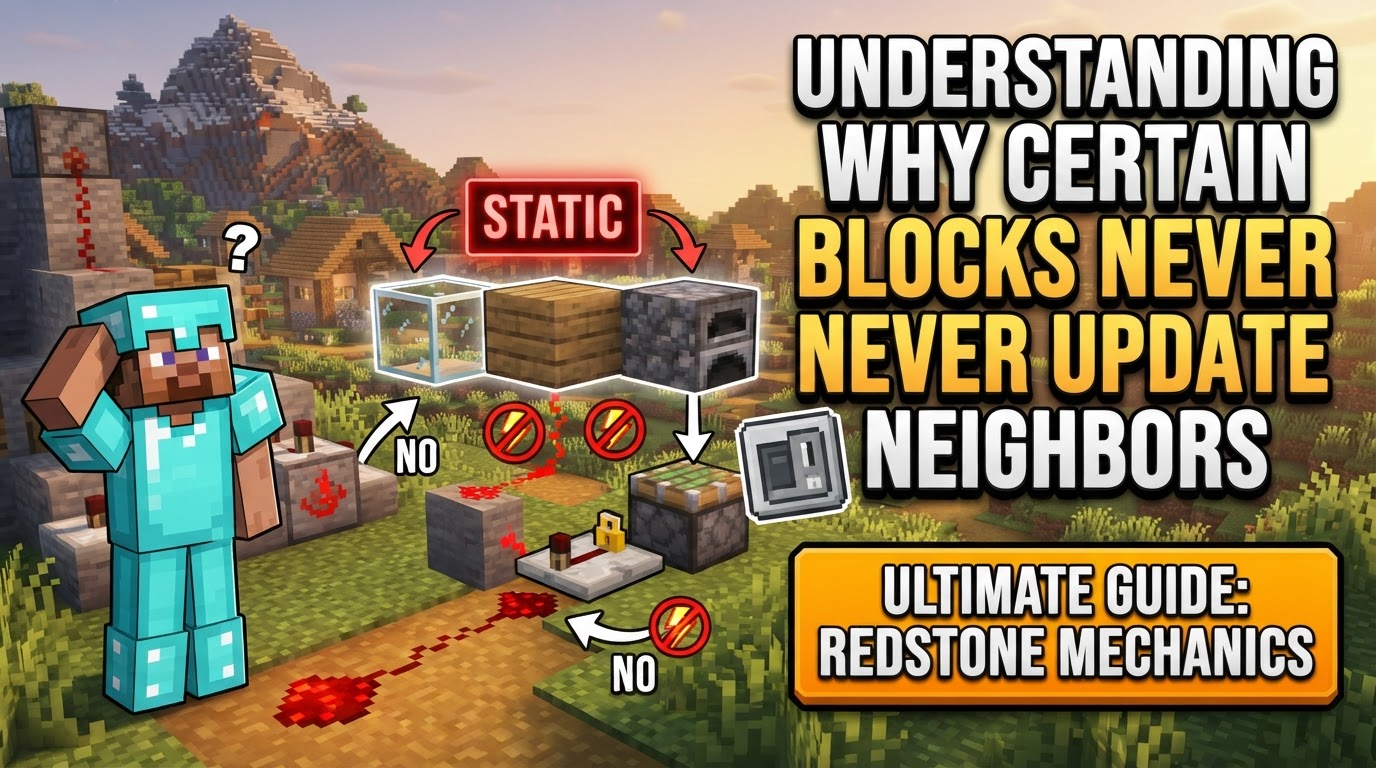
Understanding Why Certain Blocks Never Update Neighbors
In Minecraft, the seemingly straightforward world of block interactions holds a hidden layer of complexity: certain blocks, under specific conditions, simply refuse to update their neighbors, leading to fascinating and often exploitable game mechanics. While most blocks dutifully inform their surroundings of changes, understanding these exceptions is crucial for advanced redstone engineering, technical builds, and even troubleshooting unexpected circuit behavior.
The Foundation: Normal Block Update Mechanics
At its core, Minecraft’s block interaction system relies on a consistent update mechanism. When a block undergoes a significant change – be it placed, destroyed, replaced, or simply changing its internal state (like a lever being flipped from off to on) – it typically broadcasts this event to its immediate neighbors. In Java Edition, these updates are broadly categorized into two types:
- “Post Placement” (PP) Updates: These occur immediately after a block is placed or destroyed, informing adjacent blocks of the new or absent entity in their vicinity.
- “Neighbor Changed” (NC) Updates: These are triggered when a block’s internal state alters, prompting its neighbors to re-evaluate their own states in response.
These neighbor updates don’t happen randomly; they follow a specific, predictable order. For instance, updates often propagate from west to east, then north to south, and finally down to up. This sequential processing is fundamental to how many redstone circuits function. Redstone components, in particular, are designed to be highly sensitive to these NC updates, often sending additional or more frequent signals when their power state shifts, ensuring that complex contraptions react promptly.
Quasi-Connectivity (QC): The Unseen Power
One of the most famous and impactful reasons for “delayed” or “un-updated” block behavior is quasi-connectivity (QC). This is a unique property that predominantly affects pistons, dispensers, and droppers in Java Edition, and it’s notably absent in Bedrock Edition. Quasi-connectivity allows these blocks to be “powered” by a redstone source that targets the block *directly above* them, even if that space is entirely empty (air).
The critical distinction with QC is that while a component might be technically “powered” due to this overhead signal, it will not physically activate or extend until a neighboring block *actually changes state*. This external change then triggers a block update that causes the QC-affected block to re-check its power state, finally realizing it’s powered and activating. This creates a powerful “delayed activation” mechanism.
Redstone engineers have learned to exploit this delay extensively. It allows for more compact and intricate mechanisms, as it provides a way to indirectly power components without needing a direct redstone connection to their base or sides. Understanding QC is paramount for anyone delving into advanced Java Edition redstone, as it dictates how many piston-based contraptions behave and can be built.
Block Update Detectors (BUDs): Leveraging the Latent
The very existence of blocks that don’t immediately update their neighbors led to the invention of Block Update Detectors, or BUD switches. These ingenious contraptions are designed specifically to detect subtle changes in adjacent blocks that would not normally trigger a direct redstone update. They turn the absence of an immediate update into a detectable event.
Many BUD designs rely heavily on quasi-connectivity. Imagine a piston that is quasi-connected, meaning it’s technically powered but hasn’t received the block update it needs to extend. When an external event occurs – perhaps a block is placed next to it, or a furnace starts smelting – this event acts as the necessary “nudge.” The external block change triggers a block update that causes the QC-affected piston to finally re-evaluate its state and extend, sending a redstone signal in the process. This signal then confirms that a change has occurred nearby.
BUDs can detect an impressive array of events that don’t inherently trigger redstone, including:
- Placing or breaking blocks adjacent to the BUD.
- Using a furnace or brewing stand.
- Hoeing dirt or pathing grass.
- Growing crops or trees.
- Opening/closing a chest or door.
This ability to detect latent changes makes BUDs invaluable for automatic farms, security systems, and other complex automation where conventional redstone wouldn’t suffice.
Update Suppression: The Extreme Measure
Beyond the subtle delays of quasi-connectivity, there’s a far more extreme and often risky technique known as update suppression. This is an advanced, usually bug-reliant, method that intentionally prevents block updates from being processed at all. It achieves this by forcing the game to encounter an exception, such as a Stack Overflow error, which can halt the execution of code responsible for handling block updates.
Update suppression isn’t about delaying an update; it’s about making it never happen. Its application is typically reserved for highly technical builds and exploits, such as:
- Removing a block without triggering any updates to its surroundings, allowing for impossible block states or structures.
- Creating unique configurations for structures like Nether portals that would otherwise be unstable or impossible to form.
However, the power of update suppression comes with significant risks. Historically, deliberately causing game exceptions could lead to severe consequences, including world corruption or client crashes. While modern implementations or specific modded versions might mitigate some of these dangers, it remains a technique primarily for those with a deep understanding of Minecraft’s underlying code and a willingness to accept potential instability.
Specific Exceptions and Edge Cases
Not all instances of blocks failing to update neighbors are due to complex mechanics like QC or intentional exploits like update suppression. Some actions simply do not send block updates by design. For example:
- Lighting a Nether portal or the automatic generation of a Nether portal does not send “post placement” updates to surrounding blocks. This can be exploited to create specific portal designs or to prevent adjacent blocks from reacting.
- Changing block states using a debug stick, a developer tool available in creative mode, also deliberately bypasses the normal update mechanism. This allows builders to create block variations that wouldn’t naturally occur without triggering a cascade of updates.
These specific exceptions highlight that the game’s designers have, in certain instances, chosen to bypass the update system for specific functionalities, further contributing to the diverse landscape of block interaction.
Debugging and Advanced Redstone Mastery
Understanding why certain blocks don’t update their neighbors is not just theoretical knowledge; it’s a practical skill essential for advanced Minecraft gameplay. For redstone engineers, particularly in Java Edition, grasping quasi-connectivity is fundamental. Circuits that involve pistons, dispensers, or droppers often behave unexpectedly if QC isn’t factored into their design. When a redstone contraption fails to fire or triggers at the wrong time, troubleshooting often begins with considering if a component is quasi-connected and awaiting a block update.
Beyond redstone, this knowledge is vital for mod developers and server administrators. Modders creating custom blocks must explicitly implement neighbor update handling to ensure their blocks interact correctly with the game world. On server environments, issues related to missing or delayed block updates can sometimes lead to performance problems or even world corruption. Administrators might use specialized tools or temporarily disable physics to diagnose and resolve such “stuck” states.
The intricate dance of block updates, and the deliberate or accidental absence thereof, defines a significant portion of Minecraft’s technical depth. From compact redstone logic enabled by quasi-connectivity to the extreme manipulation possible with update suppression, these mechanics allow players to push the boundaries of what’s possible within the game, transforming simple blocks into sophisticated systems.
Tags:
YOU MAY ALSO LIKE...


