

Everything About Redstone Torch Update Order
One of the most frustrating experiences for a Minecraft redstone engineer is meticulously crafting a complex contraption in one game edition, only to find it utterly fails when rebuilt in another. This often stems from a fundamental, yet frequently misunderstood, concept: the Redstone Torch Update Order. This unseen sequence dictates precisely which redstone components react first when multiple changes occur simultaneously within a single game tick, a critical difference between the highly consistent Java Edition and the notoriously unpredictable Bedrock Edition.
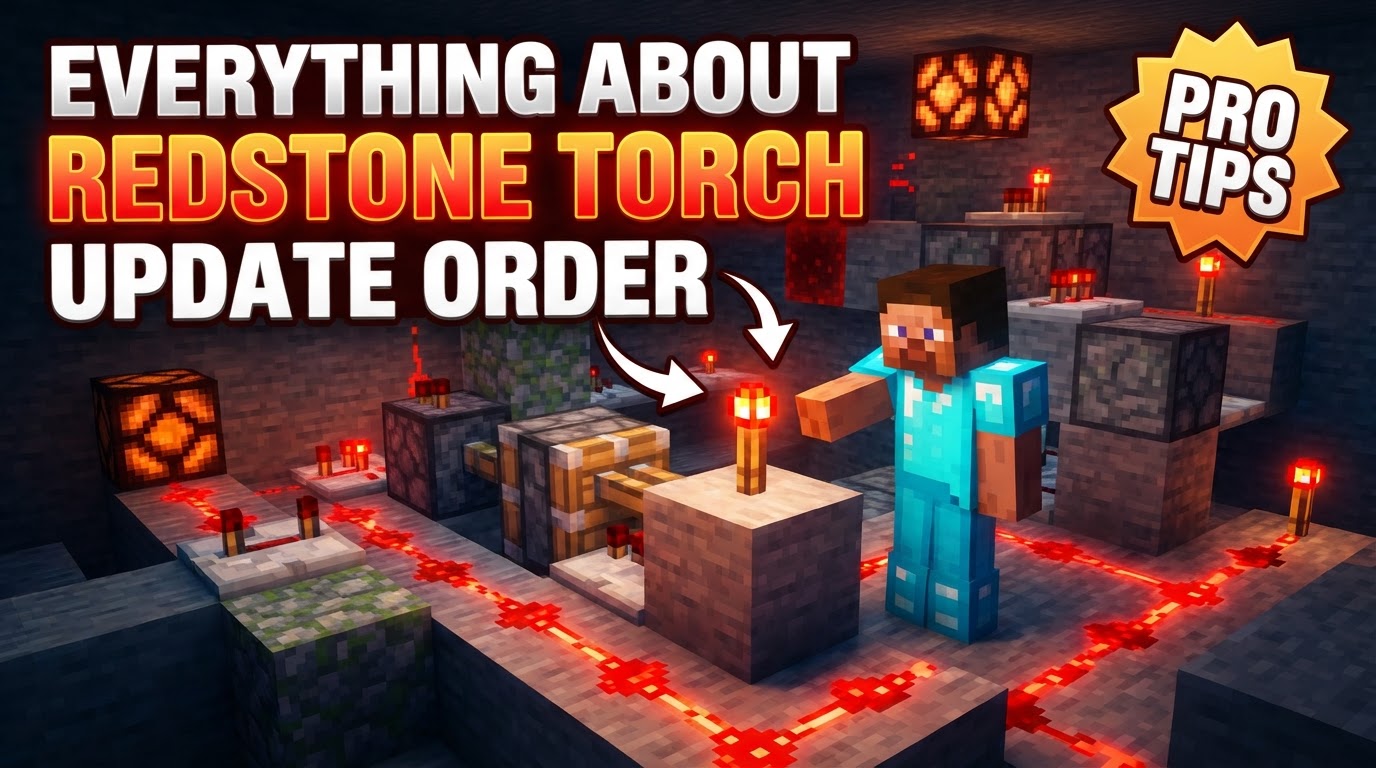
The Essence of Redstone Torch Update Order
At its core, “Redstone Torch Update Order” refers to the specific sequence in which redstone components, particularly redstone torches, respond to changes in their power state. Imagine a series of dominoes; the order in which they fall determines the final outcome. In redstone, if multiple torches or components are affected by a single input, the game’s internal update order decides which processes its change first. This seemingly minor detail can be the difference between a perfectly timed piston door and a flickering, unreliable mess.
Fundamental Torch Mechanics: Power and Deactivation
Before diving into the intricacies of update order, it’s crucial to understand how redstone torches inherently function:
- Powering Mechanisms: A redstone torch is a potent power source, providing a signal strength of 15. It can power any redstone dust or component (like pistons, lamps, or rails) that is directly adjacent to it. Crucially, a torch also powers the block directly above it. However, a redstone torch will not power the block it is placed on; it merely attaches to it.
- The Inverting Nature: One of the most useful properties of a redstone torch is its deactivation mechanic. If the block a redstone torch is placed on becomes powered, the torch will immediately turn off. This makes torches invaluable for inverting signals – turning an ‘on’ signal into an ‘off’ signal, and vice versa.
The Game’s Internal Clock: Understanding Tile Ticks
Many redstone components, including redstone torches, repeaters, and comparators, operate by scheduling what are known as “tile ticks” when their state changes. Think of tile ticks as delayed actions. When a torch (or another component) needs to change its state, it doesn’t always happen instantaneously. Instead, it schedules a tile tick with a specific position (where the component is), a delay (how long until the action happens), and a priority. The game processes these scheduled tile ticks in a particular order, and this processing order is a major determinant of the overall update sequence.
Unraveling the Update Sequence: A General Process
While a universally precise step-by-step guide for every redstone torch update scenario is incredibly complex and highly dependent on game edition and specific contraption, the general flow involves a few key stages:
- Initiating the Change: State Transition: The process typically begins when a redstone torch changes its power state. This often occurs because the block it’s attached to is either powered or unpowered, causing the torch to toggle from on to off, or off to on.
- Broadcasting the News: Block Updates: Once a torch changes state, it doesn’t just quietly sit there. It actively sends out “block updates” to its surrounding blocks and components. These updates signal to other redstone elements that they might need to re-evaluate their own state. Importantly, redstone torches can send updates up to two blocks away in all directions, which can lead to unexpected interactions if not accounted for.
- Prioritizing Reactions: The Processing Order: The game then processes these received updates. The order in which these updates are handled determines the final outcome. This processing order can be influenced by several factors:
- Delay: Components with inherent delays (like repeaters, which are specifically designed to introduce delays) or introduced delays (such as the natural slight delay in a redstone torch’s state change) will process updates based on these timings. Longer delays mean later processing.
- Signal Strength (Bedrock Proposal): In Bedrock Edition, where update order is less consistent, there has been a proposed concept that if multiple devices are on the same delay, signal strength could be a factor, with stronger signals processed first. This is less of a hard rule and more of a potential influence in Bedrock’s more chaotic update environment.
- Coordinates: In the absence of other differentiators, the game may fall back on coordinate-based processing. This means updates might be processed based on their location in the world – typically lower Y-values first, then increasing X, then increasing Z. This often leads to directional inconsistencies, where a contraption might work perfectly when facing one direction but fail when built facing another. This behavior is observed in Java Edition for some interactions and is a proposed factor in Bedrock’s update order.
- Component Priority (Java Edition): In Java Edition, different redstone components have specific update priorities. For example, repeaters and comparators have distinct priorities that influence which one processes its state change first when both are affected simultaneously. This contributes to Java’s more predictable behavior.
The Java Edition Advantage: Predictability
While Java Edition redstone has its own set of “quirky” behaviors, such as quasi-connectivity (QC) and block update detectors (BUDs), it is generally considered far more consistent in its update order. This predictability allows for highly precise and complex contraptions, as engineers can reliably predict how components will react in sequence. The underlying mechanisms, including specific component priorities and tile tick scheduling, are more deterministic.
The Bedrock Edition Conundrum: Randomness and Proposals
Bedrock Edition redstone, by contrast, is infamous for its inconsistency. Devices might produce different results with each button press, often due to random block updates occurring when multiple components are powered during the same game tick. This randomness makes designing compact, reliable contraptions significantly more challenging and often requires different design philosophies compared to Java. While there have been proposals to introduce more consistency (like the signal strength factor), the inherent unpredictability remains a hallmark of Bedrock redstone.
Navigating the Redstone Maze: Essential Tips for Builders
Understanding update order is crucial for any aspiring redstone engineer. Here are some vital tips:
- Know Your Edition: Java vs. Bedrock: Always confirm which game edition a redstone design or tutorial is for. Behaviors like quasi-connectivity, specific update orders, and even basic component interactions differ significantly. A Java-exclusive design will almost certainly fail in Bedrock, and vice-versa.
- The Golden Rule: Test, Test, Test: Especially in Bedrock Edition, where update order can be unpredictable, extensive and repeated testing of your contraptions is absolutely essential. Don’t assume it works; prove it works consistently, multiple times.
- Repeaters: Your Best Friend for Control: Repeaters are invaluable tools for introducing controlled delays and resetting signal strength. They can help regularize timing and make signals more predictable, mitigating some of the update order chaos, particularly in Bedrock.
- Mastering Powering Logic: A deep understanding of how a redstone torch powers adjacent dust and components, powers the block above it, and deactivates when its base block is powered, is fundamental to designing any reliable circuit.
Pitfalls to Avoid: Common Redstone Torch Errors
Even experienced builders can fall victim to common mistakes related to redstone torches and their update order:
- The Myth of Cross-Edition Parity: Expecting redstone mechanics, like quasi-connectivity or specific update orders, to be identical between Java and Bedrock Editions is a recipe for broken contraptions and frustration. They are fundamentally different systems.
- Underestimating Signal Decay: Redstone signals decay over distance, losing one strength point per block. After 15 blocks, the signal dies. Not accounting for this by using repeaters to boost signals is a common oversight that leads to unpowered components.
- Placement Matters: Solid Blocks and Beyond: Incorrect placement of redstone components, such as placing torches or dust on non-solid blocks (like stairs, slabs, or glass) where they might not properly connect or transmit signals, can cause unexpected failures. Always ensure components are placed on appropriate solid blocks unless you specifically intend for a unique interaction.
- Beware of Burnout: Rapidly toggling a redstone torch on and off too many times in a short period (typically 8 times within 60 game ticks) will cause it to “burn out.” A burnt-out torch will temporarily turn off and remain off for a few seconds before reactivating, disrupting any circuit it’s part of.
- The Invisible Hand: Unintended Block Updates: Not understanding how block updates propagate (up to two blocks away from a changing torch) can lead to unintended interactions. A torch might update a component that you didn’t mean to trigger, causing a chain reaction or interfering with other parts of your build. Always consider the wider ripple effect of any redstone state change.
Mastering redstone torch update order, while complex, is a hallmark of a true Minecraft redstone expert. By understanding these mechanics and avoiding common pitfalls, you can build more reliable, efficient, and impressive contraptions in any edition of the game.
Tags:
YOU MAY ALSO LIKE...


