

The Complete Mechanics of Falling Block Merging
Many players assume “falling block merging” refers to two pieces of sand combining into sandstone, or perhaps two different falling blocks fusing into a new, unique block. This couldn’t be further from the truth. In the highly technical lexicon of Minecraft, “falling block merging” is not about simple combination, but rather an advanced and often complex manipulation of falling_block entities. It describes a set of sophisticated mechanics used by technical players and map makers to achieve effects ranging from block duplication to the creation of intangible “ghost blocks” and even the acquisition of otherwise unobtainable items. Unlike item merging, where dropped items of the same type consolidate into a single stack, falling block manipulation delves into the very nature of block physics and entity behavior within the game engine.
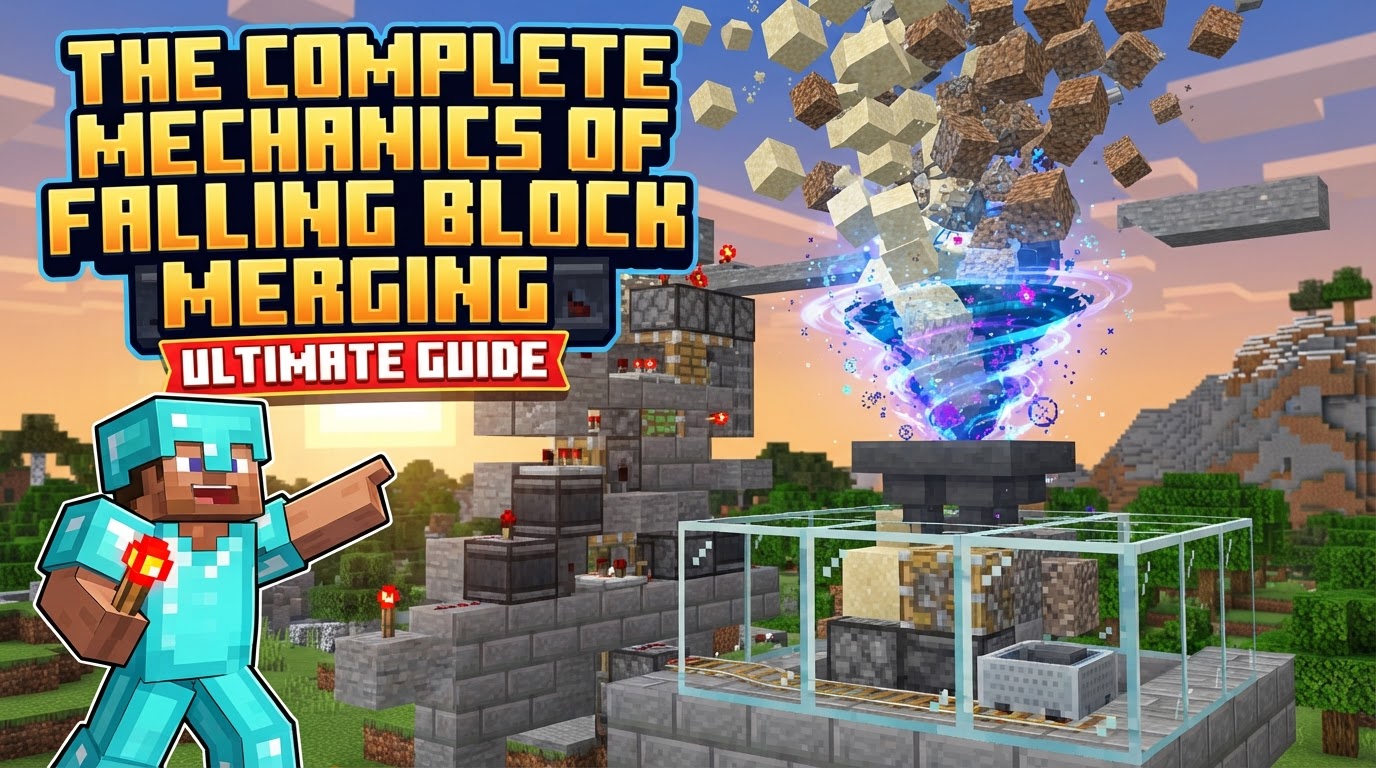
The Core Identity of Falling Blocks
At its heart, understanding falling block mechanics begins with recognizing their unique state. When gravity-affected blocks like sand, gravel, and concrete powder lose support, they don’t simply vanish and reappear below. Instead, they transform into distinct falling_block entities. These entities are separate from their solid block form, possessing their own set of properties and behaviors that can be controlled and modified. Crucially, these are not just visual effects; they are full-fledged entities within the game world, capable of interacting with other entities and the environment in specific ways.
- Entity Status: While in motion, blocks like sand, gravel, and concrete powder are no longer static blocks but dynamic
falling_blockentities. This distinction is fundamental to all advanced manipulations. - NBT Data Control: These entities can be summoned and modified using commands, allowing for intricate control over their characteristics. Named Binary Tag (NBT) data is the key to unlocking their potential.
NoGravityTag: One of the most powerful NBT tags isNoGravity:1b. When applied to afalling_blockentity, it causes the block to float in mid-air. This creates a “ghost block” that players can walk or fall through, offering unique possibilities for traps, secret passages, or aesthetic effects. However, a significant limitation is that these entities will despawn after approximately 30 seconds unless continuously refreshed by a redstone clock mechanism.- Motion and Visuals: Falling blocks can be given initial motion vectors to launch them in specific directions, adding dynamism to builds. They also produce characteristic particle effects both during their descent and upon landing, providing visual cues to their state.
- Falling Block Swaps: A pinnacle of advanced falling block mechanics, “falling block swaps” allow for the creation of
falling_blockentities of blocks that are not normally affected by gravity (e.g., end portal frames). This highly technical maneuver can also be exploited to obtain items that are otherwise inaccessible through conventional gameplay.
Advanced Manipulation: The Illusion of “Merging”
When technical players refer to “falling block merging,” they are often alluding to methods of increasing the quantity of a block, specifically through duplication, or manipulating its state in ways that defy conventional block physics. This isn’t about combining two different blocks into one; it’s about exploiting game mechanics to produce multiple instances of a single block type or to create blocks with unusual properties.
The most prominent and widely recognized form of this “merging” (in the sense of increasing quantity) is through duplication techniques, often leveraging the unique properties of End Portals. These methods allow for the creation of multiple copies of gravity-affected blocks, effectively multiplying resources.
Duplication Dynamics: End Portal Alchemy
A prime example of “merging” in the context of increasing quantity is the duplication of falling blocks using End Portals. This technique is a cornerstone for technical players aiming to generate vast quantities of blocks like sand, gravel, and concrete powder, which are finite resources in survival worlds. While the precise construction and timing of such duplication machines can be incredibly complex and vary significantly across different Minecraft versions, the fundamental principle remains consistent:
- Entity Interaction: The core idea involves manipulating the
falling_blockentity’s interaction with an activated End Portal. The portal acts as a mechanism that, under specific conditions, can cause the falling entity to be processed in a way that results in multiple instances of the block. - Gravity-Affected Blocks: This technique is particularly effective for blocks that naturally transform into
falling_blockentities, making it a staple for large-scale farm designs. - Version Sensitivity: It’s crucial to note that the specifics of End Portal duplication builds are highly sensitive to game updates. A design that works flawlessly in one version may fail entirely or behave differently in another, requiring constant adaptation and testing by the technical community.
- Preserving Old Blocks: Interestingly, End Portals can also be instrumental in preserving and even duplicating
falling_blockentities from older versions of Minecraft (e.g., 1.12.2) into newer ones (e.g., 1.18). This allows for the transfer of unique block data or states that might have otherwise been lost.
Leveraging Falling Blocks: Creative Applications and Design
Beyond duplication, the nuanced mechanics of falling_block entities offer a wealth of creative possibilities for map makers and redstone engineers:
- Dynamic Environments: For map makers, falling blocks are invaluable for crafting dynamic and interactive environments. Imagine blocks raining down from the sky, collapsing structures, or creating dramatic visual effects that react to player actions.
- Traps and Secret Passages: The
NoGravitytag, when combined with careful redstone timing, can be used to create ingenious traps where players fall through seemingly solid ground, or to construct secret passages that appear or disappear on command. - Ghost Blocks: While
NoGravityfalling_blockentities can create ghost blocks, their 30-second despawn timer makes them impractical for static, long-term installations. For creating static ghost blocks in newer versions of Minecraft,Block Displayentities are often the recommended alternative, offering persistence without the constant need for a redstone clock. However, for dynamic, temporary effects, thefalling_blockremains superior. - Unique Block States: Advanced falling block swaps allow for the creation of blocks that technically exist but are not obtainable through normal gameplay, such as an end portal frame block that can be picked up and placed. This opens doors for truly unique map challenges and custom mechanics.
Navigating the Quicksand: Common Pitfalls and Considerations
Working with falling block mechanics, especially at the advanced level, comes with its own set of challenges and quirks that demand careful attention:
- Mysterious Disappearances: Falling blocks can sometimes inexplicably disappear after traveling relatively short distances. This phenomenon is particularly noticeable when entities are very far from the world origin (0,0,0 coordinates) or in older game versions. These disappearances are often attributed to rounding errors in the game’s block calculation algorithms, leading to entities being incorrectly despawned or failing to render.
- Version Sensitivity: As mentioned, the mechanics behind advanced falling block manipulations, including chunk swaps and duplication glitches, are highly sensitive to game updates. A meticulously designed system that functions perfectly in one version might break entirely or exhibit unpredictable behavior in another. This necessitates continuous testing and adaptation for technical players.
- The 30-Second Despawn: The inherent despawn timer of approximately 30 seconds for
NoGravityfalling_blockentities is a critical limitation. Any design relying on these floating blocks for longer durations must incorporate robust redstone clock mechanisms to continuously respawn or refresh the entities before they vanish. Failure to account for this will result in temporary effects rather than persistent structures. - Complexity and Precision: Implementing advanced falling block mechanics often requires an extremely high degree of precision in timing, placement, and command execution. Even minor deviations can lead to system failures, making these techniques a test of patience and technical understanding.
In essence, “falling block merging” is a technical term that belies a world of intricate entity manipulation, often focused on duplication and the creation of unique block states. It’s a testament to the depth of Minecraft’s game engine, allowing players to push the boundaries of what’s possible, transforming simple gravity-affected blocks into powerful tools for creation and exploitation within the game world.
Tags:
YOU MAY ALSO LIKE...


