

Why Your Automatic Fishing Farm Sometimes Fails
The silent killer of many once-reliable automatic fishing farms in Minecraft isn’t a bug, but a feature: game updates. While these ingenious contraptions promise endless loot and experience with minimal effort, they often cease functioning as expected, leaving players scratching their heads. Understanding why your meticulously crafted fishing machine might be failing requires a deep dive into game mechanics, common build errors, and the ever-evolving landscape of Minecraft’s development.
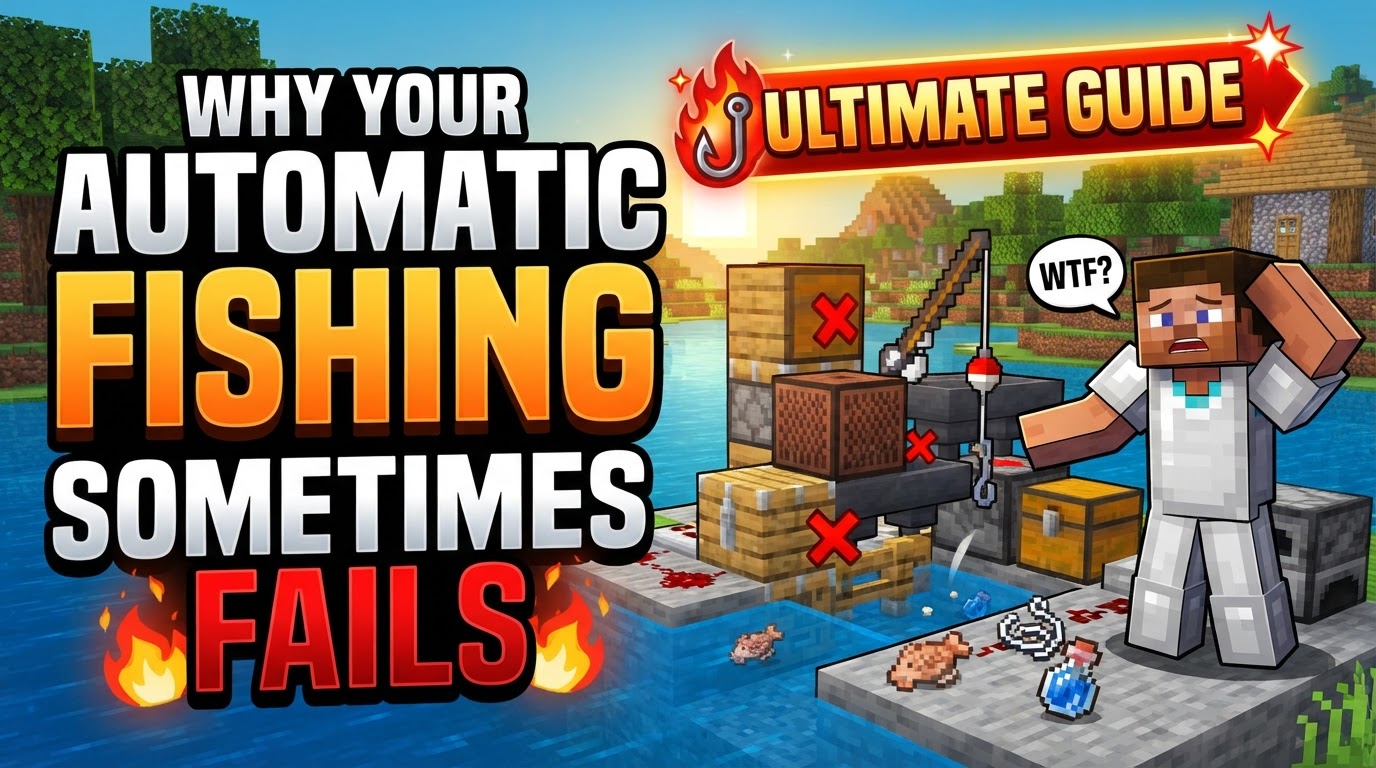
The Automated Angler: How It’s Supposed to Work
At its core, an automatic fishing farm is a marvel of redstone engineering and clever block placement designed to mimic a player’s fishing actions. The typical setup involves a player casting a fishing rod into a water source, with a redstone mechanism automating the crucial steps of reeling in and recasting. This often utilizes a pressure plate, a trapdoor, and a note block. The player’s role is usually just to maintain interaction with the fishing rod, often by holding down the right mouse button, which can be achieved through an auto-clicker or a weighted object on their mouse.
Here’s a simplified breakdown of the intended cycle:
- The player aims their fishing rod at a specific interaction point, often a note block positioned behind a trapdoor.
- The rod is cast, and the bobber lands in the water.
- When a fish or item “bites,” the bobber dips, triggering a mechanism (like a pressure plate) that registers a “reel in” action.
- The caught item is directed into hoppers, eventually leading to a storage chest.
- The rod is automatically recast, seamlessly continuing the process.
When all these components align perfectly, the player can AFK (Away From Keyboard) for hours, accumulating valuable resources, enchanted books, and experience.
The Impact of Game Updates: The 1.16+ Revolution
Without a doubt, the most prevalent reason for automatic fishing farm failures, especially for designs built before a certain point, is the significant overhaul of fishing mechanics in Minecraft versions 1.16 and later. Prior to these updates, even a single block of water could yield treasure loot like enchanted books, bows, and fishing rods. This led to compact, highly efficient “one-block” AFK fishing farms.
However, Mojang deliberately changed this to encourage more natural, open-water fishing. Post-1.16, obtaining treasure loot and enchanted items specifically requires the bobber to be in what the game considers “open water.” This means there must be no solid blocks directly adjacent to the bobber, and a minimum of a 5×5 (or 5x4x5) water source block area around the bobber to qualify. Farms built on the old, compact designs will now only yield raw fish, and crucially, no experience or enchanted items. This change alone rendered countless legacy farms obsolete for their intended purpose of treasure hunting, leading many players to believe their farms were “broken” when in reality, the game’s rules had simply changed.
Beyond Updates: Common Build and Design Flaws
Even with an updated game, subtle errors in construction can cripple a farm’s efficiency. These issues often stem from incorrect block placement or misaligned components:
- Incorrect Design or Build: Minor misplacements are common. A block directly above the note block, misaligned hoppers that don’t funnel items correctly, or an improperly placed water source can all disrupt the farm. Redstone dust placed one block too far, or a repeater facing the wrong direction, can break the entire automation sequence.
- Improper Aiming: The player’s aim is surprisingly critical. For the farm to function, the player must consistently target the precise interaction point (e.g., the edge of the pressure plate and then the note block) to trigger the mechanism correctly. Even a slight deviation can result in the rod not casting properly or the reel-in action not registering.
- Failure to Activate: The “right-click” action must be continuously maintained. If you’re not using an auto-clicker or a weighted object on your mouse, or if your auto-clicker stops working, the continuous casting and reeling will cease, halting the farm.
Environmental and Performance Hurdles
Sometimes, the problem isn’t with the farm’s design or the game version, but with external factors:
- Server Performance/Lag: On multiplayer servers, or even in single-player worlds with high entity counts or complex redstone, server lag can be a significant issue. High latency can interfere with redstone timing, causing the farm to miss catches, fail to reset properly, or inputs to be delayed, breaking the continuous cycle. A common fix for redstone timing issues, especially with trapdoors, is to place a torch on the side of the trapdoor directly powered by the pressure plate to ensure consistent power transmission.
- Full Inventories/Chests: An often-overlooked problem is full storage. If your personal inventory or the collection chests connected to your hoppers become full, caught items have nowhere to go. This backs up the system, and eventually, new items cannot be collected, effectively halting the farm. Regularly emptying your collection chests is crucial for long AFK sessions.
- Hostile Mob Spawns: While not directly breaking the farm, hostile mobs spawning around the AFK player can pose a threat, potentially killing them and stopping the farm. Lighting up the area around your farm adequately prevents these spawns, ensuring uninterrupted operation.
- Location Quirks: While not a guaranteed fix, a persistently failing farm that seems otherwise perfect might benefit from being moved. Sometimes, specific chunk loading issues or unforeseen environmental interactions can cause problems. Relocating the farm at least 100 blocks away can sometimes resolve these elusive glitches.
Edition Differences and Modded Realities
Minecraft’s various editions and the presence of mods introduce further complexities:
- Edition Differences: It’s critical to remember that Minecraft Java Edition and Bedrock Edition, while similar, are distinct games with different underlying code. AFK fishing farm designs optimized for Java Edition often will not work correctly, or at all, in Bedrock Edition, and vice-versa. Always ensure you are using a design specifically tailored for your game edition.
- Modded Environments: In modded Minecraft, custom fishing mechanics introduced by various mods can significantly alter or even completely override vanilla fishing rules. This can render standard AFK farm designs ineffective or even non-functional, requiring players to either adapt their farms to the mod’s mechanics or seek out mod-specific designs.
Optimizing for Success: Tips and Best Practices
To maximize your farm’s efficiency and longevity, consider these essential tips:
- Enchanted Rods are Key: Always use a fishing rod enchanted with Mending (for durability, repairing itself with collected XP), Lure III (to reduce wait time for a bite), and Luck of the Sea III (to increase your chances of catching treasure and valuable items).
- Consistent Power for Redstone: As mentioned, if experiencing lag, placing a torch on the side of the trapdoor directly powered by the pressure plate can stabilize redstone signals.
- Prevent Mob Spawns: Ensure the entire area around your AFK spot is well-lit to prevent hostile mobs from spawning and interrupting your session.
- Ample Storage: Design your collection system with plenty of chests. For long AFK sessions, consider automated storage solutions or a large array of double chests to prevent overflow.
- Optimal AFK Time: To truly maximize loot and experience, plan for AFK sessions lasting at least 5-10 hours. This allows the various enchantments and random drop mechanics to yield significant results.
In conclusion, while automatic fishing farms offer a fantastic way to gather resources, their occasional failures are rarely mysterious. They are typically rooted in evolving game mechanics, precise construction requirements, or environmental factors. By understanding these common pitfalls and adapting your designs, you can ensure your automated angler continues to reel in the rewards.
Tags:
YOU MAY ALSO LIKE...


