

The Real Reason Your Mob Grinder Efficiency Drops
Your meticulously crafted Minecraft mob grinder, once a beacon of XP and resource generation, suddenly seems to sputter. The once-constant stream of hostile mobs dwindles to a trickle, leaving you wondering what went wrong. The real reason your mob grinder’s efficiency drops often boils down to a fundamental misunderstanding or oversight of Minecraft’s core mob spawning mechanics, which are far more intricate than simply building a dark room.
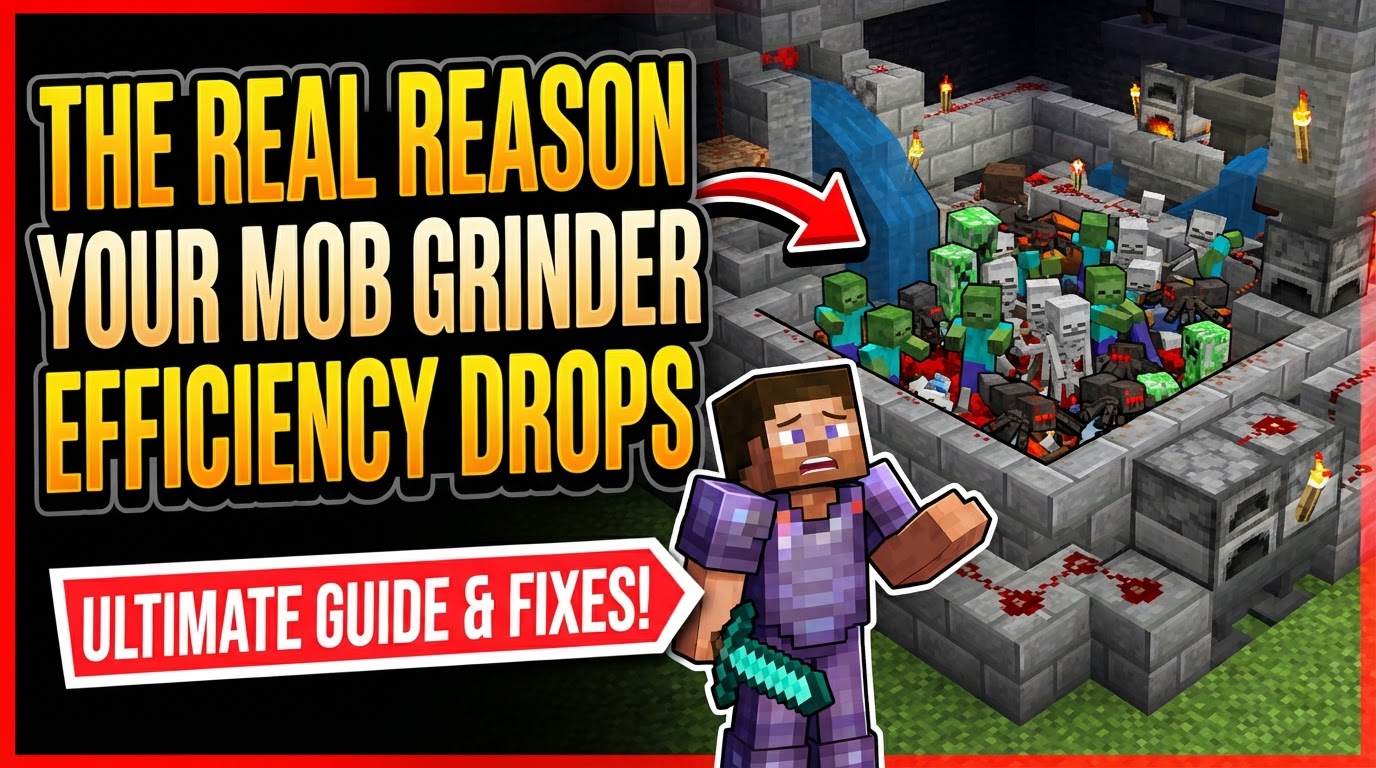
The Unseen Culprit: Understanding Core Mob Mechanics
To diagnose and fix a struggling mob grinder, you must first grasp the invisible rules governing mob life in Minecraft. These mechanics dictate when, where, and how many mobs can exist, and any deviation from their optimal conditions will directly impact your farm’s output.
- Mob Spawning Radius and Despawning
Mobs operate within a specific sphere of influence around the player. Hostile mobs can spawn anywhere from 24 to 128 blocks away from you. Crucially, they will not spawn if a player is closer than 24 blocks to the intended spawning area. Conversely, any mob that finds itself further than 128 blocks from a player will instantly despawn. This narrow window of 24-128 blocks is paramount for an effective grinder. If your AFK spot is too close, nothing spawns; too far, and they despawn before reaching your collection point.
- Light Levels: The Darkness Imperative
For hostile mobs, darkness is not just preferred, it’s essential. They require a light level of 7 or lower to spawn. This means any light source, no matter how small, can prevent spawning. Even ambient light from the sky during the day can illuminate parts of an exposed grinder, halting production. Ensuring absolute, uniform darkness within all spawning platforms is non-negotiable.
- The Elusive Mob Cap
Minecraft imposes a global “mob cap,” a limit on the total number of specific types of mobs (e.g., hostile, passive, aquatic) that can exist in loaded chunks around players. If this cap is reached by mobs spawning elsewhere – for instance, in unlit caves beneath your base or on the surface of nearby islands – new mobs simply will not spawn in your grinder, regardless of how perfect its design is. This is arguably the most common and frustrating reason for efficiency drops.
- Spawning Height Considerations
The game considers the overall height map for mob spawning. While it might seem logical to build a grinder high to avoid ground-level interference, placing a mob farm excessively high (e.g., at Y=200 or more) can paradoxically reduce spawn rates, especially after game updates that extended the world’s vertical limits. Building it high above *all* other potential spawn locations, or conversely, much lower, is generally more effective than arbitrary mid-sky placement.
Common Missteps: Why Your Grinder Underperforms
Understanding the mechanics is half the battle; identifying the common construction and operational errors is the other. Many efficiency issues stem from these easily overlooked mistakes.
- The Shadowy Threat: Unlit Surroundings
As mentioned, the mob cap is global. If you are AFK at your grinder, any unlit caves, ravines, or even dark spots on the surface within a 128-block spherical radius of your player will become active spawning grounds. Mobs spawning in these external areas will quickly fill the mob cap, leaving no room for your grinder to produce. This is a primary culprit for sudden drops in efficiency, especially in single-player worlds or on under-maintained servers.
- AFK Position: The Goldilocks Zone
Your AFK spot is critical. Being too close (under 24 blocks) to the spawning platforms will prevent mobs from spawning entirely. Being too far (over 128 blocks) will cause mobs to despawn before they can be funneled into your collection system. An optimal AFK spot is typically 80-128 blocks away from the spawning platforms, often directly above them. This ensures that only your grinder’s area is within the active spawning radius, and any external areas are either unloaded or too far for mobs to count towards the cap.
- Mob Cap Saturation: A World of Mobs
This issue is particularly prevalent on multiplayer servers. Other players exploring distant areas, or even just leaving their own bases unlit, can contribute to the global mob cap being filled. Even in single-player, if you’ve recently explored a large cave system and left it unlit, those mobs will persist and count against your cap until they despawn or are killed.
- Design Flaws: Stuck Mobs and Spiders
Even the most well-intentioned design can fail if mobs get stuck. Water currents might not be strong enough, or trapdoors might be placed incorrectly, creating small pockets where mobs can gather and block the flow. Spiders, with their 2×2 block size and ability to climb, are notorious for getting stuck in corners or on ledges, creating bottlenecks and filling the mob cap with themselves.
- Insufficient Darkness: A Glint of Light
A single torch accidentally left behind, a block removed allowing outside light in, or even light bleeding through thin walls can elevate the light level above 7 in parts of your spawning platforms. Even if 99% of your farm is pitch black, the illuminated 1% will simply stop spawning mobs, reducing overall output.
- Difficulty Settings and Non-Spawnable Blocks
This might seem obvious, but sometimes the simplest explanations are overlooked. If the game difficulty is set to Peaceful, no hostile mobs will spawn. Furthermore, hostile mobs cannot spawn on certain blocks like water, string, glass, or slabs (bottom half). Using these for spawning platforms will severely reduce or completely halt spawning in those areas.
Reclaiming Efficiency: Advanced Optimization Strategies
Once you understand the ‘why,’ you can implement the ‘how’ to bring your grinder back to peak performance.
- Aggressive Spawn-Proofing
This is perhaps the most critical step. Within a 128-block spherical radius around your AFK spot, every single cave, crevice, and surface area must be spawn-proofed. This means lighting them up thoroughly with torches, glowstone, or sea lanterns, or covering them with non-spawnable blocks like slabs or glass. This ensures that the global mob cap is reserved almost exclusively for your grinder.
- Mastering the AFK Point
Build an AFK room typically 80 blocks above the highest spawning platform of your grinder. This precise distance ensures that the spawning platforms are within the active spawning radius (24-128 blocks) while placing any ground-level or cave systems outside the loaded area, preventing external spawns from consuming the mob cap. If building over an ocean, you might be able to AFK closer.
- Expanding Your Spawning Empire
If your grinder is well-designed and spawn-proofed, increasing the number of dark spawning floors can significantly boost mob spawn rates. More dark surface area means more potential spawn locations, leading to higher output.
- Spider-Proofing and Active Mob Displacement
To prevent spiders from getting stuck, consider designs that incorporate buttons or carpets on every other block on spawning platforms, as these prevent 2×2 spiders from spawning while still allowing 1×1 mobs. For existing designs, use cascading water flows, powdered snow in corners, or even pistons/redstone-activated trapdoors to actively push mobs into the drop chute, preventing them from lingering.
- Strategic Placement: Sky-High or Oceanic
The easiest way to minimize external spawn-proofing is to build your grinder far above ground level (e.g., at Y=200+) or in a deep ocean biome. Building high in the sky means fewer blocks below you need to be spawn-proofed, as they’ll likely be outside the 128-block radius. Building over an ocean reduces the number of potential land-based spawn points considerably.
- Technical Tweaks and Build Verification
On some systems, reducing your render distance can sometimes help focus mob spawning within your farm by reducing the number of loaded chunks outside your immediate area. Finally, always double-check that your grinder is built exactly according to the intended design, paying close attention to block types, water current directions, fall damage heights, and the functionality of all collection systems.
A high-efficiency mob grinder isn’t just about building a dark box; it’s about understanding and manipulating the intricate web of Minecraft’s mob spawning mechanics. By addressing these common pitfalls and optimizing your setup, you can transform your sputtering farm back into a consistent engine of resources and experience.
Click to rate this post![Total: 0 Average: 0]
Tags:
YOU MAY ALSO LIKE...


