

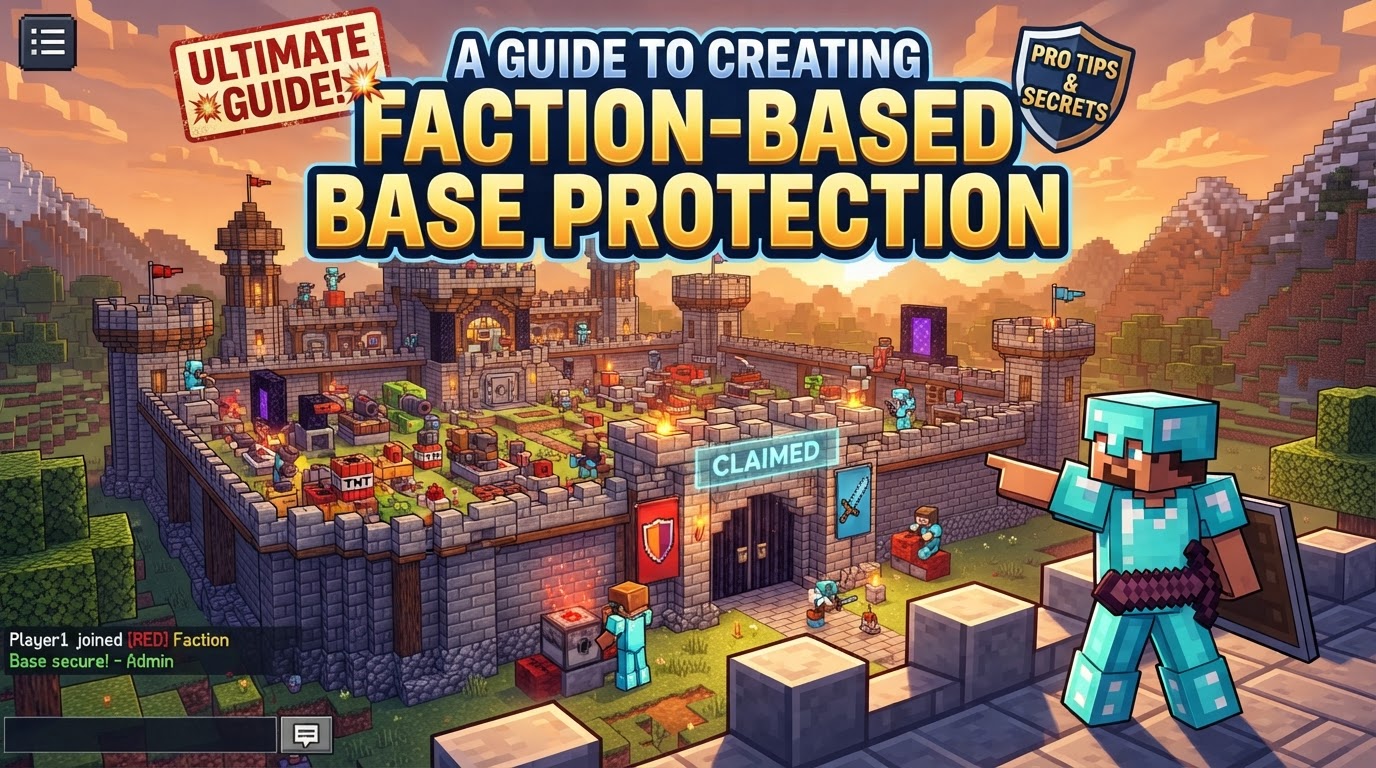
A Guide to Creating Faction-Based Base Protection
A common mistake many new faction members make is underestimating the relentless ingenuity of their opponents. In the cutthroat world of Minecraft factions, base protection isn’t just about placing blocks; it’s a strategic art form, a constant arms race against griefers and raiders. To truly secure your territory and valuables, you must understand not only the building mechanics but also the underlying faction system that governs territorial control.
The Bedrock: Understanding Faction Mechanics
Effective base protection begins with a thorough understanding of how faction plugins fundamentally operate. These core mechanics dictate the rules of engagement and the limits of your defense.
- Faction Formation: At its heart, a faction is a group of players united under a common banner. Each faction boasts a unique name and an internal hierarchy, allowing for customizable ranks that define roles and permissions within the group. Forming a strong, cooperative faction is the first step towards collective security and territorial dominance.
- Territory Claims: The cornerstone of faction protection is the ability to claim “chunks” of land. Once claimed, a chunk becomes protected territory, preventing unauthorized players from breaking or placing blocks, and nullifying environmental changes like explosions from TNT or creepers. This digital fence is what keeps your base safe from casual griefing.
- The Power System: The amount of land a faction can claim is directly tied to its collective “power” level. Each player contributes power, which naturally increases over time while they are online. Conversely, dying reduces a player’s power, impacting the faction’s total. This dynamic system creates strategic depth: to successfully raid a claimed base, an attacking faction often needs to lower the defending faction’s power, typically by repeatedly killing its members. If a faction’s power drops below its claimed land count, portions of its territory become vulnerable to being “unclaimed” or overridden by enemies.
- Diplomatic Relationships: Factions don’t exist in a vacuum; they interact through a system of relationships. These include:
- Allies: Full cooperation, shared protection, and often shared resources.
- Truces: Non-aggression pacts, ensuring peace without full cooperation.
- Neutral: The default state, allowing for potential conflict or future alliances.
- Enemies: Open hostility, signaling permission for raids and player-versus-player combat.
Understanding and managing these relationships is crucial for both offense and defense.
Constructing Your Bastion: A Step-by-Step Guide
Once the mechanics are clear, the next phase is the physical construction and strategic placement of your faction’s stronghold.
- Establish Your Faction and Claims: First, create or join a faction. Then, use the faction commands to claim the desired chunks of land. Crucially, ensure your faction has sufficient power to claim all the territory you intend to protect. Without claims, even the strongest base is vulnerable.
- Strategic Base Location: Location is paramount. Build your base thousands of blocks away from spawn points. This significantly reduces the likelihood of early detection by random explorers or new players. Underground bases with hidden access points are generally the safest, offering natural concealment and an additional layer of protection from aerial reconnaissance.
- Construct the Core Defenses: Begin by building the base’s skeleton using the most resilient blocks available. Obsidian and even bedrock (if obtainable on your server) are ideal choices, as they are highly resistant to TNT cannons and Wither attacks. This core structure forms the absolute last line of defense.
- Implement Layered Protection: True security comes from layers. Design your base with multiple layers of walls. Crucially, intersperse these layers with water. Water significantly reduces explosive damage from TNT and Creeper Eggs, acting as a natural blast dampener. For dealing with sand-stacking cannons (which drop TNT from high altitudes), strategically placed half slabs can break falling sand, preventing TNT from landing effectively.
- Secure the Underside and Internal Spaces: The underside of a base is a common and often overlooked entry point for raiders using firework launchers or TNT. Protect this area diligently with down-flowing water to negate TNT force, and consider double layers of obsidian or bedrock. Furthermore, plan for internal defenses. Even if raiders breach the outer layers, they should face further obstacles, traps, or defensive positions to prevent them from reaching your valuables easily.
- Safeguard Your Valuables: Your most precious items deserve the highest security. Hide chests and other valuable containers as far away from potential entry points as possible. Consider covering them in water to protect them from explosions, or strategically placing lava beneath them to destroy items if the chest is broken by a raider, denying them the loot.
Advanced Fortification: Tips for an Impenetrable Fortress
Beyond the basics, several advanced tactics can turn your base into an unyielding stronghold.
- Multi-Layered Walls are Non-Negotiable: Always utilize multiple layers of strong blocks like obsidian. Placing water between these layers is a game-changer, making TNT raiding incredibly difficult and resource-intensive for attackers.
- Harness the Power of Water Defenses: Water is your best friend. Water walls can completely negate TNT damage in vanilla Minecraft and drastically reduce it on most Factions servers. Moats around your base, or even building on an island surrounded by water, can deter enemies and complicate their approach.
- Never Neglect Underside Protection: This cannot be stressed enough. The base’s underside is its Achilles’ heel. Always reinforce it with flowing water or additional layers of obsidian/bedrock to prevent easy entry.
- Wither Prevention Strategies: Withers are destructive. Incorporate criss-crossing obsidian pillars or solid obsidian walls within and around your base to hinder Wither navigation and prevent them from burrowing straight through. Bedrock can be used to trap Withers, rendering them harmless.
- Embrace Stealth and Concealment: For the truly secure base, prioritize hidden access points. Building entirely underground and meticulously concealing entrances makes your base much harder to find, let alone raid.
- Vigilant Mob-Proofing: Light up the inside and surrounding areas of your base to prevent hostile mobs from spawning. This not only keeps you safe but also prevents creepers from accidentally damaging your defenses or revealing your location.
- Implement a Pillar and Gap System: Scatter pillars of obsidian outside your main walls and leave 2-3 block gaps between wall layers. This creates an irregular surface that complicates cannon aiming and makes it harder for raiders to get a clean shot or stack sand effectively.
- Internal Traps and Last-Resort Defenses: Even if raiders manage to breach the outer layers, make them “die trying.” Implement internal traps such as lava pits, suffocation traps, or TNT that obliterates chests and items upon activation, ensuring that even a successful breach yields minimal reward.
Avoiding Catastrophe: Common Mistakes to Sidestep
Even the most experienced faction members can fall prey to common errors that undermine their base’s security.
- Neglecting Underside Protection: Leaving the bottom of your base exposed is an invitation for raiders to use firework or TNT launchers to breach from below, bypassing all your elaborate top-down defenses.
- Predictable Cannon Spots: Designing a base that has easily identifiable “corner cannon-able” spots or predictable areas that can be exploited by TNT cannons makes raiding significantly simpler for experienced attackers. Vary your wall designs and angles.
- Sand-Stacking Vulnerability: Failing to use half-slabs, water, or other techniques to break falling sand allows raiders to stack sand high and drop TNT precisely where they want it, bypassing many ground-level defenses.
- Wither Penetration: Not having specific defenses that counter Wither attacks means a determined raider with a Wither can quickly tunnel through even thick walls.
- Proximity to Spawn: Building too close to the server’s spawn point drastically increases the risk of being found and raided quickly by new or random players exploring the area.
- Insufficient Obsidian/Bedrock: Relying too heavily on weaker materials, or not using enough of the strongest blocks (obsidian, bedrock) in critical areas, especially those susceptible to TNT, will inevitably lead to breaches.
- Chests Near Outside Walls: Placing valuable chests too close to the outer walls of the base makes them an easy target for raiders who manage a minimal breach, or even through wall-glitching exploits.
- Lack of Internal Defense: Having no countermeasures once the outer layers of the base are breached means that all your hard work on the exterior becomes moot once an attacker gets inside. Always plan for an interior struggle.
By understanding the core mechanics, meticulously planning your construction, implementing advanced defensive strategies, and diligently avoiding common pitfalls, your faction’s base can become a formidable fortress, a testament to your strategic prowess in the dynamic world of Minecraft factions.
Tags:
YOU MAY ALSO LIKE...


