

Why Certain Structures Generate Partially Underground Consistently
Many players mistakenly assume that any structure not fully exposed to the sky in Minecraft is the result of a generation glitch or an oversight. In reality, the consistent partial or even full burial of certain structures is a fundamental and intentional aspect of Minecraft’s sophisticated world generation mechanics, meticulously designed to create a more integrated and dynamic landscape.
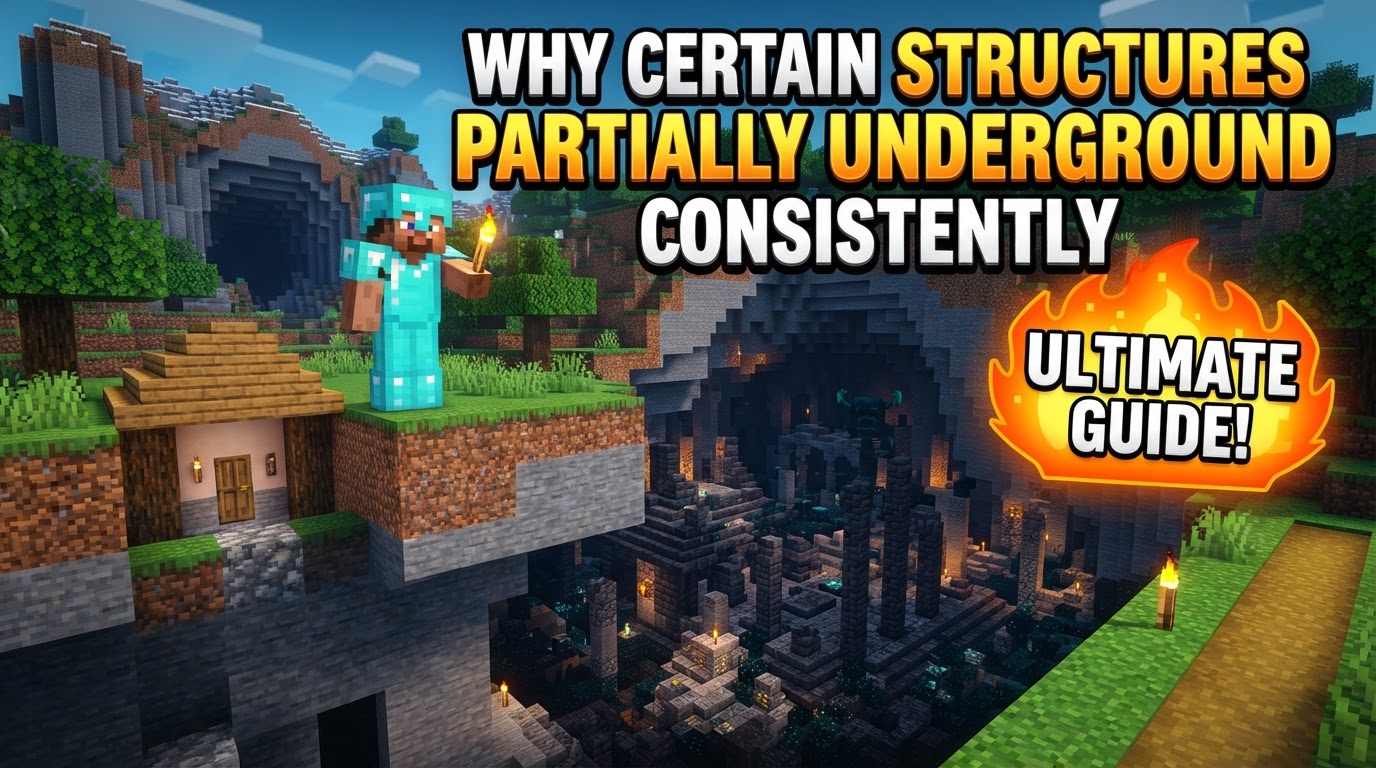
Far from being an error, this behavior is a deliberate design choice that adds depth, challenge, and realism to the game’s environments. Understanding these underlying principles can transform how you perceive the world around you, from the humble Igloo to the sprawling Mineshaft.
The Intent Behind the Earth: Core Mechanics of Subterranean Generation
The primary reason structures generate partially underground stems from a combination of specific design intentions and the technical methods used to place them within the game world. It’s a multi-faceted process, where each element contributes to the final, often buried, appearance.
- Structure-Specific Design: For many structures, being partially or entirely subterranean is not an accident but their very purpose. Consider the Igloo, often found with its base submerged in snow, or the intriguing Trail Ruins, which are explicitly designed to be mostly buried, hinting at ancient civilizations lost to time. Mineshafts, by their very nature, are meant to delve deep below the surface, while Buried Treasure chests are, as their name suggests, always found beneath a layer of earth or sand. These structures are hard-coded to interact with the ground in a way that ensures their partial or full concealment.
- Terrain Adaptation and Constraints: Minecraft’s generation engine employs sophisticated rules to integrate structures seamlessly with the existing terrain. These “grounded” constraints attempt to make structures feel like a natural part of the landscape rather than simply floating or being awkwardly cut off. If a structure has elements that are meant to be at a certain depth relative to its spawn point, and the surrounding terrain naturally rises, those elements will inevitably be enveloped by the earth. This adaptive placement avoids unsightly gaps and makes the world feel more cohesive.
- Heightmap Interaction: The game determines structure placement relative to the world’s heightmap – an internal representation of the surface level at any given X and Z coordinate. When a structure’s Y-level (vertical coordinate) is chosen, its blueprint is then laid out. If parts of the structure are designed to extend *below* this designated spawn Y-level, or if the terrain immediately surrounding the spawn point is higher than the structure’s base, those lower sections will naturally become buried. This isn’t about clearing space; it’s about fitting the structure into the existing contours.
- Biome Influence: The specific biome in which a structure generates also plays a significant role. Biomes like mountains, hills, or even snowy tundras have distinct terrain characteristics. A structure generating in a hilly biome is far more likely to encounter varying ground levels, increasing the probability of partial burial, compared to one generating on a flat plains biome. The natural undulations and elevations of different biomes directly impact how a structure integrates with the ground.
The Generation Blueprint: A Step-by-Step Descent
To truly grasp why structures end up underground, it’s helpful to understand the sequence of events the game follows during world generation. This process illustrates how even structures intended to be mostly above ground can have their lower sections swallowed by the earth.
- Location Selection: The journey begins with the game identifying suitable X and Z coordinates for a structure. This selection isn’t random; it considers factors like the current biome (e.g., a desert temple won’t spawn in a forest) and ensuring there’s enough horizontal space for the structure’s footprint.
- Y-Level Determination: Once the horizontal coordinates are set, the game determines a vertical (Y) coordinate for the structure’s placement. This Y-level is often chosen relative to the detected surface or a specific “ground level” for that location. For instance, a village house might target a Y-level slightly above the highest solid block, while a dungeon might target a specific depth.
- Blueprint Overlay and Terrain Interaction: This is the crucial step where burial occurs. The structure’s schematic, its block-by-block design, is then overlaid onto the terrain at the determined Y-level.
- If the existing terrain at that location is naturally higher than the intended base of the structure, those higher ground blocks will simply remain, encompassing the lower parts of the structure. The structure doesn’t clear the terrain; it attempts to place itself within it.
- Conversely, if the structure’s design itself extends downwards from its reference Y-level (as is common for many dungeon-like elements or foundations), those downward-extending parts will naturally be built into the existing ground.
- In cases where a structure might be placed over air (like a cliff edge), the game may also generate a supporting base or fill in the immediate area to ensure the structure doesn’t float awkwardly, further integrating it with the ground, even if it means some parts become buried by this “support.”
Beyond the Surface: Common Misconceptions About Structure Placement
A significant part of understanding partial structure burial involves dispelling common misunderstandings about how Minecraft’s world generation operates.
- Assuming Full Exposure: The most prevalent misconception is the expectation that all structures should generate entirely above ground. As explored, many structures are explicitly designed for partial or full burial. Viewing a half-buried Igloo or a submerged Trail Ruin as a “bug” misses the intentionality behind their design, which often adds to their mystique and the sense of discovery. These structures are meant to blend in, to be discovered through exploration, not always to stand out prominently.
- Unintended Overlaps: While the game has sophisticated mechanisms to prevent structures from spawning directly on top of each other, complex generation scenarios or the introduction of multiple mods can sometimes lead to unintended overlaps. If collision detection fails or is not robustly configured, one structure might generate and then partially bury another. However, for vanilla structures, this is a rare occurrence, with most instances of partial burial being a result of the intended terrain adaptation.
Shaping the World: Insights for Custom Structure Creators
For those interested in the technical aspects or even creating their own structures, the tools and parameters available further illuminate the intentionality behind partial burial.
- Utilize Offset Parameters: When designing custom structures, especially with tools like MCreator or data pack development, creators can precisely control vertical placement. Adjustable offset parameters or “terrain adaptation” settings allow developers to dictate how deep a structure spawns relative to the surface or a specific Y-level. This fine-tuning is what allows for structures like the Trail Ruins to consistently appear mostly underground.
- Employ Jigsaw Blocks: For intricate designs that require distinct above-ground and underground components, jigsaw blocks are invaluable. These special blocks allow different parts of a structure to be connected at varying depths, creating complex, multi-level generated content that naturally extends both above and below the surface. This technique ensures that even a structure with a surface entrance can seamlessly transition into a subterranean network.
In conclusion, the phenomenon of structures generating partially underground in Minecraft is a testament to the game’s intricate and thoughtful world generation system. It’s a blend of deliberate design choices, sophisticated terrain adaptation algorithms, and a careful interplay with the world’s heightmap and biome characteristics. Rather than glitches, these buried elements are features that enrich the game world, adding layers of discovery and a sense of natural integration that makes Minecraft’s landscapes feel truly alive and endlessly explorable.
Tags:
YOU MAY ALSO LIKE...


