

Why Your Fishing Farm Sometimes Attracts Wrong Drops
Your meticulously crafted AFK fishing farm might be failing to deliver the enchanted books and name tags you crave, instead drowning you in a seemingly endless supply of raw fish and broken fishing rods. This frustrating reality often stems from fundamental shifts in Minecraft’s game mechanics, particularly a significant update in Java Edition that redefined what constitutes a viable treasure-fishing environment.
Understanding Minecraft’s Fishing Ecosystem
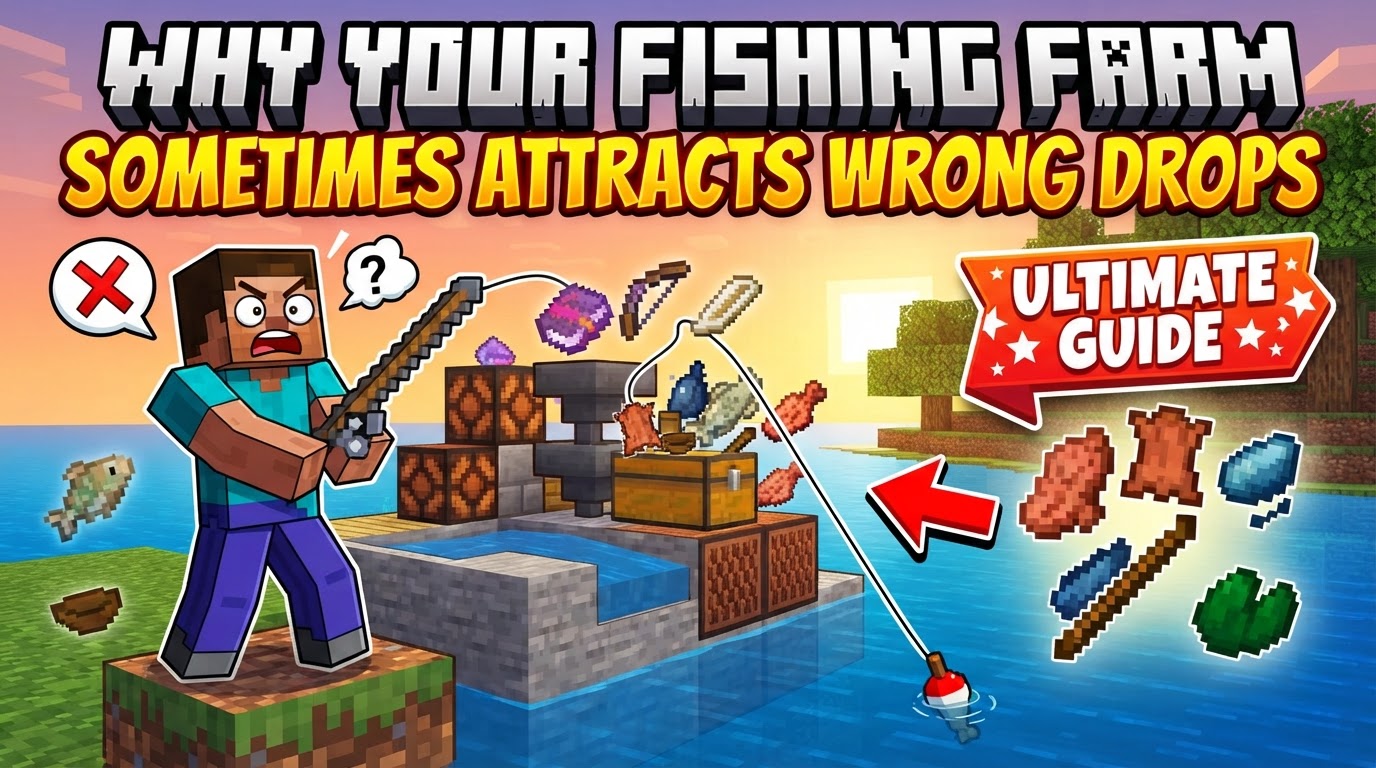
Before diving into the pitfalls, it’s crucial to grasp how Minecraft categorizes its aquatic bounty. When your bobber dips, the game determines your catch from three distinct loot tables: Fish, Treasure, and Junk. Each category holds specific items:
- Fish: This category primarily includes various types of raw fish (Cod, Salmon, Tropical Fish, Pufferfish), which are excellent food sources but rarely the primary goal of an AFK farm.
- Treasure: This is the coveted category, featuring highly valuable items such as enchanted books (often with Mending, Unbreaking, or Luck of the Sea), enchanted fishing rods, enchanted bows, name tags, saddles, and lily pads. These items are often the main reason players build fishing farms.
- Junk: As the name suggests, this category contains less desirable items like plain fishing rods, bowls, leather, leather boots, tripwire hooks, string, sticks, and water bottles. While some items like leather can be useful, they are generally not what players hope for.
The probability of landing an item from each category is influenced by several factors, most notably the enchantments on your fishing rod and the characteristics of the water body you’re fishing in.
The Power of Enchantments
Enchanting your fishing rod is not just a luxury; it’s a necessity for efficient and rewarding fishing, especially in an AFK setup:
- Luck of the Sea (I-III): This enchantment is paramount for treasure hunting. Each level significantly increases your chances of catching treasure items while simultaneously decreasing the likelihood of reeling in junk. Without it, your treasure yields will be abysmal.
- Lure (I-III): While not directly affecting drop categories, Lure drastically reduces the wait time for a bite. This translates to more catches per hour, making your farm far more productive overall.
- Mending: For any AFK farm designed for extended use, Mending is non-negotiable. It repairs your fishing rod using experience orbs you collect, ensuring your rod never breaks. Since AFK farms often generate XP from catching fish, Mending keeps your farm running indefinitely without intervention.
- Unbreaking (I-III): This enchantment increases the durability of your fishing rod, making it last longer between repairs or before breaking entirely. It complements Mending by further extending the rod’s lifespan.
The 1.16 Java Edition Conundrum: Why Your Treasure Vanished
For many veteran Minecraft players, the most common reason for a sudden drop in treasure yields dates back to a crucial change introduced in Minecraft Java Edition 1.16 (Nether Update). Prior to this, a simple 1×1 water block was sufficient for catching treasure. However, this changed dramatically.
To obtain “treasure” drops in Java Edition 1.16 and all subsequent versions, the water block where your fishing bobber lands must be part of a sufficiently large body of water. Specifically, this means the water source block must be within a 5x5x4 volume of open water (5 blocks wide, 5 blocks long, and 4 blocks deep, not necessarily filled with water, but open space for water flow). If this condition is not met, your fishing farm will be restricted to catching only fish and junk items, regardless of your Luck of the Sea enchantment.
This single change rendered countless older, compact 1-block AFK fishing farm designs obsolete for treasure hunting. Many players, unaware of this update, continued to build or use these designs, leading to significant disappointment when only junk and fish filled their chests.
Beyond 1.16: Other Reasons for “Wrong” Drops
While the 1.16 update is a major culprit, several other factors can contribute to a lack of treasure or inefficient farm operation:
Bedrock Edition Limitations
It’s important to note that AFK fishing mechanics can differ significantly between Java and Bedrock Editions. Many traditional AFK farm designs, especially those relying on specific redstone timings or player interaction quirks, may not work as intended in Minecraft Bedrock Edition. Bedrock often requires more precise timing, auto-clickers, or even manual intervention to function, and even then, treasure yields can be less reliable than in Java Edition with an optimized setup. If you’re playing Bedrock, research designs specifically tailored for that version.
Lack of Sky Access
For optimal treasure chances and overall efficiency, the water block where your bobber lands should ideally have direct sky access. This means no solid blocks directly above it. While fishing underground is possible, having sky access allows rain to hit the water, which can further improve fishing efficiency and potentially increase treasure rates. Farms built entirely indoors or under a roof without an open skylight will miss out on this potential boost and might even hinder treasure chances if the game considers the water “enclosed.”
Missing or Insufficient Enchantments
As mentioned earlier, a fishing rod without Luck of the Sea III will inherently yield very few, if any, treasure items. If you’re using a plain rod, or one with only lower levels of Luck of the Sea, you will predominantly catch fish and junk. Ensure your rod is fully enchanted for the best results.
Improper Farm Design or Construction
Even with the right water body and enchantments, a poorly constructed farm can lead to issues. Incorrect placement of vital components like trapdoors, signs, hoppers, pressure plates, or note blocks can disrupt the fishing mechanism. For instance, if the pressure plate doesn’t register a catch, the automatic re-casting won’t trigger, or if hoppers aren’t correctly aligned with storage, items will despawn. Always double-check your construction against a reliable, up-to-date tutorial.
Mob Interference and Player Safety
While not directly affecting drop *types*, hostile mob spawns can severely hinder your AFK farming session. Insufficient lighting in and around your farm can allow zombies, skeletons, creepers, or even phantoms (if you haven’t slept) to spawn. These mobs can attack you, destroy parts of your farm, or simply interrupt your AFK process, costing you valuable fishing time. Always adequately light up your farm area to prevent unwanted visitors.
Optimizing Your Farm for Consistent Treasure
To ensure your fishing farm consistently reels in those valuable treasure items, adhere to these best practices:
- Max Out Your Rod Enchantments: Use a fishing rod with Luck of the Sea III, Lure III, Unbreaking III, and Mending. This combination is the gold standard for AFK fishing.
- Construct a Large Water Source (Java Edition): For treasure, the water block where your bobber lands must be part of a 5x5x4 or larger open body of water. This doesn’t mean the entire 5x5x4 area needs to be filled with source blocks, but rather that the water block is surrounded by enough open space to qualify.
- Ensure Sky Exposure: Build your farm in an open area or create a large skylight above your fishing spot. This allows for direct sky access, potentially boosting efficiency and treasure rates, especially during rain.
- Implement Robust Mob Protection: Light up all surrounding areas with torches, glowstone, or sea lanterns. Consider enclosing your AFK spot with glass or fences to prevent mobs from reaching you while you’re away.
- Manage Your Storage: Design your collection system with ample storage (multiple double chests) to prevent items from backing up and despawning. Regularly check and empty your chests if you plan for very long AFK sessions.
The General Concept of a Modern AFK Fishing Farm
While specific designs vary, most post-1.16 AFK treasure farms in Java Edition follow a similar principle to automate the fishing process:
- Dig a Trench for Storage: Create an underground space for chests and a hopper system.
- Set Up Collection: Place double chests to store your catches, with hoppers feeding into them.
- Build the Large Water Source: Construct the 5x5x4 (or larger) body of water where your bobber will land. This is often an “infinite” water source for simplicity.
- Install the Fishing Mechanism: This typically involves a fence post placed on top of a hopper, a pressure plate on the fence post, a note block adjacent to the fishing water, and a trapdoor positioned over the water.
- Automate Casting: The player stands in a specific spot (often on the chests), aims at the trapdoor, and continuously right-clicks. When an item is caught, it lands on the pressure plate, which triggers the trapdoor to open, allowing the note block to be hit. This interaction (hitting the note block through the trapdoor) is what tells the game the player is fishing, and the pressure plate resets the mechanism for the next cast. This continuous right-click can be maintained by weighting down the mouse button, using auto-clicker software, or leveraging the F3+T trick (reloading textures while holding right-click).
By understanding these core mechanics and common pitfalls, you can transform your underperforming fishing farm into a beacon of treasure and efficiency. No longer will you be left wondering why your digital efforts yield only junk; instead, you’ll be swimming in enchanted books and valuable resources.
Tags:
YOU MAY ALSO LIKE...


