Crafting and Using a Goat Horn
The Unique World of Minecraft Goat Horns
The introduction of goat horns in Minecraft’s 1.19 “The Wild Update” brought a new and intriguing musical instrument to the game. Far from being a simple decorative item, these unique horns serve as both collectible curiosities and practical tools for communication across vast distances. Understanding their mechanics, how to acquire them, and their proper use is key to fully appreciating this distinctive addition to your Minecraft adventures.
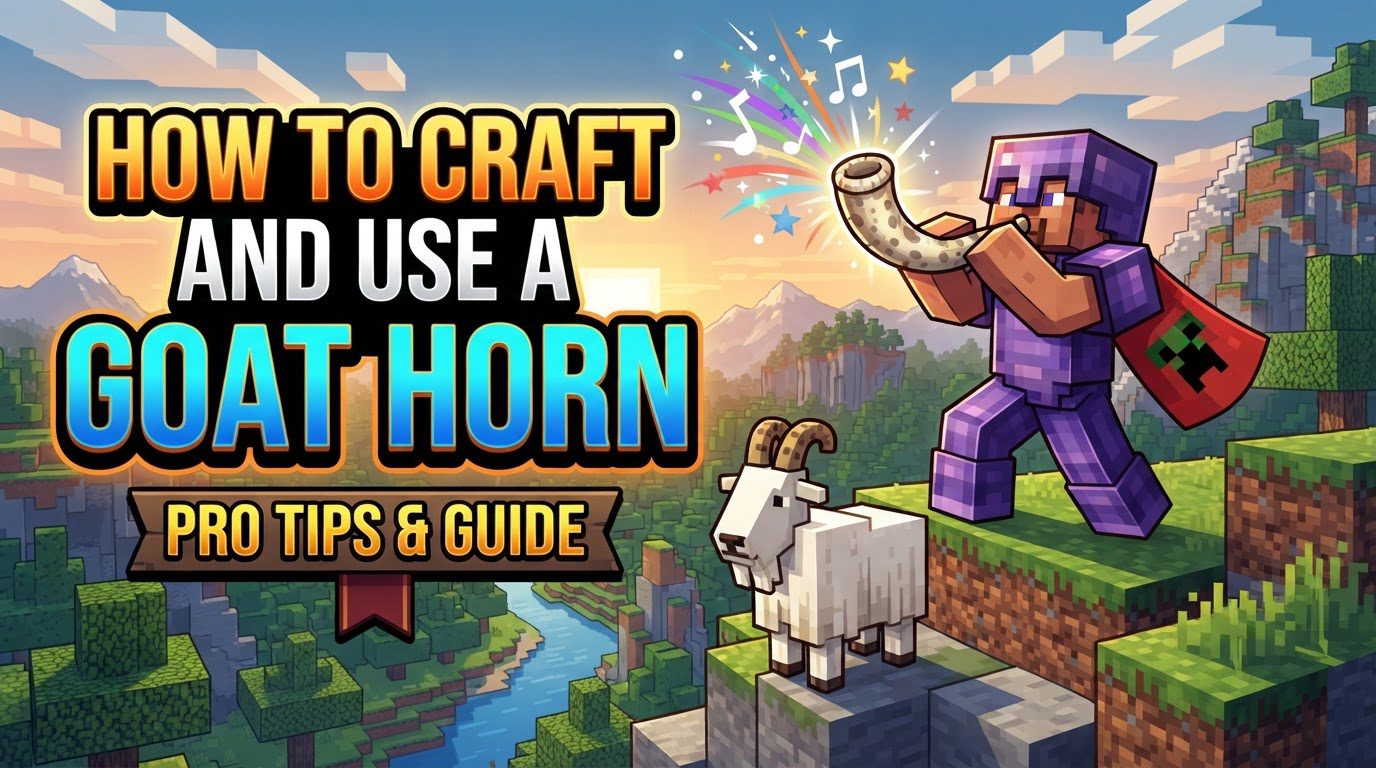
Goat horns are not crafted in the traditional sense; instead, they are a direct drop from goats under specific circumstances. There are a total of eight different types of goat horns, each producing its own unique sound, adding a layer of variety for collectors and practical users alike. Four of these types-Ponder, Sing, Seek, and Feel-are exclusively dropped by regular goats. The other four-Admire, Call, Yearn, and Dream-are rarer, obtainable only from the elusive screaming goats. This distinction means players often need to seek out or breed specific goat variants to complete their collection.
One of the most notable features of goat horns is their impressive range. The sounds they produce can be heard up to 256 blocks away, making them incredibly useful for signaling other players in multiplayer environments. Imagine coordinating mining expeditions, warning of approaching dangers, or simply calling friends back to base with a distinct musical cue. However, it’s crucial to remember that goat horns are purely manual instruments; they cannot be integrated into Redstone contraptions or automated in any way. Furthermore, each use is followed by a brief cooldown period, preventing rapid, continuous blowing.
Obtaining Your First Goat Horn
Acquiring a goat horn is a process that requires patience, observation, and a bit of strategic positioning. Unlike most tools and items in Minecraft, goat horns are not crafted from raw materials. Their acquisition is tied directly to the unique behavior of goats.
- Find Goats: Your journey to collect goat horns begins by locating goats. These agile creatures primarily spawn in mountainous biomes, which include the dramatic landscapes of jagged peaks, the serene expanses of frozen peaks, and the often treacherous snowy slopes. These biomes are typically found at high altitudes, so prepare for some climbing and exploration.
- Locate Hard Blocks: Once you’ve found a goat, the next step is to identify suitable targets for its ramming behavior. Goats will only drop horns if they ram into specific types of naturally generated solid blocks. These include common materials like stone, various ores such as coal ore, copper ore, iron ore, and even the rare emerald ore. Additionally, logs (from any tree type) and packed ice are also effective. The key is that these blocks must be hard and naturally occurring in the world.
- Provoke Ram: Goats possess a unique attack behavior where they charge and ram stationary entities. To trigger this, you need to stand still directly in front of one of the hard blocks you’ve identified, with a goat nearby. Goats will target players or other mobs for ramming approximately every 30 to 300 seconds. This means there can be a significant wait time between ramming attempts, so patience is a virtue here. Position yourself carefully so that the goat’s charge path will lead it directly into the hard block.
- Dodge and Collect: As soon as the goat lowers its head and begins its charge, you must quickly step aside. Your goal is for the goat to ram the hard block instead of hitting you. If successful, the goat will drop one of its horns. It’s important to note that a single goat can drop up to two horns before its ram attacks will no longer yield additional horns. After two successful drops, you’ll need to find a different goat to continue your collection.
- Alternative Acquisition: While ramming is the primary method, there is an alternative way to obtain some goat horns. The four types of horns dropped by regular goats (Ponder, Sing, Seek, Feel) can occasionally be found inside chests located within Pillager Outposts. This provides a less direct but potentially safer method of acquisition, especially for players who prefer to avoid direct confrontation with goats.
- No Crafting: It is crucial to reiterate that goat horns themselves are not crafted. While early game snapshots of Minecraft did include “Copper Horns” which could be crafted, this feature was removed before the final release of The Wild Update. Therefore, any attempt to craft a goat horn using a crafting table or furnace will be unsuccessful.
How to Play a Goat Horn
Once you have successfully acquired a goat horn, using it is a straightforward process, designed for quick and intuitive musical expression or signaling.
- Equip: To play a goat horn, simply hold it in your main hand or off-hand. Like other tools and items, it will appear in your character’s hand, ready for use.
- Play: With the goat horn equipped, press the “use” button. On PC, this is typically the right-click mouse button. Upon activation, your character will blow into the horn, producing its unique sound. Remember that each horn type has a distinct sound, so experimenting with your collection can be quite enjoyable. As mentioned earlier, there is a brief cooldown period after each use, preventing continuous rapid blasts.
Advanced Tips and Strategies for Goat Horns
Beyond basic acquisition and use, there are several advanced strategies that can enhance your experience with goat horns, especially for dedicated collectors or multiplayer enthusiasts.
- Breeding Screaming Goats: To obtain the rarer horn types (Admire, Call, Yearn, Dream), you’ll need to interact with screaming goats. Finding a screaming goat naturally is quite rare, as they only have a 2% chance of spawning. The most reliable method to acquire their horns is through breeding. If you breed a screaming goat with a normal goat, there is a 50% chance that the offspring (kid) will also be a screaming goat. For a much higher success rate, breeding two screaming goats together guarantees a screaming kid in the Java Edition (and a very high 98% chance in the Bedrock Edition). Establishing a breeding program for screaming goats is essential for collecting all eight unique horn types.
- Signaling: Leverage the goat horn’s impressive 256-block sound range for effective communication on multiplayer servers. Develop a system of signals with your friends: perhaps one long blast means “danger,” two short blasts mean “all clear,” or a specific horn’s melody could indicate “meet at base.” This can be invaluable for warning of hostile mobs, coordinating complex builds, or simply alerting teammates to your location without relying on chat messages.
- Goat Farms: For players looking to efficiently collect a large number of goat horns, setting up a dedicated goat farm is highly recommended. This involves creating an enclosed area in a mountainous biome where goats can spawn or be brought to. Within this enclosure, strategically place suitable ramming blocks (stone, ores, logs, packed ice) in locations where you can easily provoke goats to ram them. This controlled environment streamlines the process of obtaining horns and minimizes the effort of constantly searching for wild goats.
Common Mistakes to Avoid
While the process of obtaining and using goat horns is relatively straightforward, several common pitfalls can lead to frustration. Being aware of these can save you time and effort.
- Killing Goats: This is perhaps the most common mistake. Goats do not drop horns when killed, regardless of whether they are normal or screaming variants. The only way to obtain a horn from a goat is through its unique ramming mechanic. Killing a goat will only yield experience points and potentially some raw mutton, but never a horn.
- Incorrect Blocks: Goats are particular about what they ram to drop horns. They will only drop horns if they ram into specific hard blocks like stone, coal ore, copper ore, iron ore, emerald ore, logs, or packed ice. Ramming softer blocks, such as dirt, gravel, sand, or even crafted blocks like cobblestone (if not naturally generated), will not yield a horn. Always ensure the target block is on the approved list and naturally generated.
- Placed Blocks: There’s an important distinction regarding the ramming blocks. For a goat to drop a horn, the block it rams must be naturally generated in the world. Some sources suggest that player-placed blocks, even if they are of the correct type (like stone or logs), might not always trigger a horn drop. It is safest to use blocks that are part of the world’s natural terrain generation, especially those found where goats typically spawn.
- Same Goat, Same Horn: Each individual goat in Minecraft is assigned a specific horn type that it can drop. This means if you repeatedly provoke the same goat, it will always drop the same type of horn (assuming it hasn’t already dropped its two horns). To collect all eight distinct horn types, you will need to find or breed different goats, as each one contributes a unique sound to your collection.
Conclusion
Goat horns are a fascinating and multifaceted addition to Minecraft, offering both auditory pleasure and practical utility. From their origins in the mountainous biomes to their distinct sounds and signaling capabilities, they stand out as a unique item that enriches the gameplay experience. While they cannot be crafted, the process of acquiring them through strategic goat interaction is a rewarding challenge. Whether you’re a seasoned explorer looking for new collectibles, a multiplayer enthusiast seeking effective communication tools, or simply a player who enjoys the subtle nuances of the game, mastering the art of obtaining and using goat horns will undoubtedly add a new dimension to your Minecraft journey. Collect all eight, and let your unique symphony resonate across the blocky world.
Tags:
YOU MAY ALSO LIKE...