

Using Wind Charge Knockback Tactically — A Quick Guide
The Wind Charge, a unique projectile introduced to Minecraft, stands out not for its destructive power, but for its unparalleled utility in manipulating entities and the environment through knockback. Crafted from Breeze Rods, which are obtained from the elusive Breezes found within Trial Chambers, this item redefines movement, combat, and even Redstone interaction. Understanding its core mechanics and mastering its tactical applications can significantly enhance a player’s capabilities, from navigating treacherous terrain to gaining a decisive advantage in battle.
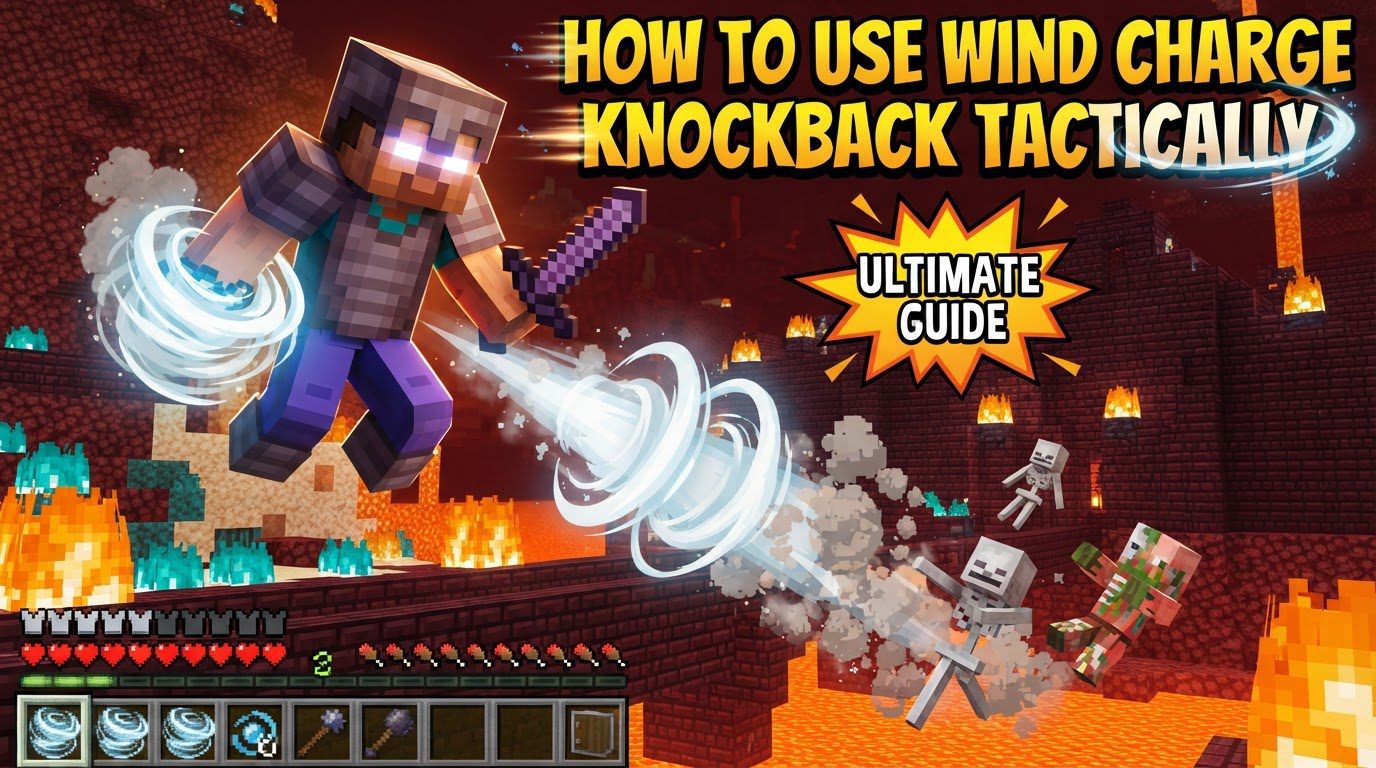
Key Mechanics of the Wind Charge
At its heart, the Wind Charge is a versatile projectile designed for displacement. When thrown, it travels in a straight line with no visible range limit, making it ideal for precise, long-distance actions. While it does inflict a modest 6 (3 hearts) damage to hostile mobs, its primary function is not raw damage output. Crucially, it deals no direct damage to players, which is a fundamental aspect of its self-utility applications.
- Knockback Prowess: The defining characteristic of a Wind Charge is its ability to apply significant knockback to any entity it strikes. This effect is powerful enough to push mobs, items, and even other players, making it an invaluable tool for crowd control, environmental manipulation, and repositioning. It’s important to note that standard knockback resistance, including that provided by Netherite armor, does not diminish the knockback effect of a Wind Charge, ensuring its effectiveness against even the most heavily armored foes.
- Fall Damage Negation: One of the most revolutionary aspects of the Wind Charge is its capacity to negate fall damage. If a player is hit by a Wind Charge (whether thrown by another player or by using one on themselves) just before impacting the ground after a fall, they will take no fall damage. This mechanic is vital for daring leaps and emergency descents.
- Enhanced Vertical Movement: Beyond simply negating fall damage, Wind Charges can actively launch players high into the air. This enables significantly enhanced jumps, allowing players to clear large gaps, scale walls, or reach elevated positions that would otherwise be inaccessible without elaborate scaffolding or parkour.
- Remote Redstone Activation: The Wind Charge is not limited to entity interaction. It possesses the unique ability to activate various Redstone components from a distance. This includes interactable blocks such as doors, trapdoors, levers, and buttons, opening up possibilities for remote base control, intricate traps, or solving puzzles without physical presence.
- Dispenser-Fired Characteristics: When deployed from a dispenser, Wind Charges exhibit a 10% increase in knockback power compared to player-thrown charges. However, this comes at the cost of accuracy, as dispenser-fired charges are less precise. This trade-off makes them suitable for automated traps or mob farms where raw power is prioritized over pinpoint targeting.
- Cooldown Limitation: A critical factor to consider is the 10-second cooldown between uses. This prevents players from spamming Wind Charges and necessitates strategic timing, especially in fast-paced combat or escape scenarios.
Tactical Applications of Wind Charge Knockback
Mastering the Wind Charge involves understanding its various applications and integrating them into your gameplay. Here’s a step-by-step breakdown of its most effective uses:
Enhanced Jumping and Vertical Ascent
One of the most immediate benefits of the Wind Charge is its ability to dramatically improve your vertical mobility. To achieve an enhanced jump:
- Execution: While standing or mid-jump, hold a Wind Charge and use it (typically right-click). The knockback will propel you upwards, significantly increasing your jump height.
- Maximizing Height: For an even greater vertical boost, try crouching just before or as you use the Wind Charge. This slight adjustment can lead to a more powerful launch.
- Utility: This technique is invaluable for scaling cliffs, crossing chasms, reaching high platforms in Trial Chambers, or simply getting a better vantage point.
Fall Damage Negation
Preventing fall damage is a lifesaver, especially in precarious situations or when exploring vertical areas.
- Execution: As you descend from a great height, throw a Wind Charge directly at your feet just before you are about to impact the ground. The brief knockback effect will reset your fall velocity, nullifying any accumulated fall damage.
- Critical Timing: The timing is crucial. Using it too early will not prevent fall damage from the subsequent fall, and using it too late will result in impact before the effect takes hold. You must deploy it precisely as you are about to land.
- Nether Advantage: Unlike water buckets, Wind Charges can be used to negate fall damage in the Nether, offering a vital safety net in a dimension where water is unusable.
Combat Knockback and Crowd Control
The Wind Charge excels at manipulating enemy positions and creating strategic advantages in combat.
- Pushing Enemies: Throw a Wind Charge directly at an enemy mob to push them away. This is excellent for creating distance, interrupting attacks, or forcing them off ledges and into environmental hazards like lava, ravines, or traps.
- Combining with Fall Damage: For increased lethality, aim a Wind Charge at an enemy’s feet while they are near a drop-off. The knockback might combine with fall damage from the drop, making it a powerful tactic against durable foes.
- Escaping Danger: In overwhelming situations, a well-placed Wind Charge can create immediate space, allowing you to retreat, heal, or reposition.
Synergy with the Mace
The Wind Charge forms a potent combination with the new Mace weapon, particularly for its smash attack mechanic.
- Execution: Use a Wind Charge to propel yourself high into the air. As you descend, perform a mace smash attack on a mob below you. The Mace’s smash attack deals increased damage based on fall distance.
- Fall Damage Immunity: A key synergy is that hitting a mob with a mace smash after a fall also negates your own fall damage, making this a high-risk, high-reward maneuver that can be executed safely with practice.
Remote Redstone Activation
For builders and redstoners, the Wind Charge offers unprecedented remote interaction capabilities.
- Execution: Throw a Wind Charge directly at any Redstone component that can be interacted with, such as buttons, levers, doors, or trapdoors. The impact will trigger the component as if a player had right-clicked it.
- Applications: This allows for remote activation of mechanisms, opening secret passages from a distance, triggering traps, or manipulating complex Redstone contraptions without physical presence. Its straight trajectory and lack of range limit make it highly effective for these purposes.
Advanced Tips and Strategic Uses
- Navigation and Parkour: Beyond simple jumps, Wind Charges are transformative for parkour. They allow you to clear unusually large gaps, scale vertical obstacles rapidly, and maintain momentum across challenging courses.
- Mob Herding and Farming: The knockback effect can be used to funnel mobs into specific areas, such as collection points in a farm or designated trap zones. This is particularly useful for automating mob capture or sorting. Similarly, they can push minecarts, aiding in automated transport systems.
- Elytra Launching: For players utilizing Elytra, a Wind Charge can serve as a rocket-free launch mechanism. Propel yourself upwards with a Wind Charge, then deploy your Elytra mid-air to begin gliding without consuming valuable firework rockets.
- Bedrock Edition Curve Throw: In Bedrock Edition, players can achieve a “curve” throw. Immediately after throwing a Wind Charge, punching in the desired direction can alter its trajectory, adding another layer of precision and trick-shot potential.
Common Mistakes to Avoid
While powerful, the Wind Charge has its limitations and nuances. Being aware of these can prevent wasted resources or critical failures:
- Overestimating Damage: Remember that Wind Charges deal minimal damage to mobs and none to players. Their utility is in knockback and movement, not direct combat damage. Relying on them for damage will be inefficient.
- Wasting Charges: Wind Charges are not infinite. Breeze Rods, their crafting ingredient, come from Breezes in Trial Chambers, which have spawn cooldowns. Treat them as a valuable, farmable resource and use them judiciously.
- Forgetting the Cooldown: The 10-second cooldown is a significant factor. In high-pressure situations, forgetting this delay can leave you vulnerable or stranded. Always factor it into your tactical planning.
- Incorrect Fall Damage Negation Timing: You must use the Wind Charge just before landing to reset fall velocity. Using it too early in a long fall will only momentarily suspend you, and you will still take fall damage from the subsequent impact.
- Ignoring Knockback Resistance: Do not assume that standard knockback resistance enchantments or Netherite armor will protect against a Wind Charge’s knockback. They do not. This makes Wind Charges uniquely effective against even the most fortified opponents.
In conclusion, the Wind Charge is a remarkably versatile and powerful item that rewards creative and strategic thinking. From enhancing personal mobility and parkour to offering novel combat tactics and remote Redstone manipulation, its applications are diverse. By understanding its mechanics and avoiding common pitfalls, players can unlock a new dimension of gameplay, making the Wind Charge an indispensable tool in any adventurer’s arsenal.
Tags:
YOU MAY ALSO LIKE...


