Routing Multiple Farm Outputs Into One Storage System (Step by Step)
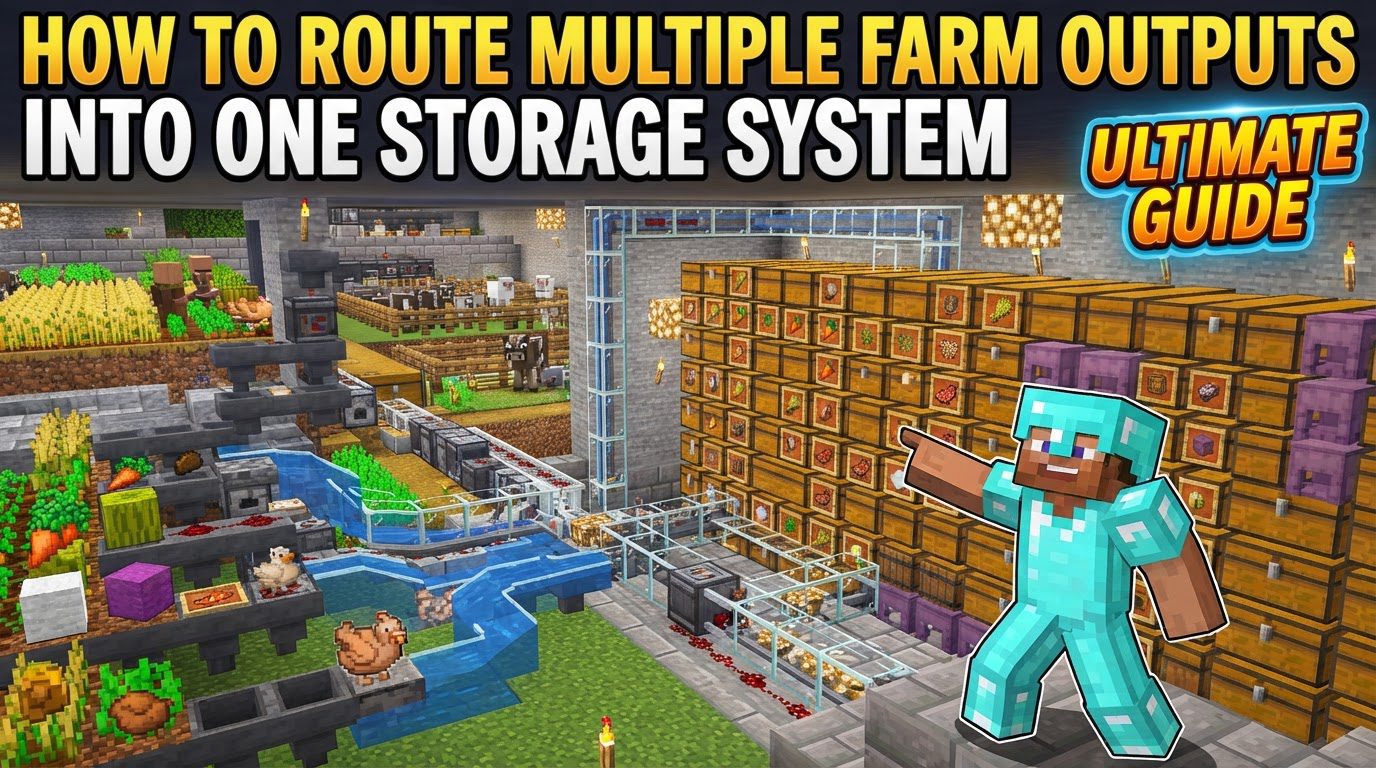
Building an efficient and organized base in Minecraft often involves creating various automated farms. As these farms produce a multitude of resources, routing their outputs into a single, cohesive storage system becomes crucial for managing inventory, streamlining crafting, and maintaining a lag-free environment. This guide will walk you through the essential mechanics, a step-by-step process, important tips, and common pitfalls to avoid when consolidating your farm outputs.
Key Mechanics
Understanding the fundamental mechanics of item transport and storage is the cornerstone of any successful automated system.
-
Hoppers: These versatile blocks are indispensable for moving items between different inventories. Hoppers pull items from containers directly above them and push them into adjacent or lower containers. They operate at a fixed throughput of 2.5 items per second. While highly useful, deploying a large number of hoppers can be resource-intensive due to their iron cost and may contribute to game lag. To mitigate lag, placing containers such as droppers or furnaces directly on top of hoppers can prevent them from constantly searching for item entities in the air above them.
-
Water Streams: For horizontal item transportation, water streams offer an efficient and significantly less iron-expensive solution, especially when moving items over extended distances. Items flow along with the water current, which extends 7 blocks from its source block. The speed of item transport via water streams can be dramatically increased by placing packed ice or blue ice blocks underneath the flowing water, creating a very fast and high-throughput transport method.
-
Minecarts (with Hopper/Chest): Minecarts are ideal for transporting bulk items over very long distances, particularly in environments where water streams are not a viable option, such as the Nether. A hopper minecart automatically picks up items from the tracks or above it and can be configured to load and unload its contents at designated stations. Hopper minecarts are notably faster than regular hoppers, operating at four times their speed. Minecarts with chests, while not auto-collecting, provide a higher storage capacity for manual loading and unloading.
-
Droppers and Dispensers: These blocks are primarily used to manipulate items from an inventory. Droppers convert items stored within them into floating item entities in the world, while dispensers can launch items or use them (e.g., bone meal, arrows). Droppers are particularly useful in constructing vertical item elevators, often in conjunction with water to create bubble columns for upward item movement.
-
Redstone Automation: Redstone is the lifeblood of advanced item management systems. It is essential for constructing sophisticated item sorting systems that direct specific items to designated chests, creating automatic collection mechanisms using components like observers and pistons, and controlling the overall flow and timing of items within your infrastructure.
-
Item Despawn: It is critical to remember that any item floating in the world (not within an inventory) will despawn after 5 minutes if left unattended. This timer is a crucial consideration when designing long-distance transport systems or overflow mechanisms to prevent resource loss.
Step-by-Step Process
Integrating multiple farm outputs requires a systematic approach to ensure efficiency and reliability.
-
Collection at Each Farm: The first step involves setting up an effective collection system at each individual farm. This typically entails using water streams to guide harvested items into hoppers, which then feed into a localized storage or directly into the transport system. The goal is to gather all items produced by the farm as quickly and reliably as possible.
-
Transport to a Central Hub: Once collected, all items from various farms need to be routed to a single, centralized location. For efficient horizontal transport, especially over long distances, ice-backed water streams are often the most cost-effective and fastest method. For extremely long distances or cross-dimensional transport (like in the Nether), minecart systems provide a robust alternative, ensuring items reach the central hub without despawning.
-
Vertical Transport (if needed): If your central storage system is situated at a different elevation than your farm collection points or transport lines, you will need a vertical transport solution. Bubble columns, created by placing soul sand for upward movement or magma blocks for downward movement in a column of water, are highly efficient for moving items vertically. Alternatively, dropper lines, using a series of droppers powered by redstone, can also elevate items.
-
Item Sorting System: Upon reaching the central hub, items must be sorted. Constructing a redstone-based item sorter is paramount. This system typically utilizes hoppers, redstone comparators, and redstone repeaters to identify different item types. Once identified, items are directed into their pre-designated storage chests, preventing items from mixing and making them easy to retrieve. Proper sorting is essential for organization and usability.
-
Overflow and Bulk Storage: It is vital to design an overflow system. This accounts for situations where primary storage chests for a specific item type become full, or for items that are not sorted. Overflow items can be directed to a general “junk” chest, an item disposal unit (such as a lava pit), or, ideally, into a bulk storage solution. For farms producing massive quantities of stackable items, integrating shulker box loaders is highly recommended. These contraptions automatically compact items into shulker boxes, dramatically increasing storage capacity within a small footprint.
Important Tips
To maximize the efficiency and longevity of your integrated storage system, consider these important recommendations.
-
Calculate Capacity: Before building, estimate the output rates of your farms. This allows you to ensure your storage system has adequate capacity for each item type, preventing overflow situations where items might back up and despawn.
-
Automate Everything: Strive to integrate automation into every step of item collection, transport, and sorting. Minimizing manual intervention maximizes overall efficiency and allows you to focus on other aspects of your Minecraft world.
-
Optimize Transport Routes: Prioritize the use of water streams with ice blocks for horizontal transport. They offer high throughput, fast item movement, and are generally more lag-friendly than extensive hopper networks. Use hopper lines sparingly, reserving them for short distances or specific loading and unloading tasks where their precise item transfer is beneficial.
-
Plan for Scalability: Design your storage system with future expansion in mind. As your farms grow and produce more items, you should be able to easily add more storage units or expand existing ones without a complete overhaul of the system.
-
Centralize and Organize: A well-organized and centralized storage system significantly enhances accessibility. This makes finding specific items for crafting, trading, or construction much simpler and less time-consuming.
-
Consider Shulker Box Loaders: For items generated in massive quantities, shulker box loaders are invaluable. They compact items into shulker boxes, saving immense amounts of space. Additionally, auto-crafters can be used to compact raw materials into blocks (e.g., iron ingots into iron blocks) before they are loaded into shulker boxes, further increasing storage density.
-
Implement Redstone Toggles: Include switches or levers in your design to turn individual farms or specific sections of your storage system on or off. This is particularly useful for managing overflow when a certain resource is not immediately needed or for troubleshooting purposes.
Common Mistakes to Avoid
Being aware of common pitfalls can save you significant time and resources.
-
Underestimating Storage Needs: One of the most frequent errors is failing to provide sufficient storage for high-yield farms. This can lead to items backing up in the system, being lost due to despawning, or even halting the farm’s operation entirely if output cannot be collected.
-
Ignoring Item Despawn Timer: Neglecting the 5-minute despawn timer for dropped items can result in substantial resource loss, especially over long transport distances. Unless chunk loaders are used to keep transport paths active, items might despawn before reaching their destination.
-
Creating Bottlenecks: Relying too heavily on long lines of hoppers for high-throughput items is a common bottleneck. Hoppers have a limited transfer speed, and extensive networks can lead to items accumulating, causing inefficiencies and potential loss.
-
Lack of Item Sorting: Without a proper item sorting system, all farm outputs will mix together in general storage. This makes items incredibly difficult to find and manage, defeating the purpose of automated collection.
-
Inefficient Hopper Usage: Using an excessive number of hoppers where water streams or minecart systems would be more efficient is a mistake. This not only incurs high iron costs but also contributes unnecessarily to game lag due to the constant item searching and transfer animations.
-
Forgetting Overflow Protection: A system without a designated overflow protection mechanism will eventually fill up. Once storage is full, items will either be lost, despawn, or cause the entire farm’s production to halt until space is cleared.
-
Improper Item Filter Setup: Incorrectly configuring item filters in your sorting system (e.g., not filling all filter hopper slots correctly) can lead to random items being sorted into the wrong chests, or the filters failing to function as intended, causing items to bypass the sorting process.
-
Ignoring Lag Considerations: Large, unoptimized redstone contraptions and extensive hopper networks can significantly impact game performance. This is especially true on multiplayer servers, where complex systems can lead to noticeable slowdowns and an unpleasant gaming experience.
By carefully planning and implementing these strategies, you can create a robust and efficient system that seamlessly routes all your farm outputs into a centralized, organized storage solution, enhancing your Minecraft experience.
Tags:
YOU MAY ALSO LIKE...