Using a Trident to Break Sulfur Spikes (Step by Step)
Unveiling the Power of the Trident Against Sulfur Spikes
Minecraft, a world of endless discovery and intricate mechanics, continually introduces new elements to challenge and engage players. With the advent of Minecraft 26.2 Snapshot 3, part of the “Chaos Cubed” update, adventurers were introduced to a fascinating new geological formation: sulfur spikes. These distinctive mineral-like structures, with their unique appearance and inherent hazards, demand specific strategies for safe and efficient interaction. While various tools can interact with these spikes, the trident stands out as a particularly effective, albeit specialized, method for their removal. This comprehensive guide will delve into the precise mechanics and step-by-step process of utilizing a trident to break sulfur spikes, ensuring both efficiency and safety in your explorations.
Understanding Sulfur Spikes: A New Geological Hazard
Before we can effectively dismantle sulfur spikes, it’s crucial to understand what they are and how they behave. Introduced in Minecraft 26.2 Snapshot 3, these formations are a signature feature of the “Chaos Cubed” update. They generate naturally within the newly discovered Sulfur Cave biomes, presenting a unique environmental challenge. Additionally, they can be found sprouting around sulfur springs on the surface, indicating areas of geothermal activity. Visually, sulfur spikes bear a resemblance to the familiar dripstone formations, but they possess a distinct sulfur appearance, setting them apart from other cave structures. They manifest in two primary forms: as stalactites, hanging precariously from cave ceilings, and as stalagmites, rising from the ground. A key characteristic of sulfur spikes, and one that makes them a significant environmental hazard, is their tendency to fall when unsupported. When a sulfur spike falls, it can deal considerable damage to any players or mobs caught beneath it, making careful handling paramount.
The Trident: Your Specialized Weapon Against Spikes
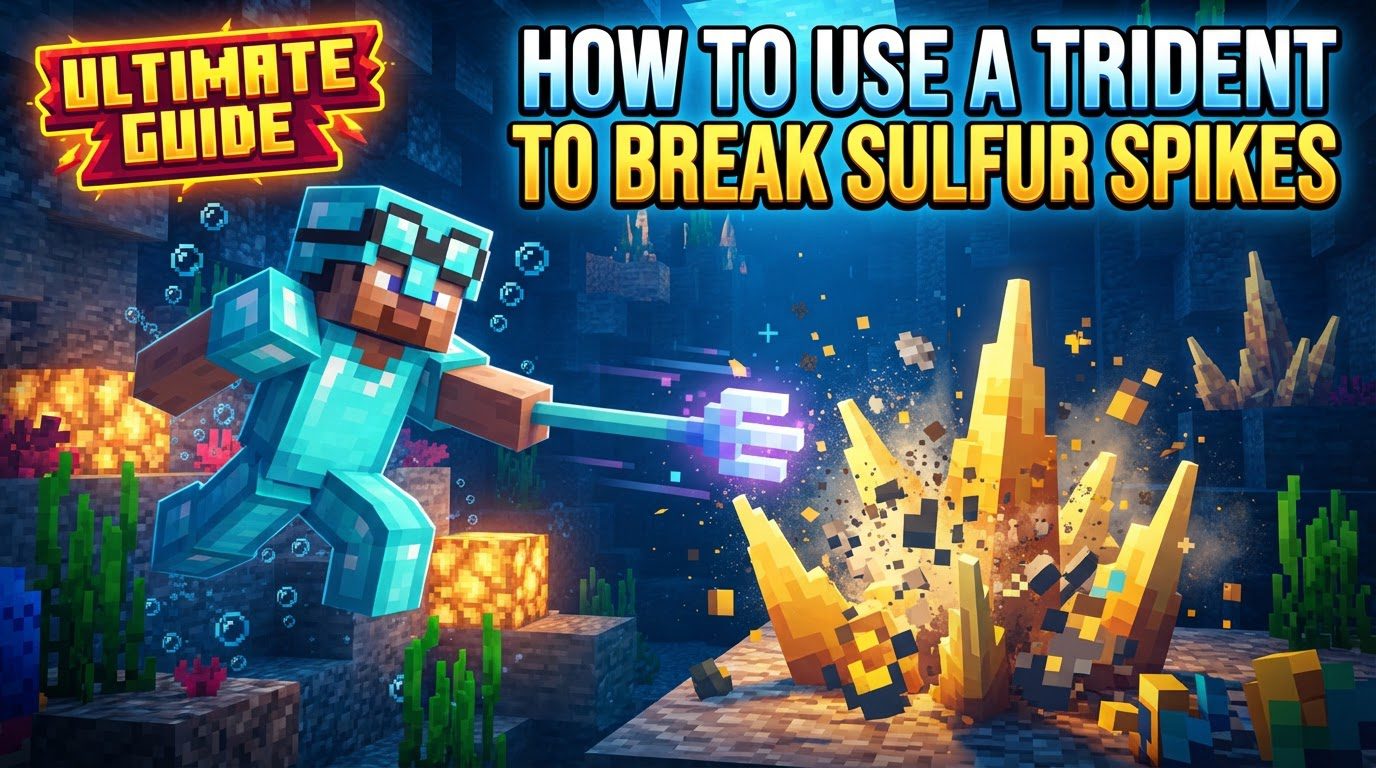
The trident is a powerful and versatile weapon in Minecraft, primarily known for its combat capabilities and unique enchantments. However, its utility extends beyond mere combat, proving surprisingly effective against certain environmental hazards like sulfur spikes. Tridents are not crafted; instead, they are obtained as a rare drop from defeating Drowned, a specific type of zombie that spawns in aquatic environments. The hunt for a trident can be an adventure in itself, often requiring players to brave oceans and rivers, fending off these aquatic undead. Once acquired, a trident becomes an invaluable tool, not just for its conventional uses, but specifically for its unique interaction with sulfur spikes. When thrown, a trident possesses the distinct property of instantly breaking any sulfur spike it impacts, offering a swift and precise method of removal.
Locating Your Target: Where Sulfur Spikes Reside
To begin your spike-breaking endeavors, you must first locate the sulfur spikes themselves. As previously mentioned, these formations are exclusive to specific biomes and geological features introduced in the “Chaos Cubed” update. Your primary hunting grounds will be the Sulfur Cave biomes. These subterranean environments are characterized by the pervasive presence of sulfur spikes, often in dense clusters, both hanging from ceilings as stalactites and emerging from the ground as stalagmites. Alternatively, you can find sulfur spikes on the surface, specifically around sulfur springs. These springs are natural geological features where sulfur-rich water or gas emerges from the ground, often surrounded by the characteristic sulfur spikes. When exploring, keep an eye out for structures resembling dripstone but with that distinct, unmistakable sulfur appearance. Identifying these locations is the first crucial step in effectively utilizing your trident.
The Step-by-Step Process: Breaking Sulfur Spikes with a Trident
Once you have your trident in hand and have located your target sulfur spikes, the process of breaking them down is straightforward, yet requires careful execution to ensure safety and efficiency.
- Acquire Your Trident: Your journey begins with obtaining this essential tool. As tridents are drops from Drowned, you will need to seek out and defeat these aquatic zombies. This often involves exploring ocean biomes, river biomes, or even underwater ruins where Drowned frequently spawn. Be prepared for a fight, as Drowned can be formidable opponents, especially underwater. Persistence is key, as the trident drop rate can be variable.
- Locate Sulfur Spikes: With your trident secured, venture into a Sulfur Cave biome or search for sulfur springs on the surface. Visually identify the spikes, distinguishing between the hanging stalactites and the ground-based stalagmites. Observe their placement and any potential hazards, such as spikes directly above your intended path.
- Equip the Trident: Open your inventory and place the trident into your hotbar. Select the hotbar slot containing the trident to equip it, making it your currently held item. This prepares you for the throwing action.
- Aim at the Sulfur Spike: Position yourself safely, ensuring you have a clear line of sight to the sulfur spike you intend to break. Use your crosshairs to accurately target the spike. Precision is important, especially for stalactites that might be out of easy reach or in precarious positions. Consider your distance; while tridents can be thrown a fair distance, closer proximity generally allows for more accurate aiming.
- Throw the Trident: To throw the trident, typically you will hold down the right-click button (or the equivalent “use item” button on your platform) to charge the throw, and then release it. The trident will launch as a projectile towards your targeted spike. Upon impact, the thrown trident will instantly break the sulfur spike, regardless of its size or form. This instantaneous destruction makes the trident an incredibly efficient tool for clearing these formations.
- Retrieve Your Trident: After throwing, your trident will be embedded in the block it hit, or if it hit a mob, it might drop as an item. It is crucial to retrieve your trident, as it is a valuable and non-renewable item through crafting. Simply walk over to where the trident landed or dropped, and it will be automatically added back into your inventory. This retrieval mechanic ensures that you can use the same trident repeatedly for breaking multiple spikes.
Safety First: Avoiding Common Mistakes
While using a trident to break sulfur spikes is effective, certain precautions must be taken to ensure your safety. Sulfur spikes, by their very nature, pose environmental risks that can be exacerbated by careless interaction.
- Do Not Stand Directly Under Falling Spikes: This is perhaps the most critical safety rule. If you are breaking a sulfur stalactite (a spike hanging from the ceiling), it will fall once broken. Standing directly beneath it will result in you taking damage upon impact. Always ensure you are standing clear of the fall zone, especially when targeting spikes directly above you. The same principle applies if you accidentally remove the support block of a stalactite; it will fall, so be mindful of the surrounding blocks.
- Be Aware of Support Blocks: Sulfur spikes, particularly stalactites, rely on a support block to remain in place. If this support block is removed, the spike will fall, even if you weren’t directly breaking the spike itself. When mining or moving around sulfur spike formations, always be conscious of which blocks provide structural integrity to the spikes. Unintentionally removing a support block can lead to unexpected falling spikes and potential injury.
Beyond Breaking: Properties and Uses of Sulfur Spikes
While the trident excels at breaking sulfur spikes, it’s important to understand their broader context within the game, including alternative breaking methods, their renewable nature, and their potential applications.
- Alternative Breaking Methods: While a trident provides an instant break, it’s not the only way to remove sulfur spikes. A pickaxe is actually the fastest tool for mining sulfur spikes, making it the preferred method for bulk collection. If you find yourself without a trident or a pickaxe, your bare hand can also break sulfur spikes, though this method is considerably slower and less efficient. Each method has its place, with the trident being ideal for quick, ranged removal of hazardous spikes without needing to get close, and the pickaxe for resource gathering.
- Renewability and Growth: Sulfur spikes are a renewable resource. They possess a unique growth mechanic: they can grow taller when placed on a point block, or they can be combined with other spikes to form larger columns. This means that even after clearing an area, you have the potential to cultivate more spikes for various purposes, making them a sustainable resource for future projects.
- Crafting and Traps: Sulfur spikes are not merely decorative or hazardous; they have practical applications. Four sulfur spikes can be combined in a 2×2 crafting pattern to create a sulfur block, opening up possibilities for new building materials or further crafting recipes. Furthermore, their inherent property of dealing falling damage makes them excellent components for traps. Players can strategically place sulfur spikes above pathways or mob spawners, using their falling mechanic to create dangerous deterrents or automated damage systems.
In conclusion, the trident offers a unique and highly effective method for breaking sulfur spikes in Minecraft’s “Chaos Cubed” update. By understanding the nature of these new formations, acquiring your trident, and following the precise steps for aiming, throwing, and retrieving, you can safely and efficiently clear these environmental hazards. Remember to prioritize safety by avoiding falling spikes and being aware of their support structures. With this knowledge, you are well-equipped to navigate the new challenges and opportunities presented by sulfur spikes in your Minecraft adventures.