

Barrel vs Chest Storage Comparison
For many Minecraft players, the choice between a barrel and a chest often seems trivial, yet one crucial difference can revolutionize your base’s design and efficiency: barrels can be opened even with a solid block directly above them, a feat chests simply cannot manage. This subtle yet powerful distinction is just one of many factors that differentiate these two fundamental storage blocks in the world of Minecraft, each offering unique advantages depending on your building style, storage needs, and technical aspirations.
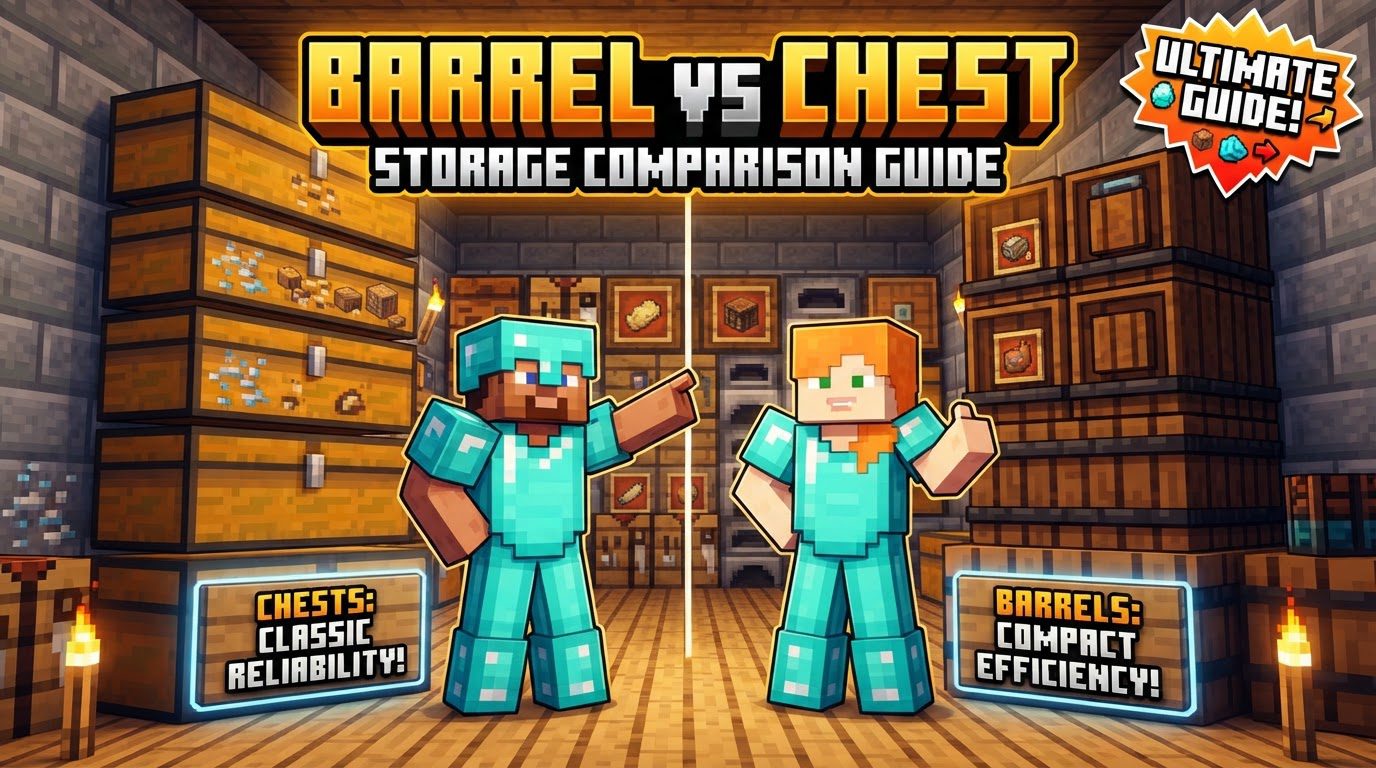
Both barrels and chests serve the essential purpose of safeguarding your precious inventory. From rare diamonds to stacks of cobblestone, these containers are the backbone of any organized base. While they share a core function, a deeper look reveals distinct characteristics in terms of capacity, placement flexibility, crafting requirements, and even their impact on game performance. Understanding these nuances is key to optimizing your storage solutions, whether you’re building a compact starter home or an expansive, automated sorting facility.
The Fundamental Capacity: Single vs. Double
At their most basic, both a single chest and a barrel provide an identical storage capacity of 27 inventory slots. This means a single unit of either can hold just over a stack and a half of any item, or 27 different types of items. This parity in individual capacity often leads players to believe they are interchangeable, but this is where the similarities begin to diverge significantly.
Chests possess a unique ability to combine. When two single chests are placed adjacent to each other, they automatically merge to form a “double chest.” This expanded unit offers a generous 54 inventory slots, effectively doubling the storage space within the footprint of two blocks. This makes double chests incredibly efficient for mass storage, allowing you to store large quantities of items in a relatively compact area. Barrels, however, lack this capability. Placing two barrels next to each other, or even stacking them, simply results in two independent 27-slot barrels. They will never combine to form a larger storage unit. For large, centralized storage rooms where maximizing capacity per block is paramount and vertical space above the containers is not an issue, double chests remain the undisputed champion.
Unlocking Vertical Space: The Overhead Advantage
Perhaps the most significant functional difference between barrels and chests lies in their interaction with overhead blocks. Barrels are incredibly versatile in their placement: they can be opened and accessed even if there is a solid or transparent block directly above them. This quality makes them ideal for compact builds, hidden storage, or integrating seamlessly into walls and floors. Imagine a barrel built directly into the floor of your house, accessible with a simple click, or tucked neatly under a workbench without obstructing its use.
Chests, on the other hand, demand an empty air space directly above them to be opened. If a solid block, like stone, dirt, or even another chest, is placed directly on top of a chest, it will be impossible to access its contents. There are a few exceptions, such as bottom-half slabs, which allow chests to open, but generally, chests require clear overhead access. This limitation often dictates the layout of chest-based storage systems, requiring more vertical clearance and potentially making them less suitable for tightly packed or aesthetically integrated designs. This crucial distinction makes barrels superior for space-efficient designs, allowing for storage solutions that are hidden, integrated, or simply more compact.
Assembling Your Storage: Crafting Recipes
Both storage solutions are relatively easy to craft early in the game, requiring only basic wooden materials. However, their recipes differ slightly.
Forging a Barrel
- To craft a barrel, you will need 6 wooden planks and 2 wooden slabs. Any type of wood plank and any type of wooden slab can be used, and they do not need to match.
- Place three wooden planks in the left column and three in the right column of a 3×3 crafting grid.
- Then, place one wooden slab in the top-center slot and one in the bottom-center slot.
- Collect the crafted barrel from the output slot.
Constructing a Chest
- Crafting a chest is even simpler, requiring just 8 wooden planks of any type.
- Open a crafting table and place the 8 wooden planks in all slots of the 3×3 crafting grid, leaving only the very center slot empty.
- Collect the crafted chest.
The slightly simpler recipe for a chest often means players encounter and craft them first, but the barrel’s recipe is still quite accessible, especially after acquiring an axe for wood and crafting a few planks and slabs.
Automated Organization: Hoppers, Droppers, and Redstone
For players delving into the realm of automation, both barrels and chests are fully compatible with Minecraft’s Redstone mechanics for item transfer and signal generation. Both containers can seamlessly integrate into automated sorting and storage systems using hoppers and droppers. Hoppers can be placed on top of, or pointing into, either a barrel or a chest to deposit items, and they can also pull items out from the bottom.
Furthermore, both barrels and chests can emit a Redstone signal via a comparator when items are stored inside. The strength of the signal scales with how full the container is, allowing for sophisticated Redstone contraptions that react to storage levels. This compatibility ensures that regardless of which container you choose, your automated systems will function effectively. However, barrels’ ability to open with blocks above them can sometimes simplify the design of complex Redstone contraptions in tight spaces, as you don’t need to account for overhead clearance for access.
Optimizing Performance: Lag and Large-Scale Systems
In very large-scale storage systems, particularly on servers or for players with less powerful hardware, performance becomes a significant consideration. Here, barrels often hold an advantage. Barrels are generally considered more “lag-friendly” than chests. The technical reason for this is that chests are “ticked” by the server, meaning the game constantly checks their state, which can contribute to server load and client-side FPS (frames per second) lag when thousands of chests are present. Barrels, on the other hand, are simpler blocks that do not require constant ticking, making them a better choice for massive storage arrays where minimizing lag is crucial. While a few chests versus a few barrels will show negligible difference, in mega-bases with tens of thousands of storage units, opting for barrels can lead to a noticeable improvement in game performance.
Beyond Storage: Aesthetics and Utility
Beyond their primary function, both barrels and chests can contribute to the aesthetic and functional design of your base in unique ways.
- Aesthetics: Barrels have a distinct, rustic appearance that fits wonderfully into various build themes. They are perfect for medieval villages, pirate ships, fishing docks, or any build where a more natural, wooden container is desired over the more utilitarian look of a chest. They can also be used decoratively as tables, seats, or structural elements.
- Villager Trading: Barrels serve a crucial role in villager mechanics. They are the job site block for Fisherman villagers. Placing a barrel near an unemployed villager can convert them into a Fisherman, allowing you to access specific trades like enchanted fishing rods, cooked fish, and even boats. Chests do not have this secondary utility.
Avoiding Storage Snafus: Common Misconceptions
Understanding common mistakes associated with both barrels and chests can save you frustration and wasted effort:
- Expecting Barrels to Combine: As mentioned, a frequent misconception is that barrels will form “double barrels” like chests do. They never will; they always remain single 27-slot units.
- Blocking Chests: A classic error is placing a solid block directly above a chest, rendering it inaccessible. Always ensure chests have an empty space above them (or a bottom-half slab) if you want to open them.
- Incorrect Slabs for Barrels: While the barrel recipe is straightforward, remember it specifically requires wooden slabs, not other slab types like stone or iron.
- Cats on Chests: A common annoyance for many players is when a tamed cat decides to sit on a chest, preventing it from being opened. Barrels are immune to this feline obstruction, providing reliable access even with a furry companion perched nearby.
Strategic Storage: Choosing the Right Container
Ultimately, the choice between a barrel and a chest isn’t about one being inherently “better,” but rather about understanding their strengths and weaknesses to apply them strategically:
- Use Double Chests for: Mass storage rooms where you need to store vast quantities of items and have ample vertical space above the containers. Their 54-slot capacity per two blocks is unmatched for sheer volume efficiency.
- Use Barrels for: Compact storage in tight spaces, under floors, built into walls, or hidden compartments where overhead clearance is limited. They are excellent for decorative purposes in themed builds (medieval, pirate, fishing). Use them as job site blocks for Fisherman villagers. For very large-scale automated storage systems, barrels are preferred to reduce server load and client FPS lag. They are also ideal for small, quick access storage near crafting stations or furnaces.
By considering these factors, you can design more efficient, aesthetically pleasing, and lag-friendly storage solutions in your Minecraft world. Both barrels and chests are invaluable tools in your inventory management arsenal; knowing when and where to deploy each will elevate your building and survival experience.
Tags:
YOU MAY ALSO LIKE...


