Creating Skill-Based PvP Ranking Systems
The sophisticated Elo rating system, born from chess, forms the bedrock of most fair and dynamic PvP ranking systems even in the blocky world of Minecraft. While many servers might start with simple win/loss tallies, truly capturing a player’s skill requires a deeper dive into mechanics that reward strategic play and fair competition.
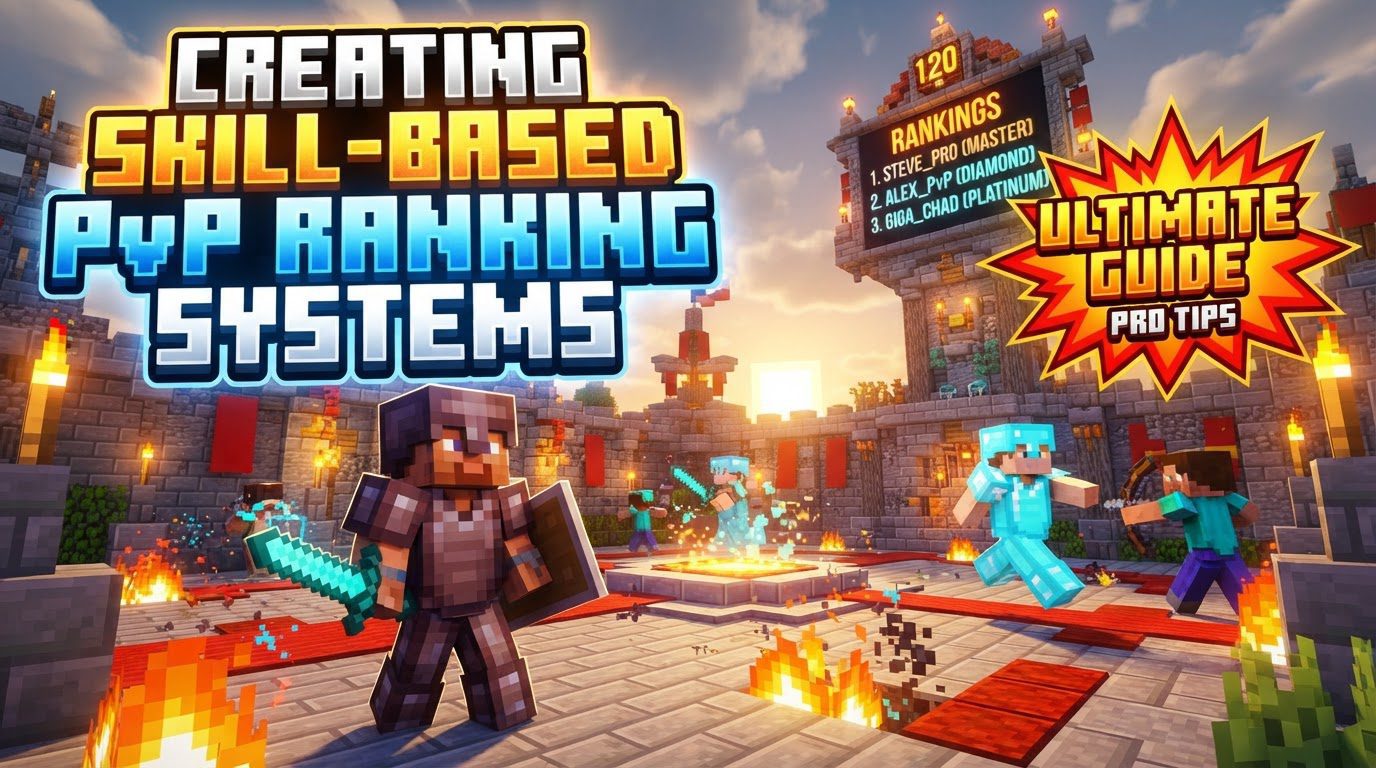
Creating a robust, skill-based PvP ranking system in Minecraft is crucial for fostering a competitive environment, retaining players, and providing clear progression paths. This guide will explore the core mechanics, offer a conceptual step-by-step process for implementation, and highlight key considerations for building a system that stands the test of time and player scrutiny.
Understanding Core Ranking Mechanics
At the heart of any effective PvP ranking system are the metrics used to assess and categorize player skill. Several approaches exist, each with its own strengths and applications:
- Elo Rating System: This is the gold standard for skill-based ranking. Players gain or lose points based on match outcomes and the ratings of their opponents.
- Rating Adjustments: Defeating a higher-ranked player yields a significant Elo boost, while losing to a lower-ranked player results in a steeper drop. Conversely, beating a lower-ranked player grants fewer points, and a loss to a higher-ranked opponent results in a smaller deduction. This system naturally encourages players to seek out challenging opponents rather than “farming” weaker ones.
- Configurability: Elo systems are highly adaptable. Server owners can fine-tune parameters like base Elo changes per fight, maximum rating ratios between competitors, and the maximum percentage of Elo that can be lost in a single match, allowing for a balanced and server-specific experience.
- Kill-Death Ratio (K/D): A straightforward metric, K/D ratios track points gained for kills versus points lost for deaths. While simple, its weighting can be adjusted to reflect different server philosophies on individual performance.
- Win Rates and Total Wins: These are commonly tracked metrics for leaderboards, providing a basic overview of player success. However, they are generally less nuanced than Elo for true skill assessment, as a win against a beginner often counts the same as a win against a seasoned veteran.
- Rank Progression & Tiers: Most systems integrate customizable rank tiers (e.g., Bronze, Silver, Gold, Diamond). Players progress through these tiers as their performance and Elo score improve. The community has also developed informal “tier” systems (e.g., Tier 1 being the best, Tier 5 the worst, with High Tier and Low Tier within each) to categorize player skill, though these often suffer from subjectivity.
- Anti-Farming Protection: Advanced Elo systems often incorporate features to prevent players from unfairly boosting their ranks by repeatedly defeating significantly weaker opponents, ensuring competitive integrity.
- Match History Tracking: Providing players with a transparent record of their past matches offers valuable insight into their performance, progress, and areas for improvement.
Conceptualizing Your Custom Ranking System
For those looking to build a unique ranking system from the ground up, here’s a conceptual step-by-step process, often implemented via plugins or custom server modifications:
- Define Ranks: Start by clearly outlining your rank structure. This involves creating an enumeration or similar data structure to represent different tiers, such as Bronze, Silver, Gold, Platinum, and Diamond, each with defined score thresholds.
- Store Player Ranks/Scores: You’ll need a robust data structure, commonly a Map or a database, to associate each player’s unique identifier with their current rank or numerical score (like their Elo rating). This is the central repository for all player performance data.
- Implement Scoreboard Objectives: Minecraft’s native scoreboard system is an invaluable tool. Use commands like
/scoreboard objectives add [name] dummy [display_name]to create objectives for tracking kills, deaths, wins, or custom Elo scores. Then,/scoreboard players set [player] [objective] [score]can be used to update these values in real-time, making them visible to players. - Develop Logic for Rank Changes: This is the core of your system.
- For Elo-based systems: Implement the mathematical formulas to calculate score adjustments based on the match outcome and the ratings of both participants. This will involve comparing the expected outcome to the actual outcome.
- For K/D or Win-based systems: Write code that triggers upon a kill, death, or match victory, updating the respective scoreboard objectives and player scores accordingly.
- Implement Rank Display: Make ranks visible! This can be achieved through various methods:
- Using
/team modify [name] prefixto add prefixes (e.g., “[GOLD]”) to players’ names in chat and above their heads. - Displaying ranks on custom scoreboards.
- Integrating with existing plugins that provide visual flair for ranks.
- Using
- Data Persistence: Crucially, implement methods to load and save all player ranks and scores. Without this, all progress will be lost every time the server restarts. This typically involves saving data to a file (e.g., JSON, YAML) or a database (e.g., MySQL).
Crafting an Effective and Engaging System
Beyond the technical implementation, several design principles contribute to a truly successful PvP ranking system:
- Focus on Objective Metrics: Base your ranking on quantifiable performance data rather than subjective judgment. This ensures fairness and reduces disputes.
- Encourage Fair Competition: Design the system to actively reward players for challenging and defeating opponents of similar or higher skill. This inherently discourages “griefing” or preying on weaker players, fostering a healthier competitive environment.
- Provide Clear Progression: Players are motivated by visible progress. Clearly communicate how players can improve their rank, what the different tiers represent, and what rewards (if any) are associated with higher ranks.
- Consider Different PvP Styles: Minecraft PvP isn’t monolithic. Recognize that different modes (e.g., Crystal PvP, Sword PvP, UHC PvP) demand distinct skill sets. A truly comprehensive system might need to account for these variations, perhaps with separate rankings or specific weighting for actions relevant to each style.
- Leverage Existing Plugins/Solutions: For many server owners, building a system from scratch is daunting. Numerous pre-built plugins exist that handle the complex calculations, data management, and display aspects of PvP ranking systems, offering a robust and often battle-tested solution.
Common Pitfalls and How to Avoid Them
Even well-intentioned ranking systems can fall victim to common mistakes that hinder player experience and competitive integrity:
- Subjective “Tier” Systems: Relying on community-invented “tier” systems, which often involve subjective testing or arbitrary judgments, is a significant challenge. These systems are prone to bias, inconsistency, and can have wildly varying skill gaps between tiers, leading to player frustration.
- Lack of Global Ranking: It’s important to understand that there is no official global ranking system for Minecraft PvP. Leaderboards and ranks are inherently tied to individual servers or networks, meaning a player’s rank on one server does not transfer to another. Manage player expectations regarding this limitation.
- Ignoring Game Sense: While mechanical skill (aim, movement, clicking speed) is undeniably crucial in Minecraft PvP, an effective ranking system shouldn’t neglect “game sense.” Decision-making, strategic positioning, reading opponents, and resource management are equally vital components of a player’s overall skill. A system that only rewards raw mechanics provides an incomplete assessment.
- Simple Win Count Systems: Ranking players solely based on their total wins or win rates can be “brutal” for new players and doesn’t accurately reflect skill differences. A win against a novice counts the same as a win against a top-tier player, failing to account for the challenge presented by the opponent. Elo-based systems are inherently smarter in this regard, offering a more nuanced and fair measure of skill by considering opponent strength.
By carefully considering these principles and avoiding common pitfalls, you can create a dynamic and rewarding PvP ranking system that elevates the competitive experience on your Minecraft server, fostering a thriving community of skilled players.
Tags:
YOU MAY ALSO LIKE...