Composter Bone Meal Conversion Rate
Many aspiring Minecraft farmers overlook a critical aspect of efficient resource management: the composter’s true potential. While seemingly simple, understanding its mechanics and optimizing its use can dramatically boost your bone meal production, transforming excess crops into invaluable fertilizer for your agricultural endeavors.
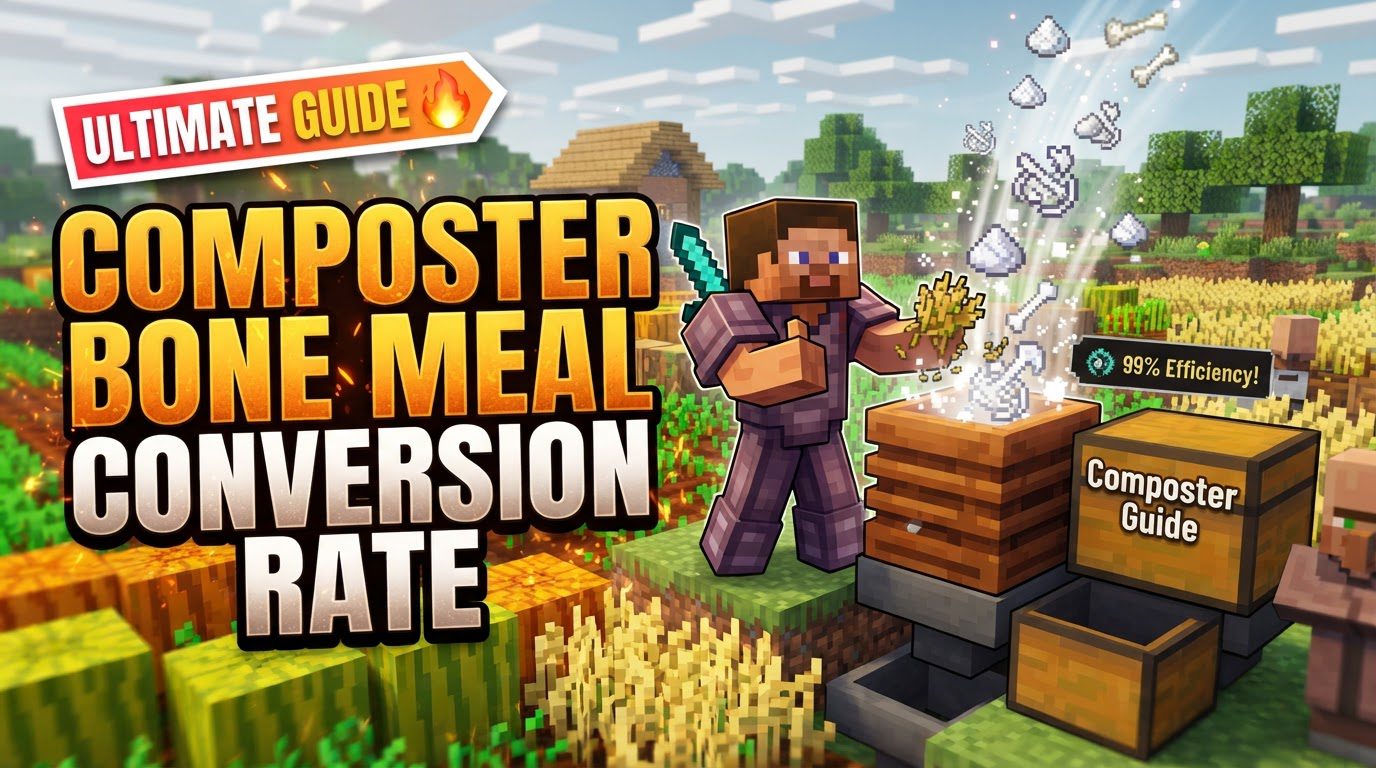
The Heart of Organic Conversion: What is a Composter?
At its core, a composter is a utility block designed to convert various organic materials into bone meal. This transformation is not only a boon for farming but also offers a practical way to manage surplus plant matter and certain food items. Beyond its primary function, the composter also serves a vital role in village life, acting as a job site block that can assign the farmer profession to unemployed villagers.
The internal mechanism of a composter involves seven distinct layers. As compostable items are added, they contribute to filling these layers. Once the seventh and final layer is filled, a single bone meal is ready for collection. Each item placed into the composter has a specific percentage chance of successfully increasing its fill level by one layer. This probabilistic nature means that while some items are guaranteed to advance the fill level, others might require multiple attempts or simply have a lower chance.
For those interested in redstone automation and detection, the composter offers unique capabilities. Its fullness can be precisely detected by a Redstone comparator, which emits a signal strength ranging from 0 (when completely empty) to 8 (when it is fully charged and ready to dispense bone meal). This feature is instrumental in designing sophisticated, automated composting systems.
Furthermore, composters are highly amenable to automation using hoppers. Items can be automatically fed into a composter by placing a hopper directly above it. Similarly, once bone meal is produced, a hopper placed beneath the composter can automatically collect the output, ensuring a continuous and hands-free operation.
From Raw Materials to Fertilizer: The Composting Process
Understanding the step-by-step process of converting organic waste into bone meal is fundamental to efficient composting. It begins with crafting and placement, then moves through the crucial stages of item addition, the composting itself, and finally, collection.
- Crafting Your Composter: The journey starts by crafting the composter itself. This is achieved by arranging seven wooden slabs in a U-shape on a crafting table. The type of wood slab does not matter, allowing for flexibility in material choice.
- Strategic Placement: Once crafted, place the composter block in your desired location. Consider its proximity to farms, storage, or other automation components if you plan for a larger setup.
- Adding Compostable Items: To initiate the composting process, you can either right-click on the composter with compostable items held in your hand, or, for a more automated approach, feed items into it via a hopper placed directly above.
- Visualizing Progress: As items are successfully composted, the composter’s internal fill level will visually increase. You can observe the number of layers filling up, indicating your progress towards a complete bone meal. There are seven layers in total.
- Collecting Your Bone Meal: Once all seven layers are complete, signifying a full composter, simply right-click it with an empty hand. A single bone meal will be dispensed, ready for use as fertilizer or for other crafting recipes.
Maximizing Your Output: Tips for Efficient Bone Meal Production
Not all compostable items are created equal. To truly optimize your bone meal conversion rate, it’s crucial to understand which items offer the best return and how to integrate the composter into a larger, automated ecosystem.
- Prioritize High-Efficiency Items: For the fastest bone meal production, always prioritize items with higher “compost-ability” percentages. Examples of these high-value items include baked potatoes, cookies, bread, cake, and pumpkin pie. While seeds or grass are compostable, their lower efficiency means they take significantly longer to fill the composter.
- Embrace Automation: Manual item feeding and bone meal collection are tedious and inefficient. Building an automated system with hoppers is paramount for any serious bone meal operation. Hoppers above feed items in, and hoppers below collect the bone meal, allowing for continuous, unattended production.
- Integrate with Farming Setups: The composter shines brightest when integrated directly into your existing farming infrastructure. Turn excess crops, such as wheat, carrots, or potatoes, directly into fertilizer that can then be used to boost future harvests, creating a highly efficient, self-sustaining loop.
- Harness the Power of Kelp Farms: Kelp is an incredibly easy-to-farm item that provides a consistent and abundant source of compostable material. Automated kelp farms can generate vast quantities of dried kelp, which then converts efficiently into bone meal.
- Explore Moss and Nylium Farms: For advanced players, automated farms utilizing moss blocks or nylium can be incredibly lucrative for bone meal production. These farms often leverage specific game mechanics to generate large volumes of organic materials that are highly compostable, yielding a significant profit in bone meal.
Avoiding Common Composting Blunders
Even seasoned players can fall into traps that hinder their composting efficiency. Being aware of these common mistakes can save you time and resources.
- Inefficient Item Use: A frequent mistake is relying solely on low-efficiency items like seeds or grass for composting, especially when higher-value items are readily available. This significantly slows down the bone meal production rate. Always aim for items with better compost-ability percentages when possible.
- Neglecting Automation: Manually adding items to the composter and collecting bone meal is a slow and often frustrating process. Failing to implement even basic hopper automation is a major pitfall that limits the scale and efficiency of your operation.
- Attempting to Compost Uncompostable Items: Not all organic-looking items can be composted. Common uncompostable items include meat, fish, rotten flesh, poisonous potatoes, bamboo, and dead bushes. Trying to use these items will yield no progress and waste your time. Always verify an item’s compost-ability before attempting to use it.
- Expecting Instant Results: Composting is a gradual process. It takes time to fill all seven layers of the composter and produce bone meal. Patience is key, especially when dealing with lower-efficiency items or smaller-scale setups.
Advanced Automation Setups
For large-scale operations, fully automated composting systems are essential. These setups typically involve multiple composters fed by a continuous supply of compostable items and automatically collecting the bone meal.
A basic automated system would involve a chest feeding into a hopper, which sits directly above the composter. Below the composter, another hopper would collect the produced bone meal and feed it into another chest or a distribution system. For more complex designs, a Redstone comparator can be used to detect when a composter is full (signal strength 8), triggering mechanisms to empty it or even to redirect item flow to other composters once one is full. This allows for a modular and scalable bone meal factory, ensuring that no organic waste goes unutilized.
By understanding the composter’s mechanics, prioritizing efficient items, and embracing automation, players can transform what might seem like a minor utility into a powerful engine for agricultural prosperity in their Minecraft worlds.
Tags:
YOU MAY ALSO LIKE...