Hidden Mechanics of Campfire Smoke Rising
Did you know a simple campfire in Minecraft can communicate across vast distances, far beyond its humble glow? While often seen as a basic light source or cooking utility, the smoke rising from a campfire possesses intricate mechanics that transform it into a powerful signaling device and a versatile tool for builders. Understanding these hidden properties can drastically enhance your ability to navigate, mark locations, and create more dynamic structures in your blocky world.
The Fundamentals of Campfire Smoke
At its core, a campfire in Minecraft naturally produces a distinct pillar of smoke. This smoke rises approximately 10 blocks into the air, making it visible from a moderate distance. Beyond its functional role in cooking food and providing light (at a level of 15), this consistent smoke plume serves as a subtle landmark in its unenhanced state. Many players utilize this basic smoke for aesthetic purposes, such as creating realistic-looking chimneys for their in-game houses, adding a touch of domestic warmth to their builds.
Amplifying Your Reach: The Hay Bale Signal
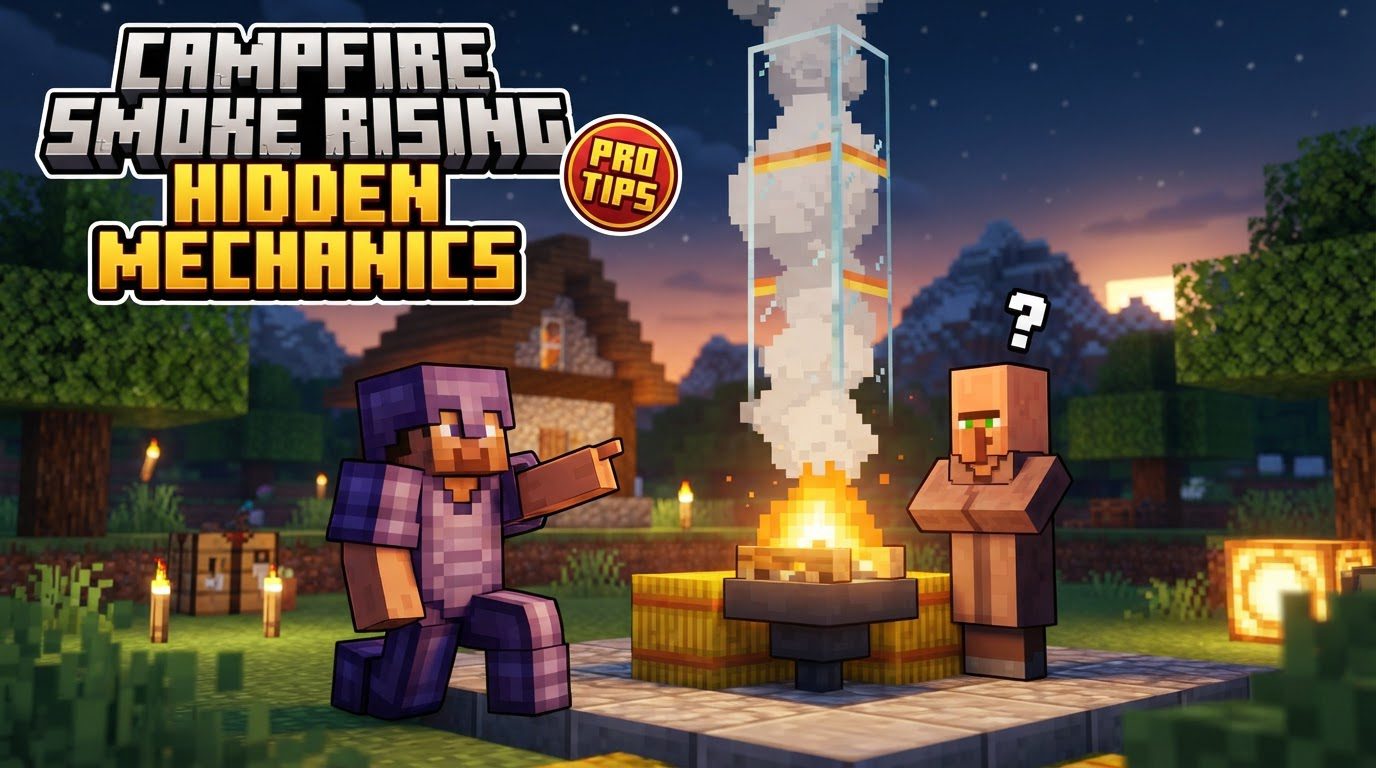
For those seeking to truly leverage campfire smoke for long-distance communication or base marking, the humble hay bale is your secret weapon. Placing a hay bale directly underneath a campfire dramatically increases the smoke’s height. Instead of a modest 10 blocks, the smoke column will now soar to approximately 24-25 blocks high. This significant boost effectively transforms a regular campfire into a powerful signal fire, making it visible from much greater distances across the landscape. It’s an invaluable technique for multiplayer servers or for marking critical waypoints in vast single-player worlds.
Crafting a Powerful Signal Fire: A Step-by-Step Guide
Creating one of these enhanced signal fires is straightforward:
- Step 1: Craft a Campfire. Gather 3 logs (or any type of wood blocks), 3 sticks, and 1 piece of coal or charcoal. Arrange them in a crafting grid to produce your campfire.
- Step 2: Craft a Hay Bale. You’ll need 9 pieces of wheat. Place them in all nine slots of a crafting table to craft a single hay bale.
- Step 3: Place the Hay Bale. Find the desired location for your signal. Place the hay bale on the ground first.
- Step 4: Position the Campfire. Finally, place the crafted campfire directly on top of the hay bale. The moment it’s placed, you’ll observe the smoke rising significantly higher, reaching its maximum boosted height.
Smoke’s Interaction with the Environment
The behavior of campfire smoke as it rises is quite unique and offers several opportunities for creative builders and redstone engineers. One key characteristic is its ability to pass through non-solid blocks. This means that smoke particles can freely travel through blocks like glass panes, fences, iron bars, and even open trapdoors. This property is particularly useful for designing enclosed chimneys that still allow smoke to escape, or for creating visually interesting effects where smoke appears to seep through cracks or grates.
Conversely, smoke is completely blocked by solid blocks. If you place any full, solid block (like cobblestone, wood planks, or dirt) directly above a campfire, the smoke will cease to rise past that point. This is crucial to remember when constructing structures around your campfires; an accidental block can negate your signal or ruin your chimney effect. It’s also worth noting that while smoke passes through non-solid blocks, its behavior when passing through multiple non-full blocks can sometimes be inconsistent. For reliable passage, it’s best to ensure there’s clear air or a single non-solid block directly above the smoke source.
Advanced Control and Concealment Techniques
For those who need more dynamic control over their smoke signals, Minecraft offers several ingenious methods:
- Temporary Concealment: If you need to temporarily hide your smoke signal or extinguish a campfire, you have a few options. A simple right-click with a shovel will put out a campfire. Alternatively, pouring a bucket of water over it or throwing a splash potion of water will also extinguish it. When you’re ready to reactivate your signal, simply use flint and steel to relight the campfire.
- Redstone-Controlled Trapdoors: For highly controlled, automated smoke signals, trapdoors are your best friend. By placing a trapdoor directly above a campfire, you can block the smoke. Connect this trapdoor to a redstone circuit, and you can then open and close it at will, allowing for precise, on-demand smoke signaling. This is perfect for complex warning systems or timed signals.
- Smoke-Free Campfires: Believe it or not, you can create a campfire that produces no smoke at all for purely decorative purposes. While the exact block interaction can vary with game updates, placing a campfire over certain blocks, such as moss, can sometimes prevent smoke particles from generating. This allows you to have the light and warmth of a campfire without the visual clutter of smoke, ideal for indoor decorative elements where smoke would be impractical.
Soul Campfires: A Different Kind of Smoke
Beyond the standard campfire, Minecraft also features the Soul Campfire. These spectral versions also produce smoke, but they come with their own distinct characteristics. While they still emit a smoke pillar, they produce less light, clocking in at a light level of 10 compared to a regular campfire’s 15. This makes them less effective as primary light sources but can be advantageous in builds where a dimmer, more eerie glow is desired, alongside their smoke plume.
Avoiding Common Pitfalls
To ensure your campfire smoke mechanics work as intended, keep these considerations in mind:
- Clear Path Above: The most common mistake is placing a solid block directly above the campfire. Always ensure the path upwards is completely clear for the smoke to rise to its full potential, especially when using a hay bale for maximum height.
- Rain and Shelter: Unprotected campfires are susceptible to the elements. Rain will extinguish a campfire if it’s not sheltered by a block above it. Always build a small roof or enclosure if you want your campfire to remain lit and smoking during inclement weather.
The seemingly simple campfire, with its rising smoke, offers a surprising depth of utility in Minecraft. From basic aesthetic touches to advanced redstone-controlled signals, understanding these hidden mechanics unlocks new possibilities for communication, navigation, and creative building within your blocky adventures.
Tags:
YOU MAY ALSO LIKE...