

Immersive Engineering Concrete
Many new Immersive Engineering players quickly discover that not all concrete is created equal in Minecraft. While vanilla Minecraft offers its own version, Immersive Engineering (IE) introduces a distinct, robust, and visually appealing concrete material with its own set of unique mechanics and production methods. This guide will delve into every aspect of IE Concrete, from its fundamental nature as a decorative block to advanced production techniques and common pitfalls to avoid.
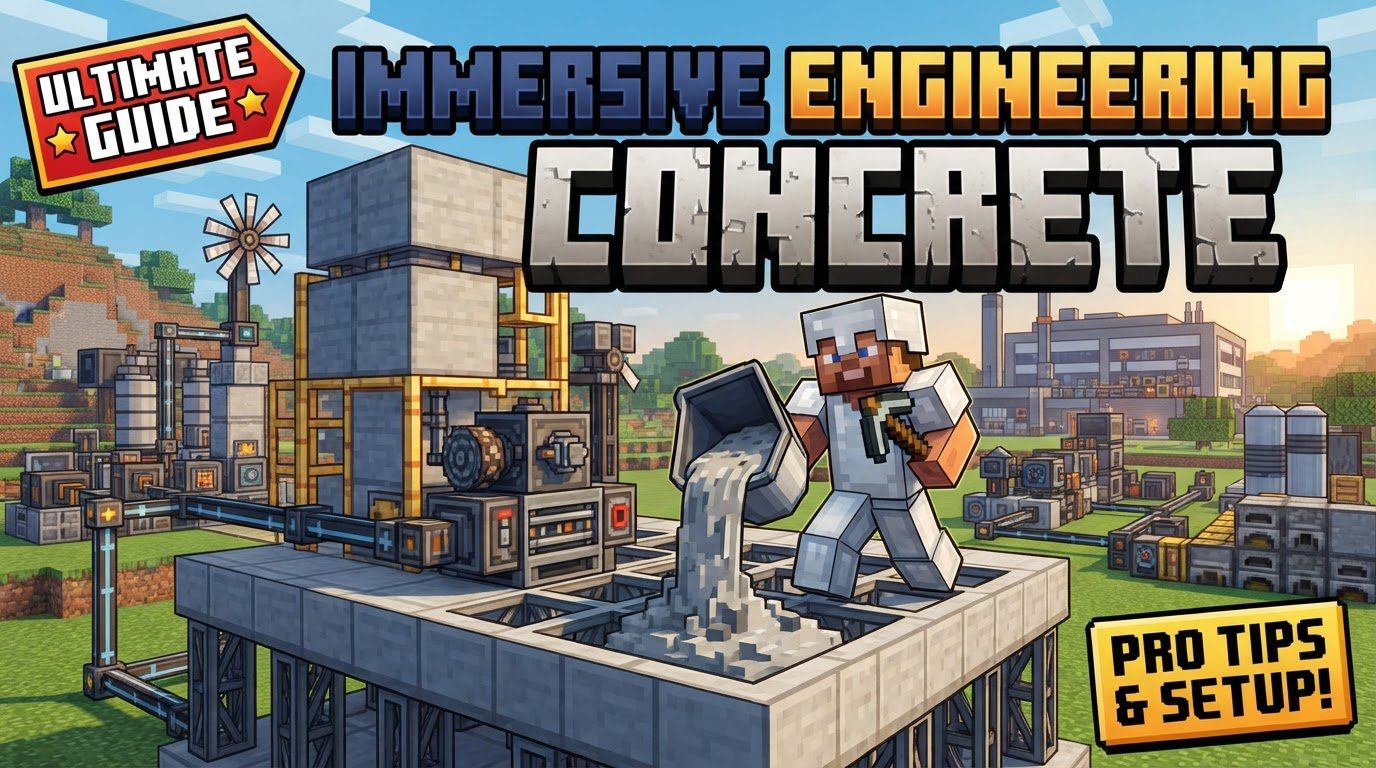
Understanding Immersive Engineering’s Concrete
At its core, Immersive Engineering Concrete is a specialized decorative building block. It stands apart from its vanilla counterpart not just in texture but in how it’s acquired and utilized. The central element of IE Concrete production is Liquid Concrete, a unique fluid added by the mod. This fluid is the precursor to most IE Concrete blocks you’ll place in your world.
Beyond standard blocks, IE Concrete has some interesting properties and variants:
- Solidification: Pouring Liquid Concrete directly into the game world will cause it to solidify into concrete blocks, forming a solid structure.
- Quickdry Concrete: For more immediate application, spraying Liquid Concrete from an Immersive Engineering Chemical Thrower results in “Quickdry Concrete,” which likely solidifies even faster or with different properties, making it useful for rapid construction or specific industrial applications.
- Unconventional Consumption: In a curious twist, drinking Liquid Concrete will induce a 10-second nausea effect. However, it also offers a minor benefit, restoring two shanks of your food bar, making it a last-resort sustenance option in a pinch.
- Decorative Variants: Standard Concrete can be further processed into Concrete Tiles for more intricate designs, or combined with other materials to create specialized blocks like Leaded Concrete.
The Path to Production: Crafting Your Concrete
There are primary methods to obtain Immersive Engineering Concrete, catering to different scales of production and immediate needs.
Method 1: Direct Crafting Grid Creation
For smaller batches or when you need concrete blocks immediately without setting up complex machinery, a traditional crafting grid recipe is available. This method bypasses the liquid form entirely, yielding solid blocks directly.
- Ingredients: To craft eight concrete blocks, you will need four blocks of sand, two blocks of gravel, one bucket of water, and two pieces of clay.
- Process: Arrange these ingredients in a crafting grid in any valid pattern that allows the recipe to be recognized. This is the simplest way to get started with IE Concrete.
Method 2: The Mixer – For Liquid Concrete Production
For any large-scale project or when you want to leverage the unique properties of Liquid Concrete, the Immersive Engineering Mixer is your essential tool. This is a multiblock machine that processes raw materials into the fluid form.
- Machine Setup: First, you’ll need to construct the Immersive Engineering Mixer. As a multiblock structure, it requires specific components and a precise arrangement to function.
- Input Materials: Once built, the Mixer requires a steady supply of its base ingredients: water, sand, gravel, and clay. These are typically piped into the machine.
- Ratios for Liquid Concrete: To produce 1,000 millibuckets (equivalent to one bucket) of Liquid Concrete, the Mixer typically consumes four units of sand, two units of clay, and two units of gravel, alongside the necessary water input. Efficiently automating the delivery of these resources will be key for continuous production.
- Output: The Mixer will then output Liquid Concrete, which can be piped into tanks, transported via buckets, or directed to its final destination for solidification.
Solidifying Liquid Concrete into Blocks
Once you have Liquid Concrete, turning it into solid blocks is straightforward but requires understanding its unique behavior.
- Direct Placement: The most common way to solidify Liquid Concrete is to simply place it into the world. Much like water or lava, it will flow and spread. As it settles, it will solidify into solid Concrete blocks.
- Chemical Thrower: As mentioned, using a Chemical Thrower to spray Liquid Concrete will produce “Quickdry Concrete,” which offers a different application method and potentially faster solidification.
Expanding Your Concrete Palette: Tiles and Leaded Variants
Beyond the basic block, Immersive Engineering offers ways to diversify your concrete builds.
- Concrete Tiles: For more detailed architectural work or flooring, standard Concrete blocks can be crafted into Concrete Tiles. The recipe is simple: combine four Concrete blocks in a 2×2 square in a crafting grid to yield four Concrete Tiles. These provide a finer texture and a different aesthetic.
- Leaded Concrete: When radiation shielding or a distinct industrial look is desired, Leaded Concrete is an excellent option. This variant is created by combining a single Concrete block with one Lead Plate in a crafting grid. Lead Plates are typically produced by processing lead ingots through an Immersive Engineering Metal Press or by other mod-specific means. Leaded Concrete retains the structural integrity of regular concrete while offering a unique visual and potentially functional property depending on other mods present.
Advanced Strategies for Liquid Concrete Management
Working with Liquid Concrete effectively, especially for large-scale projects, benefits from a few clever techniques.
- Integrating with the Create Mod: If you have the Create mod installed alongside Immersive Engineering, its Hose Pulley can become an invaluable tool. The Hose Pulley allows for more precise and controlled placement and removal of fluids. This can be particularly useful for intricate architectural designs or creating smooth, even roads, helping to manage Liquid Concrete’s often-rapid solidification and flow characteristics more effectively than manual placement.
- High-Efficiency Production from Liquid: For mass-producing concrete blocks from Liquid Concrete, a highly efficient strategy involves leveraging its flow mechanics.
- Preparation: Create a large vertical tunnel, for example, a 5×5 air shaft, extending several blocks downwards.
- Base Layer: Place a temporary layer of blocks at the very bottom of this shaft.
- Pouring: Pour Liquid Concrete onto this temporary layer. Allow the liquid to spread across the entire surface of the temporary blocks.
- Solidification and Drop: Once the Liquid Concrete has spread and solidified into a thin layer of concrete blocks, remove the temporary blocks beneath it. The newly formed concrete blocks will then fall, allowing the liquid concrete above to continue flowing downwards, solidifying as it goes. This method allows a single bucket of Liquid Concrete to produce many stacks of concrete blocks as it cascades down, making it incredibly efficient for large-scale block generation.
Navigating the Quirks: Common Issues with Liquid Concrete
While powerful, Liquid Concrete isn’t without its challenges, and understanding these can save you frustration.
- Rapid Solidification: Historically, Liquid Concrete has been noted for its extremely quick drying time. This makes it significantly more challenging to work with in its liquid form compared to simply placing pre-crafted concrete blocks. Precision and speed are often required when placing it for specific shapes.
- Adjacent Source Block Anomaly: A peculiar and persistent issue exists where if two Liquid Concrete source blocks are placed directly adjacent to each other, they will often fail to solidify. Instead, they remain indefinitely as liquid, creating an unexpected and often unwanted pool of fluid. This behavior needs to be considered when designing liquid concrete pouring systems or large pours.
- Unpredictable Shapes: Users frequently express difficulty in reliably controlling the final shape of concrete when it dries from its liquid form. Due to its flow mechanics and rapid solidification, it can often result in many thin sheets, small slabs, or irregular shapes rather than perfectly formed full blocks. This requires careful planning and often the use of temporary forms or the aforementioned Create mod integration to achieve desired outcomes.
Mastering Immersive Engineering Concrete transforms your building capabilities, offering a robust, industrial aesthetic and efficient bulk production methods. By understanding its unique mechanics, production paths, and common quirks, you can effectively integrate this versatile material into your Minecraft world.
Tags:
YOU MAY ALSO LIKE...


