

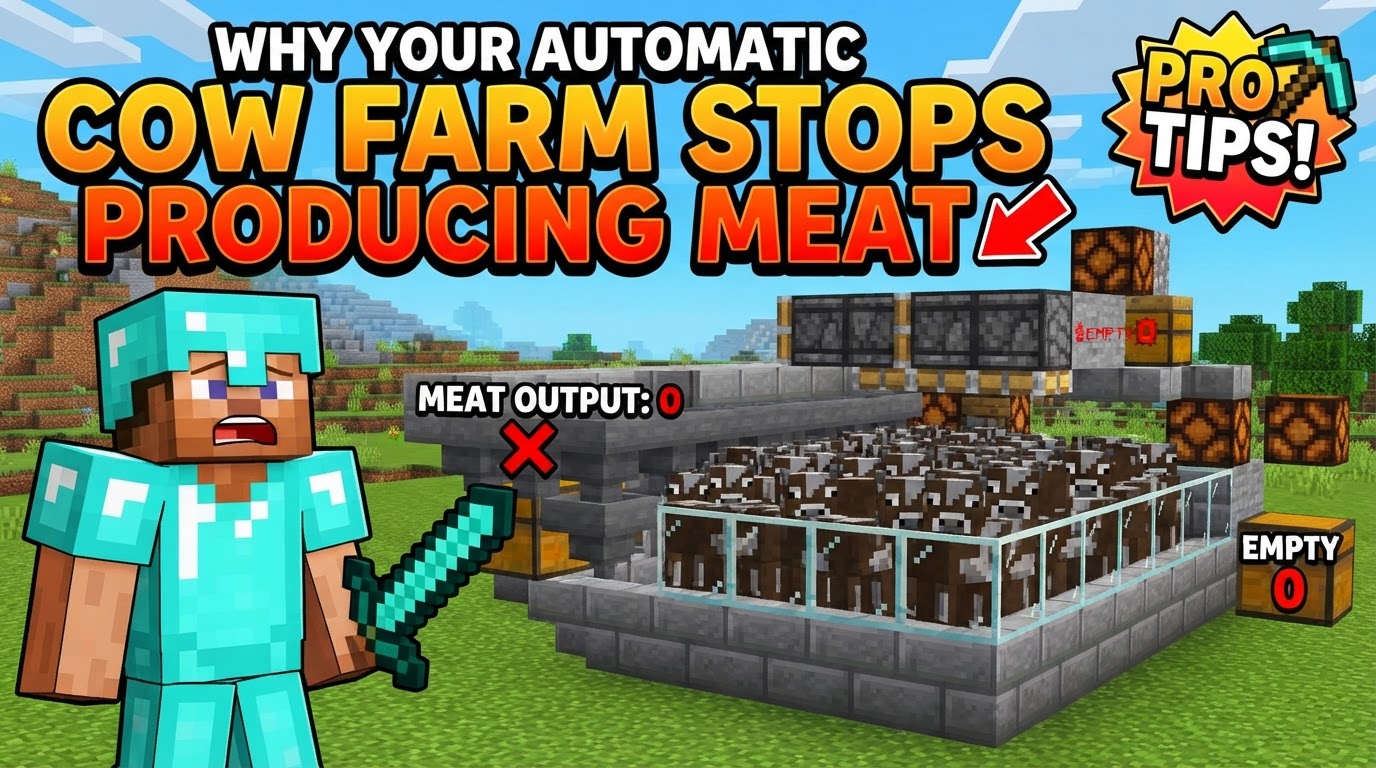
Why Your Automatic Cow Farm Stops Producing Meat
Many a seasoned Minecraft player has stared in confusion at a once-thriving automatic cow farm, now eerily silent, its hoppers empty and its lava blade cold. Automatic livestock farms are cornerstones of efficient survival, providing an endless supply of meat, leather, and often experience. However, these complex contraptions are susceptible to a variety of issues that can bring production to a grinding halt. Understanding these common pitfalls is key to diagnosing and reviving your automated protein factory.
The Passive Mob Cap Conundrum
One of the most insidious and often overlooked reasons for a cow farm’s failure to produce is Minecraft’s passive mob cap. This fundamental game mechanic limits the total number of passive mobs (like cows, pigs, sheep, chickens) that can exist within the loaded chunks around a player. Its purpose is to prevent an excessive number of entities from causing significant lag, especially on servers. While beneficial for performance, it can be a silent killer of your farm’s efficiency.
If the combined population of passive mobs in all loaded chunks around you – including those in your farm, other animal pens, or even naturally spawned animals in the wilderness – exceeds this cap, the game will simply stop attempting to spawn new passive mobs. Crucially, this can also impact breeding. Even if your cows are fed and ready to breed, the game’s underlying systems might prevent the creation of new baby cows if the cap is already met. For Java Edition, this cap is often a mere 10 passive mobs in single-player worlds. Hitting this limit is surprisingly easy, especially if you have multiple farms or explore areas with natural animal spawns. In multiplayer environments, the cap can scale with more players, but individual server configurations might also impose stricter limits, such as a set number of animals per chunk or per player lot, further complicating matters.
Bedrock Edition has a more forgiving global mob cap of 200, but this primarily affects natural spawns and not bred mobs directly. However, it also features density caps for 9×9 regions, which can still indirectly impact the ability for new animals to be created or grow if local limits are exceeded. The primary takeaway is that if your farm isn’t producing, and your breeding stock seems healthy, check the passive mob count in your loaded area. You might need to cull excess animals from other areas or temporarily reduce your farm’s population to allow breeding to resume.
The Breeding Cooldown Cycle
Cows, like most breedable animals in Minecraft, don’t breed endlessly. After successfully breeding, they enter a mandatory cooldown period during which they are “unwilling” to breed again, even if fed. This mechanic is a natural limiter on population growth and prevents players from creating an astronomical number of animals in an instant. If your automatic breeding mechanism is too aggressive or your Redstone clock runs too fast, it will attempt to breed cows before their cooldown has expired, leading to failed breeding attempts and zero new calves.
In Java Edition, cows have a breeding cooldown of approximately 5 minutes. This means that once a pair of cows has produced a calf, you must wait five minutes before they can be bred again. Bedrock Edition is a bit more lenient, with a shorter cooldown period, typically around 1 minute. Farm designs that continuously feed cows with dispensers on a rapid pulse will often run into this issue, wasting wheat and failing to produce. To troubleshoot this, observe your breeding chamber. If you see hearts appear briefly but no baby cow, and the cows don’t immediately enter cooldown mode (indicated by a period of smoke particles), your farm is likely trying to breed them too soon. Adjusting your Redstone timing to align with the cooldown period, or ensuring there’s a delay between feeding cycles, is crucial for consistent production.
Entity Cramming Calamities
Entity cramming is a double-edged sword in Minecraft farming. While it’s often intentionally used to automatically kill adult mobs for their drops, it can also inadvertently destroy your breeding stock or prematurely kill baby cows if not managed precisely. Entity cramming occurs when too many entities occupy the same block space. The game’s default limit is 24 entities per block. Once this limit is exceeded, entities will start taking damage until the count drops below the threshold.
In the context of a cow farm, if your breeding chamber becomes too crowded – perhaps due to an issue with the killing mechanism or baby/adult separation – adult cows might die from cramming before they can breed sufficiently or produce enough offspring. Even worse, baby cows, which need to grow up to become part of the breeding pool or the final product, can be killed by cramming if the collection pen or growing area becomes oversaturated. This leads to a significant loss of potential output. A well-designed farm will manage entity cramming to its advantage, ensuring that only adult cows in the designated kill chamber reach the cramming limit, while the breeding stock and growing calves are kept safely below it. If your farm is inexplicably losing adult cows or you’re not seeing calves grow up, check for signs of overcrowding in unexpected places.
Farm Design Flaws and Malfunctions
Even the most expertly planned automatic farms can fall victim to design flaws or subtle mechanical failures. These issues can range from simple oversights during construction to complex Redstone glitches that prevent the farm from executing its intended cycle. The intricate dance of Redstone, water, and lava must be perfect for continuous operation.
- Redstone Circuits: The heart of any automatic farm. If dispensers aren’t activating, pistons aren’t pushing, or observers fail to detect changes, the entire breeding or killing process can halt. A single broken Redstone wire, a mis-placed repeater, or an empty dispenser can render the whole system inert.
- Water/Lava Flow: Incorrect placement of water sources can fail to push mobs into the correct positions, leading to them getting stuck. Similarly, a misplaced lava blade might burn item drops instead of just killing the mobs, or it might not be low enough to kill adults while leaving babies unharmed, disrupting the farm’s entire purpose.
- Collection System: What good is an automatic farm if its produce isn’t collected? Hoppers must be correctly aligned and pointing into chests or other storage. If a chest becomes full, the hoppers leading into it will stop functioning, causing items to despawn on the ground or block the system. Ensure your storage is adequate and correctly linked.
- Baby/Adult Separation: Many efficient cow farms rely on separating baby cows from adults so that only fully grown cows are sent to the killing chamber. If this separation mechanism fails – perhaps a water stream is too weak or a trapdoor is misaligned – baby cows might be prematurely killed by the lava blade, preventing them from maturing and contributing to future breeding cycles.
- Lack of Resources: While often obvious, it’s worth mentioning. If your farm relies on an automated wheat supply for breeding, and that supply runs dry, your cows simply won’t breed. Manual resupply or integrating a dedicated automated wheat farm becomes essential for long-term production.
Troubleshooting these issues often involves methodically checking each component of your farm, from the Redstone input to the final collection chest, ensuring every block and wire is in its correct place and functioning as intended.
The Impact of Chunk Unloading
Minecraft operates on a system of loaded and unloaded chunks. Game events, mob activities, and farm mechanics only function within chunks that are currently loaded into the game’s memory. If a player moves too far away from their automatic cow farm, the chunks containing the farm will unload, and the farm will cease all operations. This means no breeding, no growth, no killing, and no item collection.
Typically, chunks within a 128-block radius of the player are loaded. Mobs outside this radius may despawn, and those outside a 24-block radius won’t naturally spawn. For an automatic farm to work, it needs to be in a loaded area. This is why many players build their farms near their primary base or within spawn chunks (a 5×5 area around the world spawn point that generally remains loaded on multiplayer servers, though this can be server-dependent and often doesn’t process entities as fully as player-loaded chunks). If you return to your farm after an extended period away and find no new items, it’s highly probable that the chunks containing it were unloaded. For continuous production, you or another player must be nearby, or you might need to consider more advanced chunk-loading techniques if playing on specific server types, though these are not vanilla mechanics.
An automatic cow farm is a marvel of Minecraft engineering, transforming simple resources into a steady stream of valuable items. At its core, an automatic cow farm leverages the natural breeding cycle of cows, their growth stages, and a killing mechanism to efficiently collect meat and leather. Typically, players will feed a small group of cows, causing them to breed. The resulting calves are either separated to grow or allowed to grow in the same chamber. Once adult, they are automatically pushed into a killing chamber, often utilizing lava blades or entity cramming, and their drops are collected via hoppers into chests. Understanding the mechanics outlined above is crucial for both designing a resilient farm and quickly diagnosing why your once-flourishing operation has fallen silent.
Tags:
YOU MAY ALSO LIKE...


