

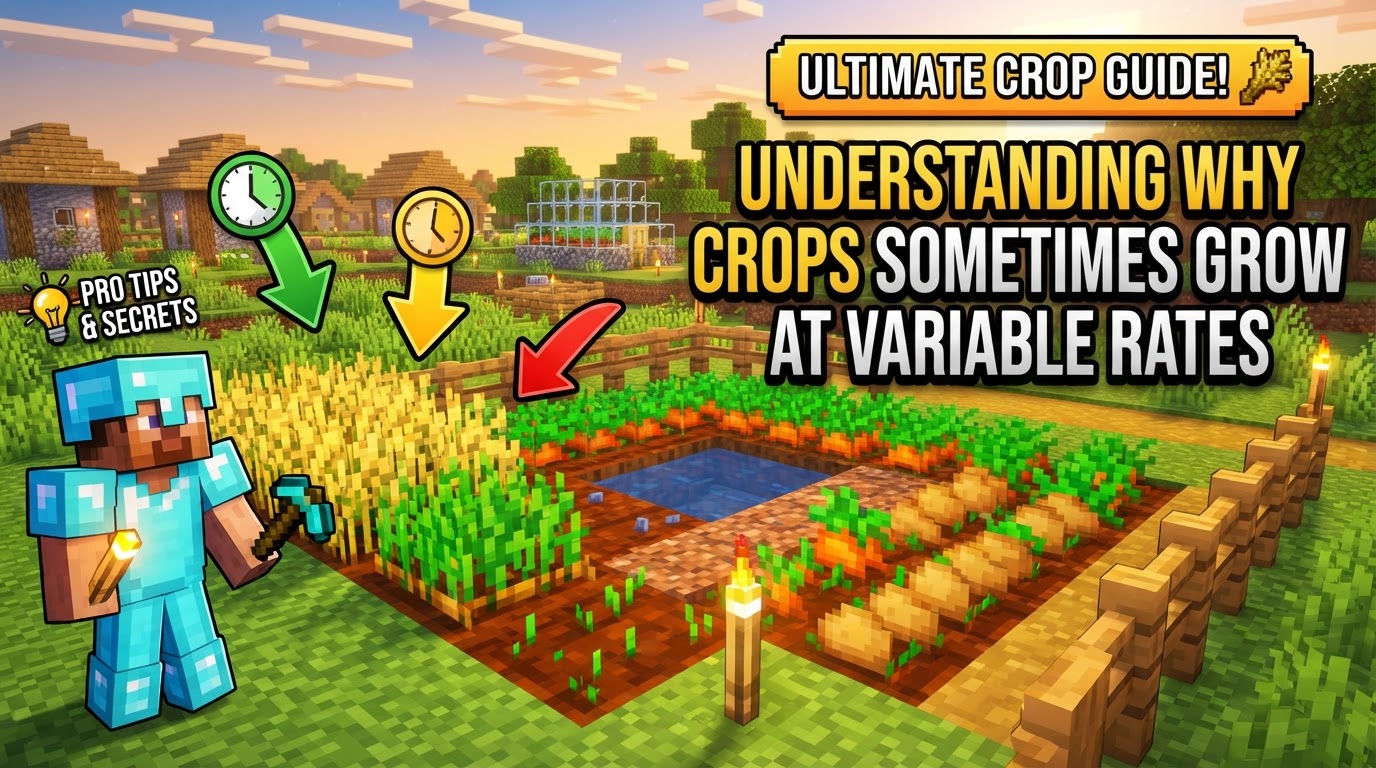
Understanding Why Crops Sometimes Grow at Variable Rates
Many Minecraft players assume that once a seed is planted, its growth is a simple, predictable timer ticking down to maturity. The reality, however, is far more nuanced. Crop growth in Minecraft is not a fixed process but a dynamic interplay of internal game mechanics and environmental factors, often leading to seemingly erratic and inconsistent harvest times across even a well-designed farm.
The Invisible Hand: Random Ticks and Growth Probability
At the heart of Minecraft’s crop growth variability lies a mechanic known as “random ticks.” Unlike a conventional timer, a crop doesn’t simply advance a growth stage after a set number of seconds. Instead, growth is dependent on a random tick “landing” on its block. Even then, merely receiving a random tick isn’t enough; a subsequent “growth roll” must succeed for the crop to progress. This two-step, probabilistic system inherently introduces inconsistency, meaning some crops might mature quickly while others, right next to them, lag behind.
The likelihood of a successful growth roll is governed by “growth points.” These points are an internal metric influenced by the crop’s immediate surroundings. The more growth points a crop accumulates, the higher its probability of advancing a stage when a random tick occurs. This is where environmental factors come into play, allowing players to manipulate these probabilities for more efficient farming.
Further influencing the overall pace of growth is the randomTickSpeed game rule. Set to a default value of 3, this rule dictates how many random ticks occur per block within a chunk section. Increasing this value will universally accelerate the rate at which crops (and other time-based blocks) receive random ticks, thus speeding up growth across the board, albeit still subject to the individual growth point probabilities.
The precise chance of growth per random tick is calculated as 1 divided by (floor(25 / growth points) + 1). While the exact mathematics aren’t crucial for everyday play, understanding that higher growth points significantly increase this probability is key to optimizing your farm layouts.
Environmental Catalysts: What Fuels Crop Development
The journey from seed to harvest is a multi-faceted process, with several environmental elements directly impacting a crop’s growth points and overall speed:
- Planting Foundation: The very first step is planting seeds on tilled farmland. While seemingly basic, the quality of this foundation is paramount.
- Hydration is Key: Farmland hydration is perhaps the most critical factor. Farmland must be within four blocks (orthogonally or diagonally) of a water source block to become hydrated. Hydrated farmland provides a substantial 4 growth points to the crop planted on it, whereas dry farmland offers a mere 2. This difference alone can halve a crop’s growth potential.
- The Power of Light: Crops demand a minimum light level of 9 in the block directly above them to grow. This requirement affects growth during both day and night cycles. While daylight naturally provides sufficient light, nighttime growth necessitates artificial light sources to maintain continuous development. Without adequate light, crops will simply cease to grow until conditions improve.
- Adjacent Block Influence: The blocks immediately surrounding a crop significantly contribute to its growth points.
- Hydrated Farmland Neighbors: Each adjacent block of hydrated farmland adds 0.75 growth points.
- Dry Farmland Neighbors: Each adjacent block of dry farmland adds 0.25 growth points.
- Diverse Cropping: Crops experience a bonus if they are adjacent to a different crop type or empty farmland. This mechanic encourages diversified farming patterns.
- Non-Farmland Borders: Conversely, crops grow slower if they are bordered by non-farmland blocks, such as dirt, stone, or even pathways.
- Nature’s Boost: Pollination by Bees: A more recent addition to the growth mechanics involves bees. When bees return to their hives after visiting flowers, they can pollinate nearby crops, providing a significant boost to their growth rate. This introduces an organic, active element to farm optimization.
Cultivating Consistency: Strategies for Faster and More Reliable Growth
Understanding these underlying mechanics allows for the implementation of strategies that can dramatically improve farm efficiency and consistency:
- Hydrate Every Block: Design your farms so that every single block of farmland is within the 4-block radius of a water source. A common and efficient layout is a 9×9 plot with a single water source block in the very center, which hydrates all 80 surrounding farmland blocks.
- Illuminate the Night: Place light sources like glowstone, sea lanterns, or Jack o’Lanterns strategically above or around your crops. This ensures a light level of 9 or higher, allowing crops to grow around the clock, regardless of the sun’s position.
- Embrace Diversity: Avoid monoculture farming in large blocks. Instead, plant crops in alternating rows or a checkerboard pattern. For example, plant wheat, then carrots, then potatoes, or alternate wheat with empty farmland. This leverages the bonus growth from being next to a different crop type or empty space, significantly increasing overall yield speed.
- Harness the Power of Bees: Integrate beehives into your farm design. Plant flowers near your crops to encourage bees to visit them, then return to their hives, thus pollinating your plants and accelerating their growth.
- Bone Meal for Instant Growth: For immediate results or to kickstart a harvest, bone meal remains the most direct method. Applying bone meal directly to a crop instantly advances it through one or more growth stages.
- Optimal Layouts: The fastest growth is achieved with a full layer of hydrated farmland, crops planted in alternating patterns (e.g., checkerboard or alternating rows), and consistent high light levels. Consider semi-automated designs using hoppers and dispensers for planting and harvesting for peak efficiency.
Common Pitfalls: Why Your Farm Might Be Underperforming
Despite best intentions, certain common mistakes can inadvertently hinder your crop growth, leading to frustration and lower yields:
- Monoculture Farming: Planting vast fields of only one crop type (e.g., a 100×100 field of just wheat) prevents crops from benefiting from the “adjacent different crop” bonus, making growth slower than it could be.
- Incorrect Water Placement: A common error is not ensuring every farmland block is within range of a water source. Dry farmland dramatically reduces growth points, crippling efficiency. Always double-check water placement.
- Insufficient Lighting: Neglecting to provide adequate artificial light means crops will only grow during daylight hours, effectively halving their potential growth time.
- Ignoring Surroundings: Allowing non-farmland blocks (like paths, dirt blocks, or even blocks of stone) to border your crops, or having too many identical crops adjacent to each other, will slow down growth by reducing available growth points.
- Building in the Wrong Biome: While not directly affecting standard crop growth rates, certain biomes can present environmental challenges. For instance, cold biomes can cause exposed water sources to freeze, disrupting hydration unless covered or heated.
By understanding that crop growth is a complex interplay of random ticks, environmental factors, and strategic planning, players can move beyond inconsistent harvests and cultivate highly efficient, productive farms. Mastering these variables is the key to becoming a true Minecraft agriculturalist.
Tags:
YOU MAY ALSO LIKE...


